“We knew buyers were asking AI assistants which food waste system to choose, and Orbisk wasn’t the brand those answers were built on. Seven months later, orbisk.com is the site they cite most often. SaaStorm treated AI search as seriously as Google from day one, and made sure every claim we published was one we could stand behind.”






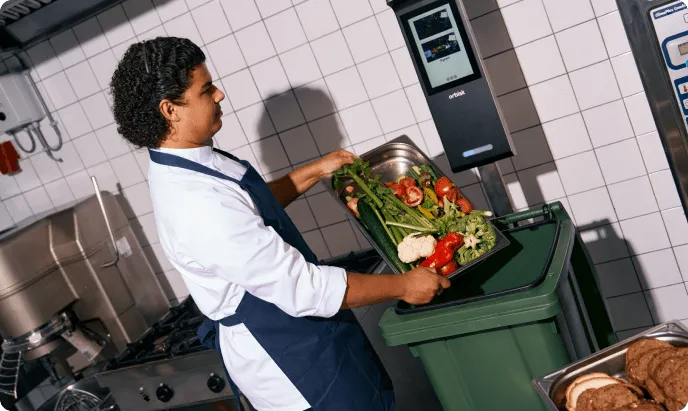
Orbisk captures kitchen food waste at the moment of disposal, before ingredients mix. Its AI identifies 800+ ingredients at around 90% accuracy and turns them into cost and CO₂ data that chefs, F&B directors and ESG leads can act on. More than 1,000 kitchens in 50+ countries use it, from hotel groups to hospitals and cruise lines.
The category is small and crowded at the top. Winnow and Leanpath had years of head start in search and were the names AI assistants reached for first. When a buyer asked ChatGPT or Google which food waste tracking system to choose, Orbisk was often in the answer, but it was rarely the source the answer was built on.
Orbisk came to us with a clear goal: become the brand buyers find, and the source AI assistants quote, when they research food waste technology. Over seven months we built the content engine, the AI visibility programme and the blog experience to get there.
Before SaaStorm:
- Named in 52.1% of non-branded AI answers, behind Winnow (87.2%) and Leanpath (82.0%)
- orbisk.com the 3rd most-cited domain in those answers, behind both competitors
- 189 organic Google clicks a month to the blog and key landing pages, 159 of them to the blog
- Priority blog topics scoring 22.68% on content quality, at an average position of 10.1
With SaaStorm:
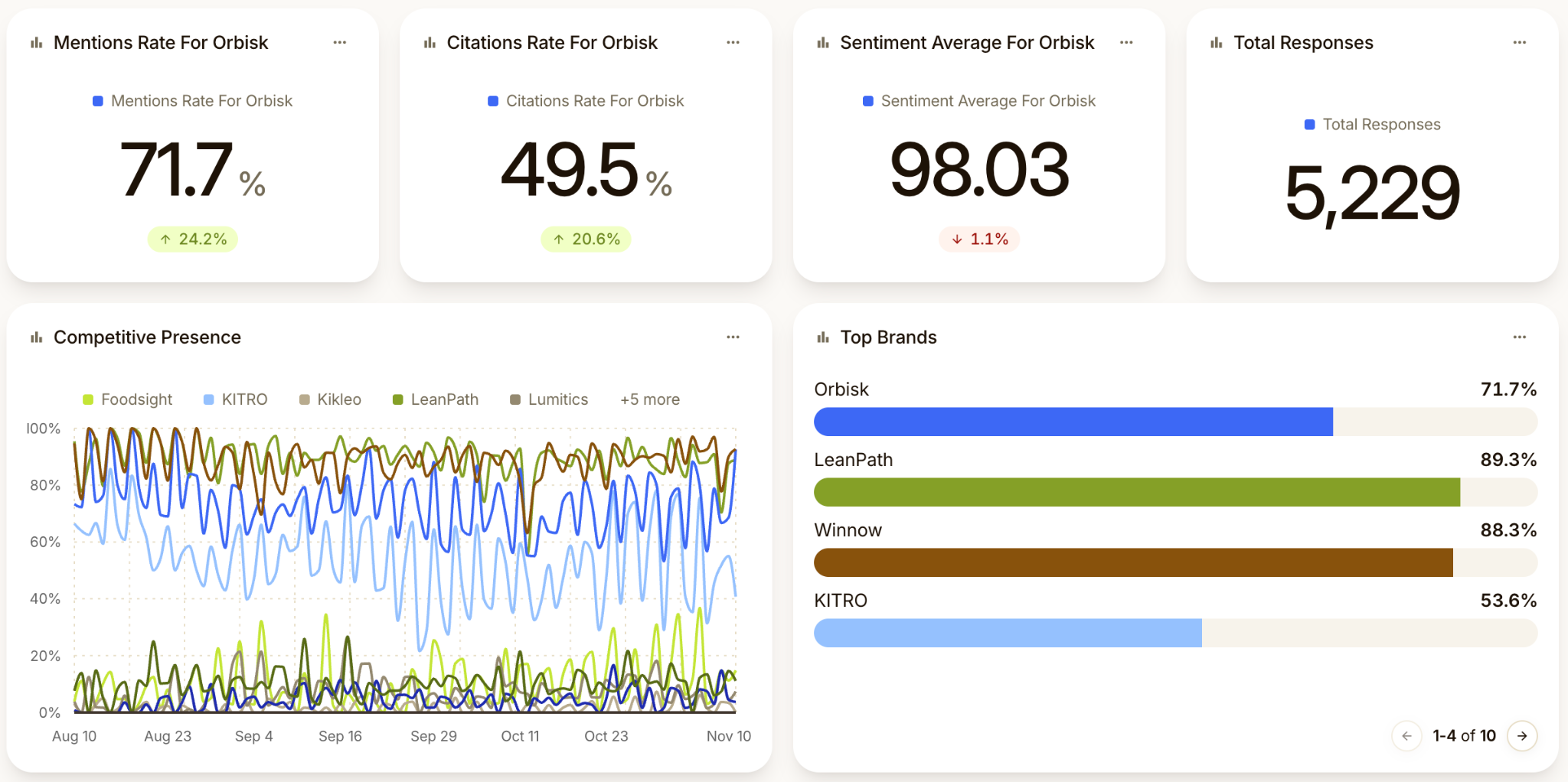
- Named in 69.6% of non-branded AI answers; the gap to Winnow halved, from 35.0 to 18.1 points
- orbisk.com the most-cited domain, with 1,569 citations in October
- 303 organic clicks a month to the blog and key landing pages (+60%), 277 of them to the blog (+74%)
- 39 new blog posts, 2 landing pages and a redesigned blog, category and author experience
Impact at a glance


The challenge
Orbisk had a strong product and a blog, but the blog was not built to win search. Our audit of the 35 priority SEO topics on the blog found an average SurferSEO content score of 22.68%, an average Google position of 10.1 and a click-through rate close to 0.5%. The articles existed; they just weren’t ranking or getting clicked.
AI search made the gap sharper. Food waste buyers increasingly ask ChatGPT, Gemini or Perplexity for a shortlist, and those answers leaned on winnowsolutions.com and leanpath.com as their sources. Orbisk was mentioned, but on someone else’s terms.
The audience was demanding too. A single deal involves an ESG lead who needs auditable CO₂ data, an F&B VP who needs proof across sites, an executive chef who won’t accept extra admin, and a COO or finance director who signs off on ROI. Content had to speak to each of them, in markets from the US to APAC.
There was a window, though. The eight competitors we analysed were barely investing in SEO: the most active ranked for around 300 keywords in the US, Orbisk for 65. In a category that quiet, a focused content programme could lead within months.
The solution
We started in April 2026 with a discovery phase, working in three layers:
- Product layer: Orbisk’s pages, battle cards, positioning documents, customer reviews and videos, plus deep research in Claude on the market and the buying committee.
- Marketing layer: existing content, Search Console data, Semrush opportunities and what competitors were doing in search.
- Tactical planning: turning those insights into a content framework Orbisk could approve and we could ship.
What Orbisk got from discovery:
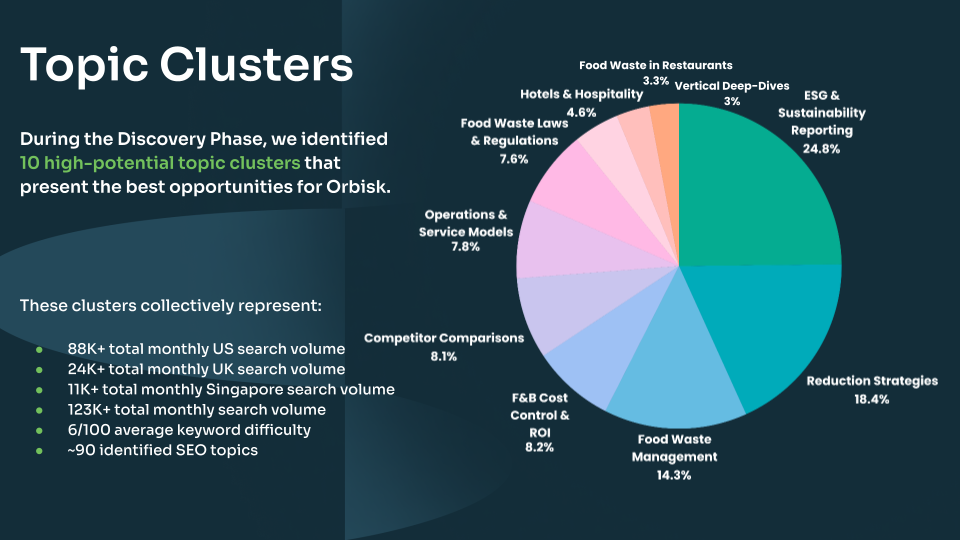
- Content cluster mapping: 10 topic clusters and a plan of around 90 topics
- Existing content audit of the 35 priority blog topics
- Competitor gap analysis across 8 competitors and the 700 keywords they rank for
- Technical SEO audit (desktop passed Core Web Vitals; mobile fixes flagged for the dev team)
- Internal linking strategy
- Website recommendations for AI visibility, traffic and conversions
- A traffic forecast built with Orbisk’s own data and KPIs


The SEO and AEO strategy for Orbisk
01. Keyword research and topic clusters
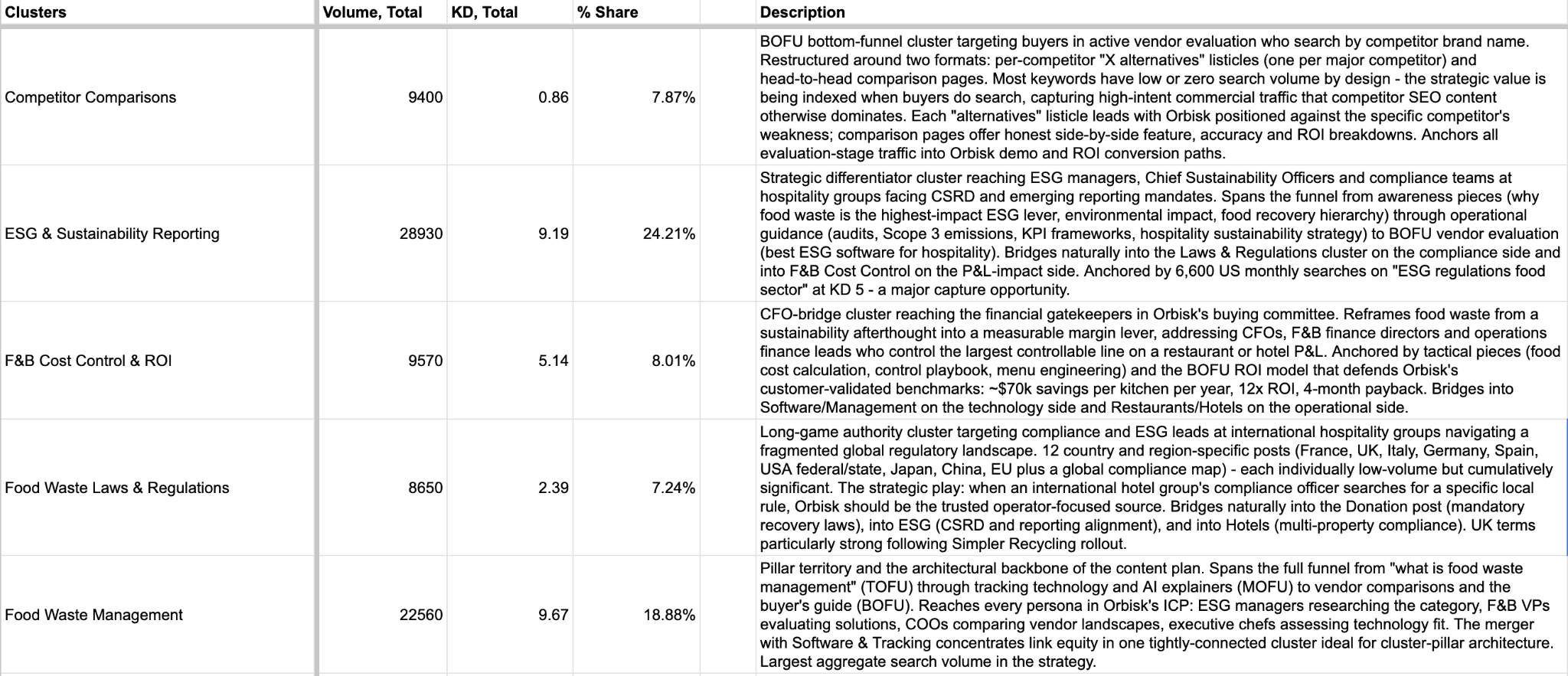
We built the plan around the problems Orbisk’s buyers search for, not around product features. The research fed four main cluster groups:
- F&B cost control and ROI: food cost formulas, calculators and the business case for waste tracking
- ESG and sustainability reporting: the largest opportunity at 24% of the plan’s search volume, covering CSRD, ESRS and audit-ready data
- Competitor comparisons: “X alternatives” listicles and head-to-head pages for every major competitor
- Industry clusters: hotels, hospitals, cruise lines and company catering
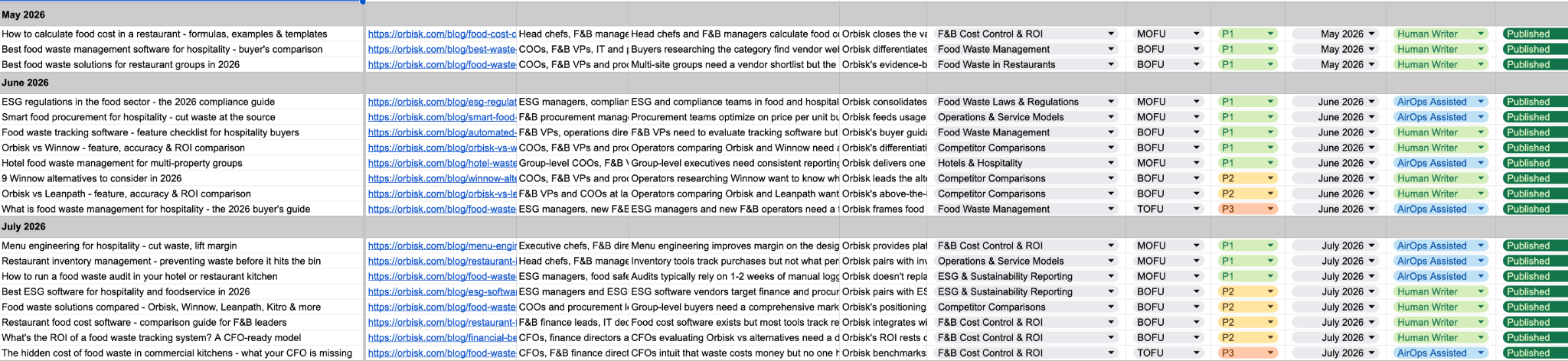
Every topic sits in one content backlog with its cluster, funnel stage, priority, primary keyword and target month.
02. Content for every seat in the buying committee
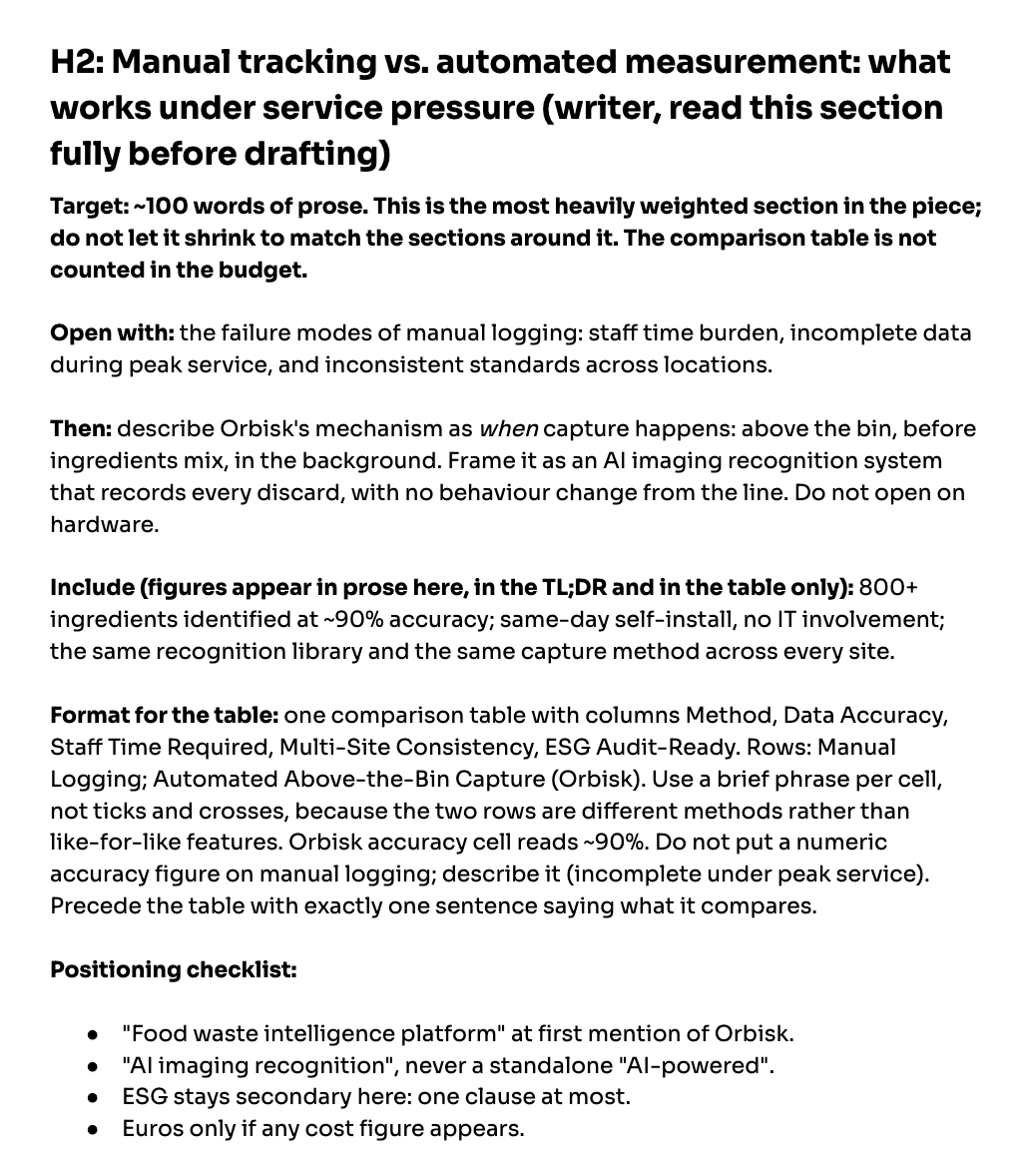
Each brief names the persona it serves: the ESG lead, the F&B director, the executive chef or the COO. Briefs follow one house format, with Orbisk’s approved figures, banned terms and positioning rules built in, and go to Orbisk’s team for sign-off before writing starts.
We held the content to a high bar on accuracy. Regulatory claims only say “must” when there is a legal source behind them, and comparisons state where competitors are stronger. That honesty is what makes the pages worth citing.
03. Content engineering with AirOps
Around 90 planned topics, four personas and a strict set of product rules meant two things. Writing every brief by hand would not scale, and generic AI briefs would not survive Orbisk’s review. So we engineered the brief process instead: one pipeline in AirOps that takes a topic from the content backlog and turns it into a reviewed, on-brand brief, with people signing off at the points that matter.
The foundation: Orbisk’s brand context, loaded once
Every workflow draws on the same two sources, so no prompt starts from scratch:
- Brand kit: Orbisk’s positioning, its Capture, See, Act story, its audiences and its writing rules.
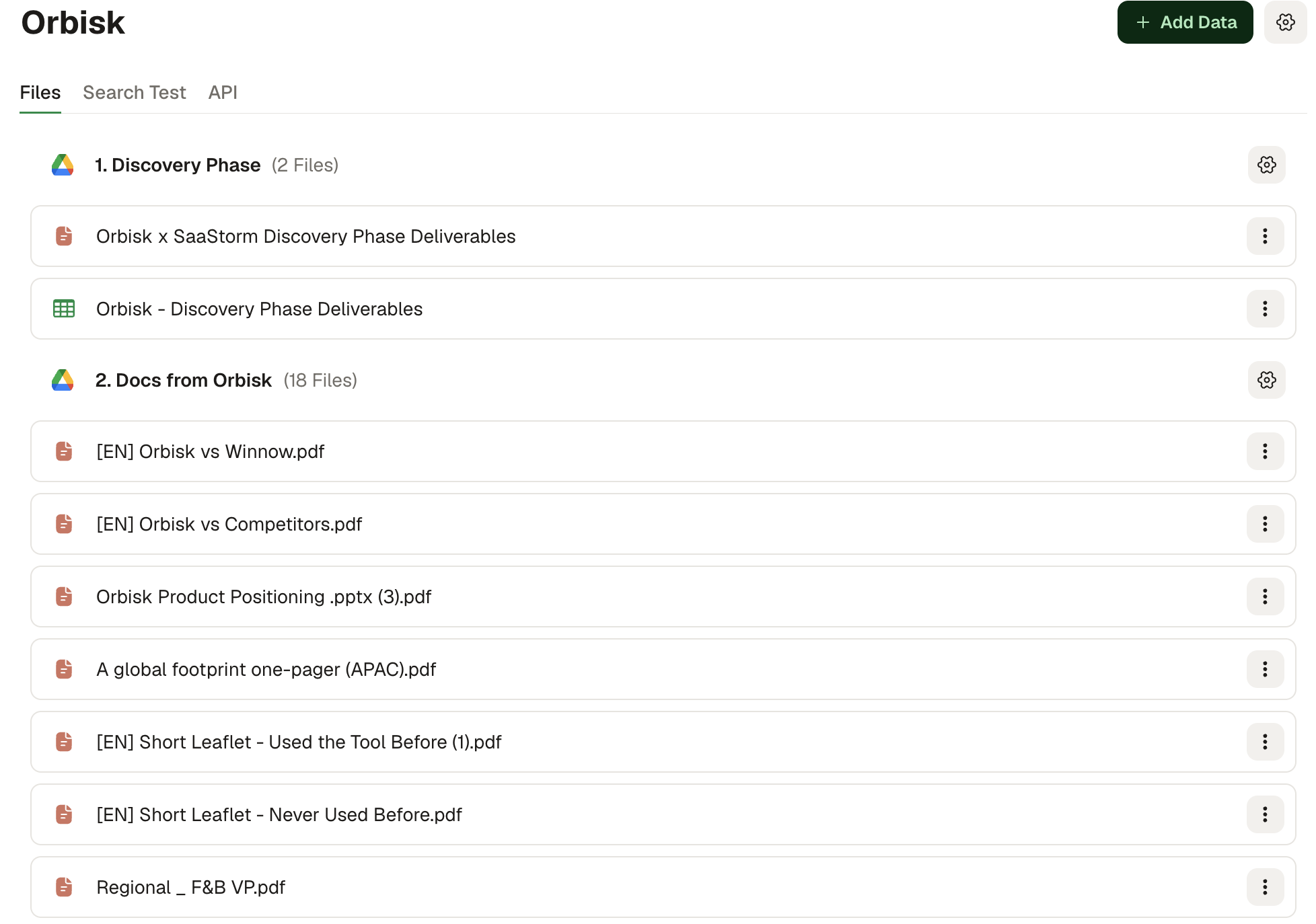
- Knowledge base: 22 documents, including the ICP and persona profiles, the messaging framework, the content style guide and the brief template.

The workflows at a glance
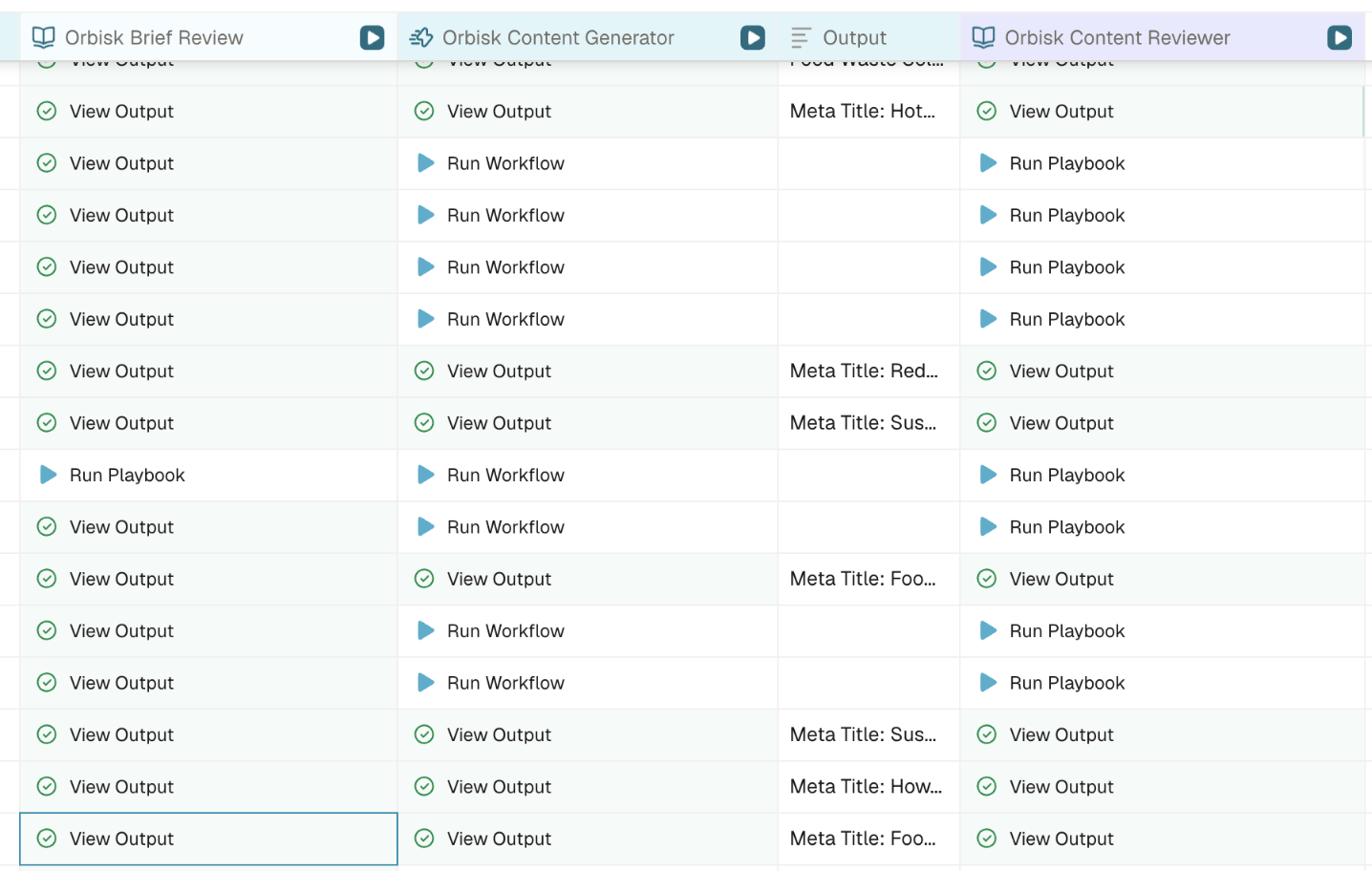
- Content backlog grid. In: the discovery backlog: working title, audience, pain point, Orbisk’s role, funnel stage, keywords. Out: one row per topic, which runs every workflow below.
- Content brief generation. In: the row’s inputs, the brand kit, the knowledge base and a SurferSEO draft. Out: a full brief, saved to Google Docs.
- Content reviewer. In: a brief or a draft. Out: an editorial audit and a corrected redraft.
- Content generator. In: an approved brief. Out: a first draft for AI-assisted topics.
Step 1 – The backlog grid
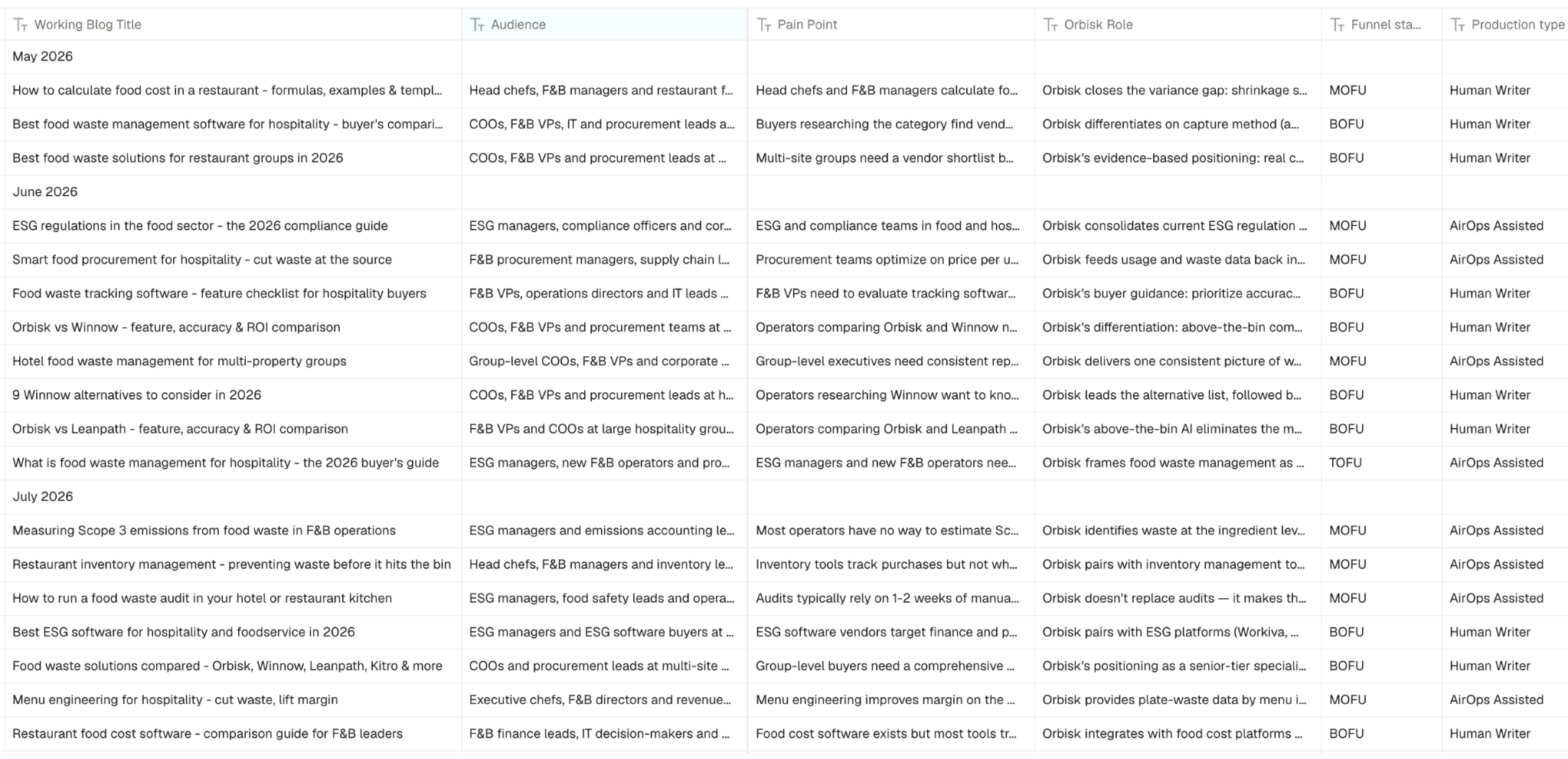
We imported the discovery backlog into an AirOps grid. Each topic arrived with the research already attached: who it is for, the pain point it answers, Orbisk’s role in the answer, the funnel stage and the keyword cluster. Those columns feed straight into the workflows, so every brief starts from the strategy, not from a blank prompt.
Take “How to calculate food cost in a restaurant”, a MOFU topic. The row names the audience (head chefs, F&B managers and finance teams who calculate food cost every month but can’t explain the variance), the pain point (“shrinkage” as the catch-all answer) and Orbisk’s role: turning shrinkage into itemised waste data, so theoretical and actual food cost reconcile.
Step 2 – Brief generation
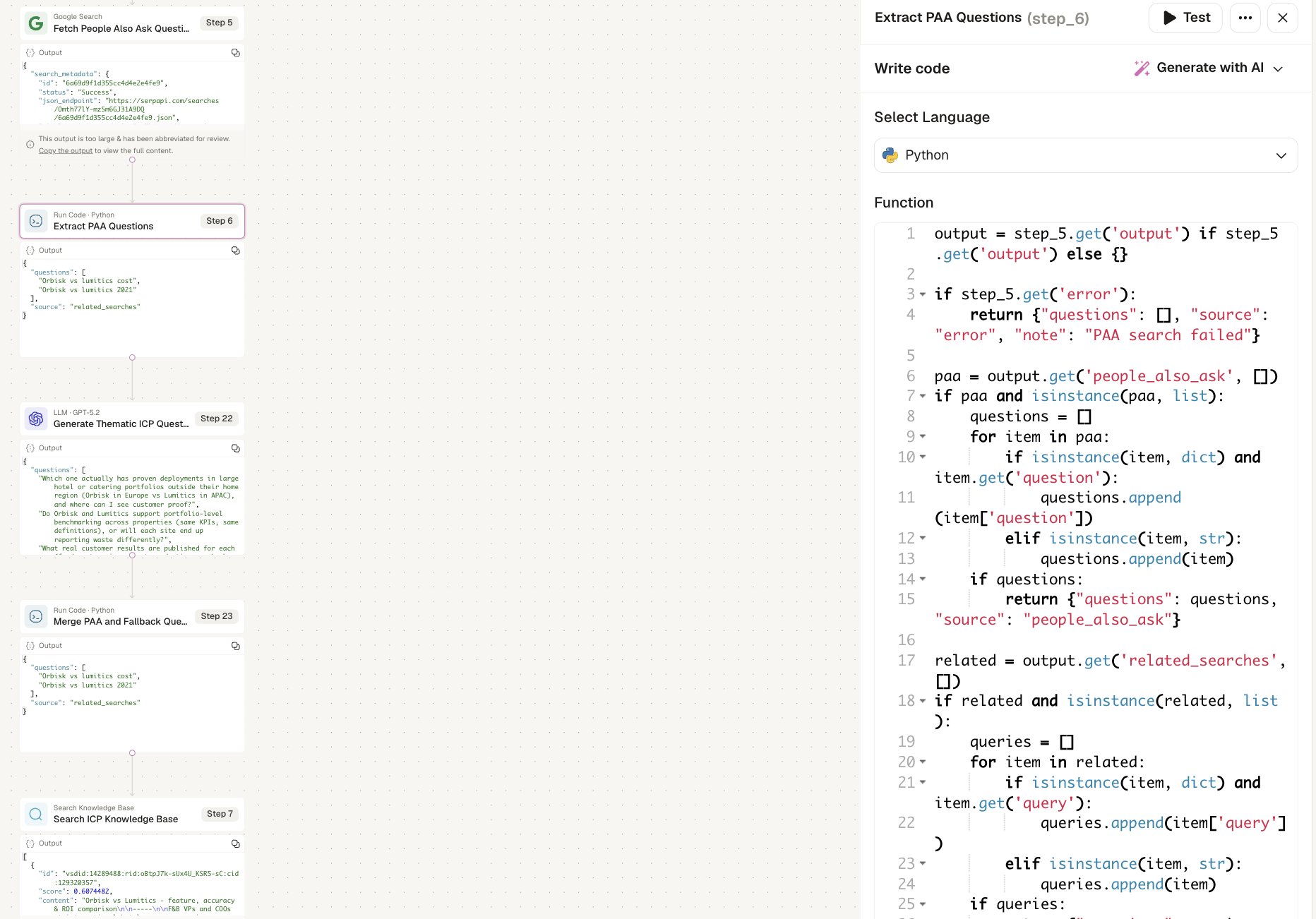
The brief workflow runs in five stages:
- Reads the backlog inputs and pulls persona, messaging and style rules from the brand kit and knowledge base.
- Analyses the pages ranking for the primary keyword and sets a word count anchored to the search results: the average of the top three pages plus a 15% margin, with extra length allowed only for named content gaps.
- Writes the metadata: meta title and description, slug, H1, article goal, funnel stage, keywords, competing content and internal links.
- Writes a section-by-section structure, with a word target and writing directives for every H2, where each keyword goes, the CTAs, and an FAQ built around the questions buyers ask.
- Saves the brief to Google Docs for review.
For “ESG regulations in the food sector: the 2026 compliance guide”, the workflow set a 2,166–2,466 word range from the ranking pages, organised the guide around CSRD (ESRS E5), SASB and EU national food waste laws, and added a 90-day readiness roadmap as a gap the ranking pages left open.
We treated the workflow like a product. 42 briefs ran through it, and it went through 11 published versions across two generations as we tuned it against Orbisk’s feedback.

Step 3 – Automated review
Raw AI briefs fail in predictable ways: an invented example figure, a metric the client doesn’t use, the wrong name for the product. Our early outputs showed exactly that. So we built a review playbook that encodes Orbisk’s rules and audits every brief and every draft through five lenses, in priority order:
- Editorial stance: would the piece read the same with a competitor’s name on it? If so, it fails.
- Persona fit and banned messaging: the right register for the ESG lead, the chef or the finance director, and none of the terms Orbisk has ruled out.
- Tightness and formatting: every paragraph earns its place, British English throughout, length matched to the funnel stage.
- Structure: H1, a four-point TL;DR, introduction and body, an Orbisk section as the conclusion and the FAQ last, plus honest category framing in comparisons.
- Proof: approved figures only, in euros and with their qualifiers, retired stats flagged, no invented quotes. Where proof is missing, the playbook leaves a [PROOF POINT NEEDED] flag rather than making one up.
The playbook returns an audit that quotes each problem with a suggested fix, then a redraft with the fixes applied.

Step 4 – Drafting
BOFU and comparison topics went to human writers, because those are the pages buyers check line by line. For TOFU and MOFU topics marked as AI-assisted, a content generator workflow turned the approved brief into a first draft with the same brand kit and knowledge base, and the draft went back through the review playbook before an editor picked it up.
Where people stay in the loop
The workflows do the repeatable work; people make the calls. We adapted every brief into Orbisk’s house format with Claude and a dedicated formatting skill, checked it against Orbisk’s product knowledge base, and sent open questions to Orbisk’s marketing team for sign-off before writing started. Finished drafts were optimised in SurferSEO, edited, and approved by Orbisk before they went live.
The pipeline, end to end: backlog row → brief → automated review → house format and fact check → Orbisk sign-off → draft → automated review → SurferSEO and edit → Orbisk approval → publish.
04. Comparison content that AI assistants quote
Buyers in this category compare before they shortlist, so we built pages that answer that comparison directly: Orbisk vs Winnow, Orbisk vs Leanpath, competitor alternatives listicles and a full solutions comparison. The solutions comparison became Orbisk’s most-cited page in AI answers, with 419 citations in October alone.
05. AI visibility (AEO)
We tracked 175 non-branded buyer prompts across seven AI platforms in Scrunch: ChatGPT, Claude, Gemini, Perplexity, Copilot, Google AI Overviews and Google AI Mode. Each month we reported which prompts named Orbisk, which pages the answers cited, and which third-party pages competitors were winning on.
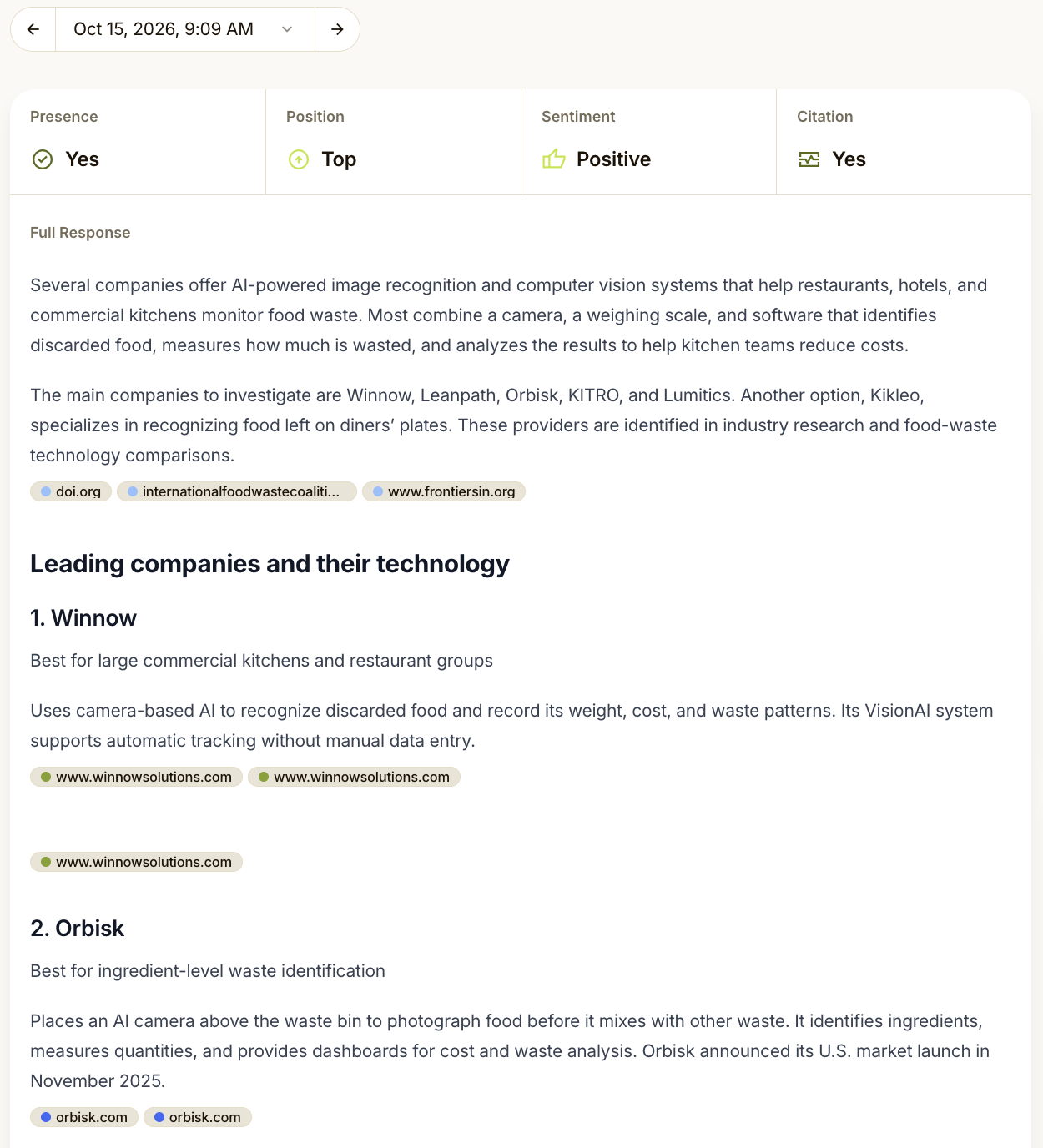
In one October answer, Google AI Mode used Orbisk’s comparison page as the source for every vendor it listed, Winnow and Leanpath included.
06. A blog and website built to convert
Alongside content, we redesigned the places that content lives:
- Two landing pages: Food Waste Management Software and ESG Software for food waste data

- Category pages: one shared design for the blog, press release and success stories pages, with a featured article, category filters and a card grid

- Blog article template: author byline, table of contents, TL;DR summary and a sidebar CTA on every post
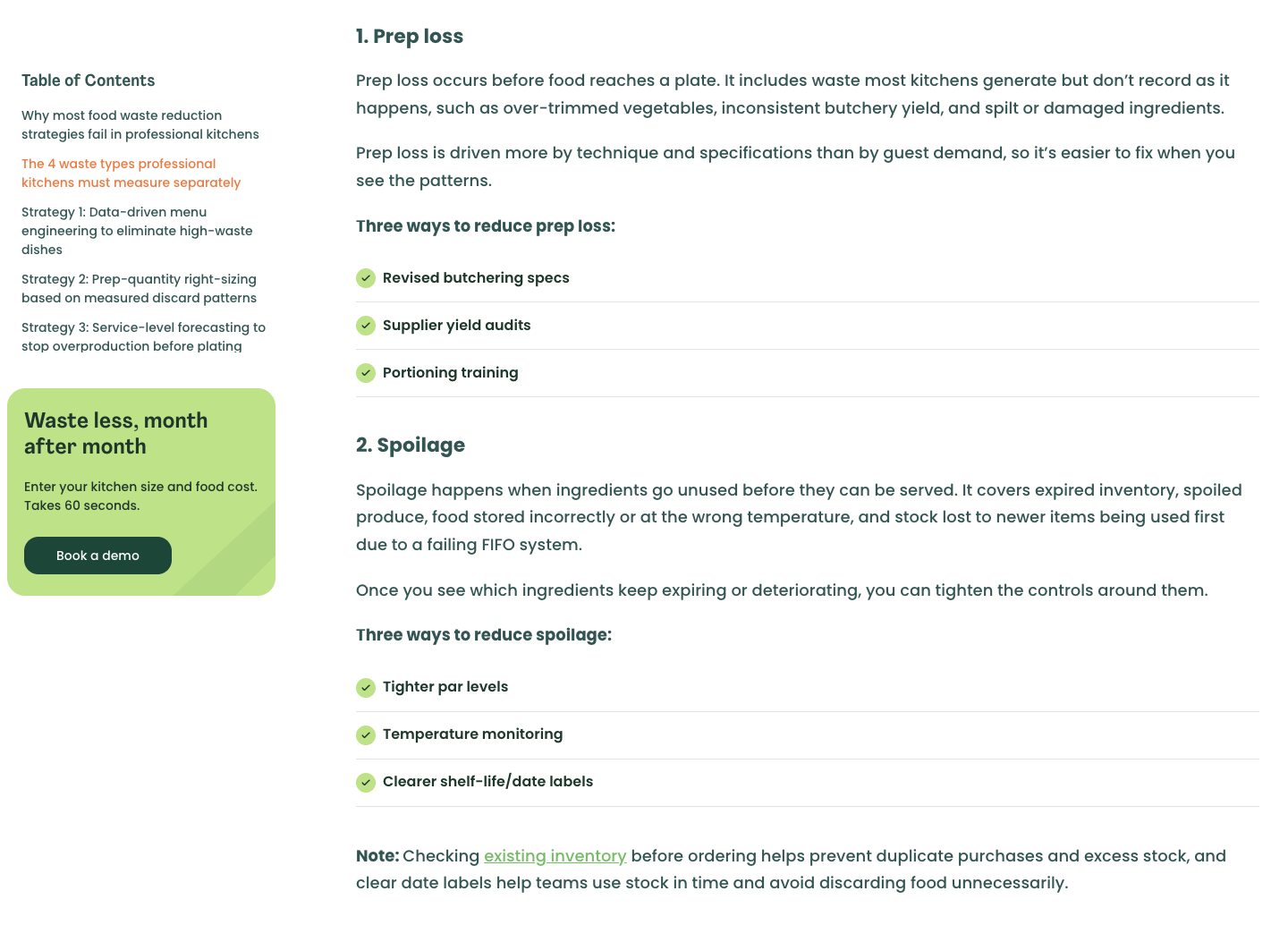
- New design elements: styled lists, an in-article demo CTA banner and an FAQ accordion
- Author pages: a new profile page for each writer
07. Reporting that shows impact
Every month Orbisk received one report covering AI answers, Google Search, rankings, website traffic and what we shipped. Google data came straight from Search Console through our data warehouse, and rankings from Semrush position tracking on 55 priority keywords.

The results
In seven months we shipped 39 blog posts, two landing pages and a redesigned blog. Here is what changed between the start of the engagement and October 2026.
AI answers
- 69.6% presence: AI assistants now name Orbisk in 69.6% of non-branded buyer prompts, up from 52.1% in May. On ChatGPT it is 90.4%.
- Most-cited domain: orbisk.com went from 526 to 1,569 citations a month, overtaking leanpath.com (1,352) and winnowsolutions.com (1,275).
- 15.6% citation share: Orbisk’s share of all citations in those answers rose from 6.3%.
- Gap to the leaders halved: Winnow’s lead in being named fell from 35.0 to 18.1 points, and Leanpath’s from 29.9 to 17.6.
Google Search
- +60% organic clicks to the blog and key landing pages: from 189 in April to 303 in October, and 75% more than in October 2025 (173). From April to October these pages earned 1,949 organic clicks.
- +74% blog clicks: from 159 in April to 277 in October, and 79% more than in October 2025.
- +167% blog impressions year on year: 52.8K in October 2026, against 19.8K in October 2025.
- New content carries the blog: articles first shown in Google since April earned 905 clicks and 222K impressions, and 60% of October’s blog clicks.
Rankings
- 19 keywords in the top 3, up from 8 when tracking began in June.

- 32 keywords in the top 10, up from 16 when tracking began.
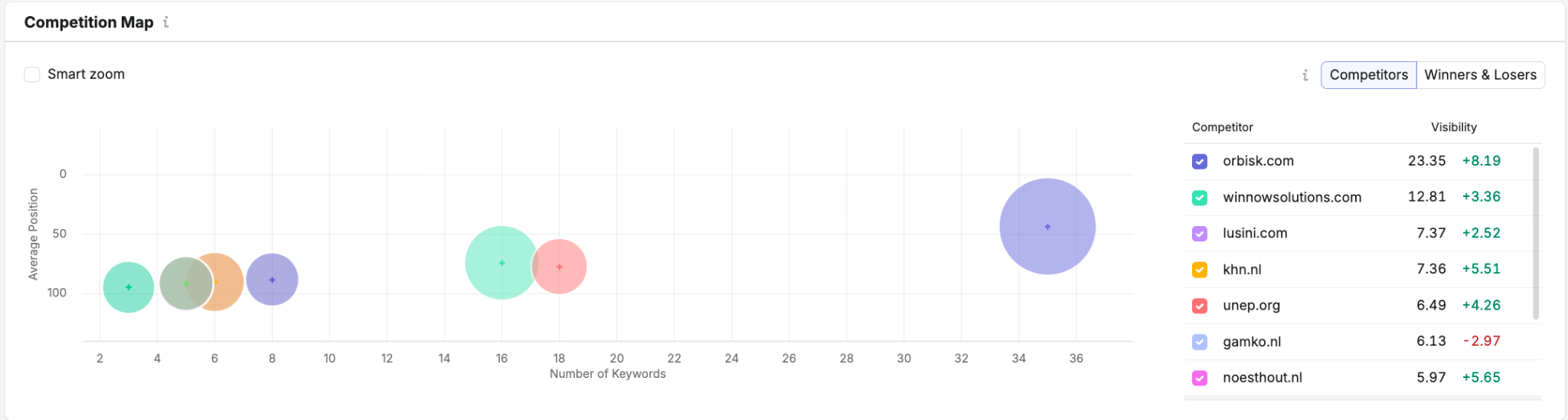
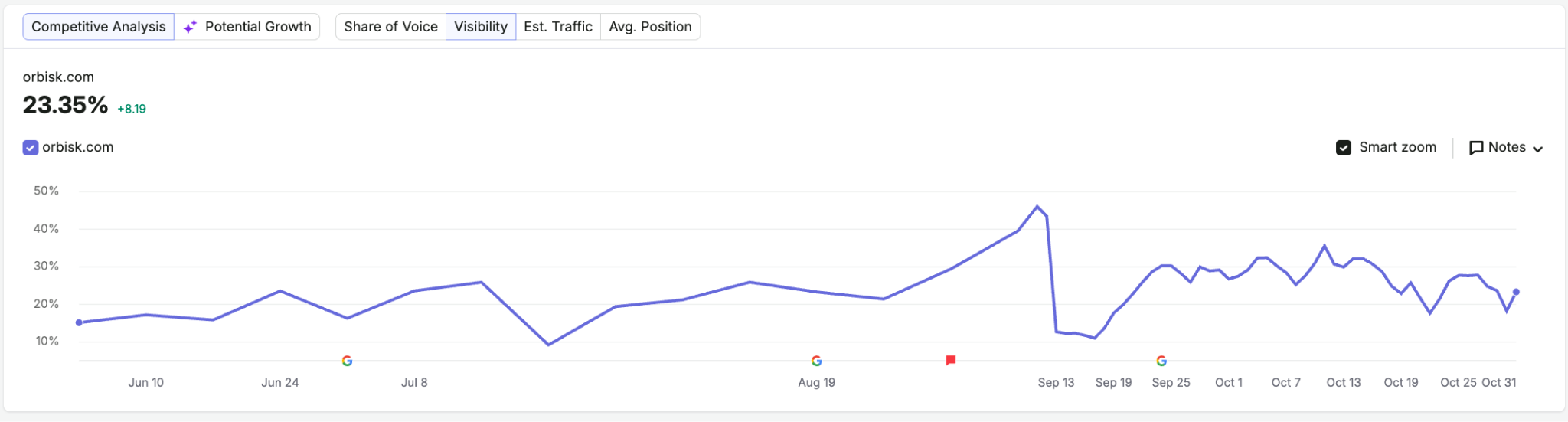
- Semrush visibility from 15.2% to 23.3%, with a peak of 48%, ahead of every tracked competitor (winnowsolutions.com at 12.8%).



Conclusion
Seven months ago, AI assistants mentioned Orbisk but built their answers on Winnow and Leanpath. Today orbisk.com is the source they cite most, Orbisk is named in 7 out of 10 non-branded buyer prompts, and the blog brings in 74% more clicks than when we started.
None of it came from volume for its own sake. It came from content planned around every seat in the buying committee, briefs engineered in AirOps and checked by people, and comparison pages honest enough for AI assistants to quote.
Not traffic for its own sake. Visibility with the people who buy, and in the answers they trust.