Back to blog
GEO vs SEO: What Changes for B2B SaaS and What Doesn't

- GEO (generative engine optimization) doesn't replace SEO. It builds on it, and adds everything that happens outside your website.
- What doesn't change: AI engines still pull from pages that rank in traditional search engines. No SEO foundation, no GEO.
- What changes on your site: AI crawlers need access, pricing needs to be real text, and pages need to be readable by bots and AI agents, not just humans.
- What changes off your site: reviews, listicles, Reddit and consistent brand mentions now shape how AI tools describe you.
- What changes in measurement: you track mentions, citations and AI-sourced pipeline, not just rankings and organic traffic.
"The future is AI search. Is classical SEO still a smart play?"
A Head of Marketing asked me exactly that on a call last year, and some version of the same question has come up on almost every discovery call since. How do you decide between SEO and GEO? Should you move budget? Do you now need a GEO agency on top of your SEO agency?
It's a fair question, because the search landscape really has shifted. Your buyers ask ChatGPT, Claude and Perplexity for vendor shortlists. Google AI Overviews answer questions before anyone clicks. And every week LinkedIn seems to invent a new acronym for it.
So this guide is for Heads of Marketing and CMOs at B2B SaaS companies who need to decide where next year's organic budget goes. It's based on what we've learned running SEO and GEO side by side for 20 B2B SaaS companies, from pre-seed to Series C. Some things change a lot. Some don't change at all. And the part that doesn't change is exactly the part most teams skip.
"Good GEO starts with the SEO foundation." – Romana Kuts, Founder at SaaStorm
What is the difference between GEO and SEO?
Before we get into what changes, it helps to be clear on what each term actually means, because a lot of the confusion starts there. The two disciplines share most of their foundations, but they aim at different moments in the buyer's journey.
Search engine optimization (SEO) is about getting your pages to rank in traditional search results on Google and Bing, so that people click through to your website. SEO aims to win the click.
Generative engine optimization (GEO) is about getting your brand mentioned, cited and described correctly in AI generated answers – in ChatGPT, Claude, Perplexity, Gemini and Google's AI Overviews. Unlike traditional SEO, the goal isn't always a click. It's being the brand the AI recommends when your buyer asks for options.
That leads to the key difference. SEO focuses mostly on your own website. GEO focuses on how AI systems understand your brand across the whole internet: your site, plus every review, listicle, Reddit thread and article that talks about you.
"GEO is thinking outside of your website. SEO is still a lot about your own website." – Romana Kuts
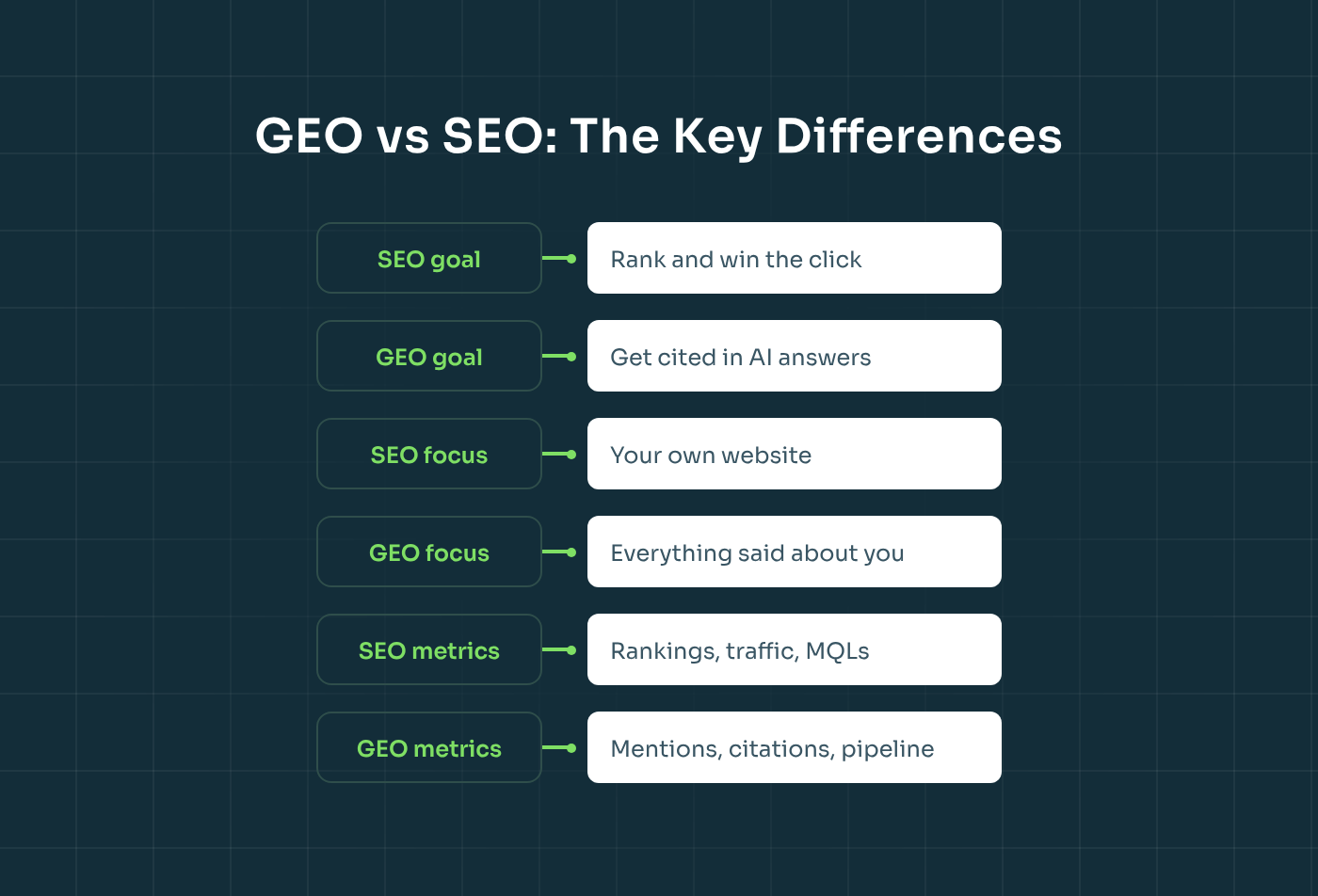
If you want the side-by-side version, here's how the two compare:
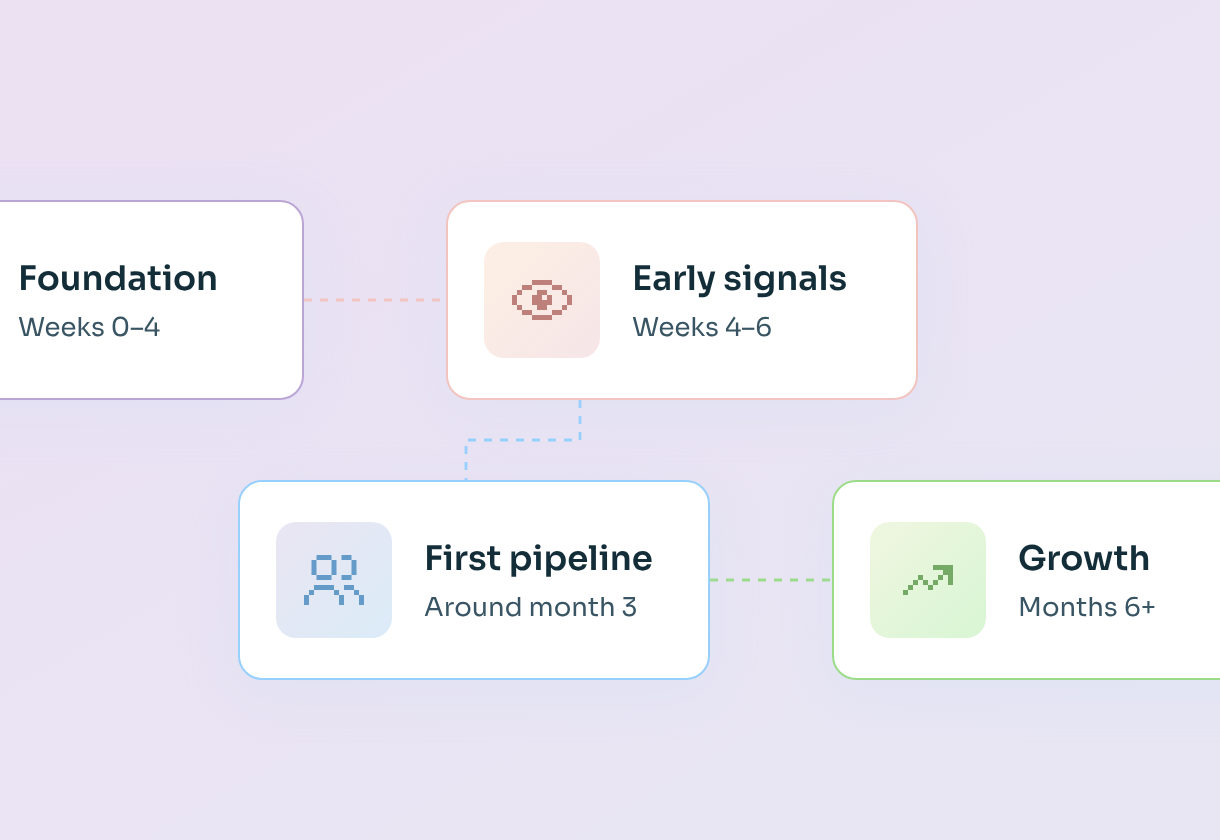
The row most GEO pitches leave out is the last one. GEO takes months too, and how many months depends almost entirely on how strong your SEO already is. Which brings us to the part that doesn't change.
What doesn't change: SEO is still the entry ticket
Here's the uncomfortable truth for anyone hoping GEO is a shortcut: AI search engines don't have their own magic index of the internet. When ChatGPT, Claude or Gemini answer a question that needs fresh information, they run searches – and they read what ranks. So the foundations of good SEO are still the foundations of GEO.
Every AI tool leans on a search engine
You can see this clearly when you track AI-sourced pipeline across client accounts. Gemini and Google AI Overviews follow Google Search, so traditional SEO does most of the work there. ChatGPT leans on Bing, and loves Wikipedia, review sites and Reddit. Claude runs on Brave and tends to favour official pages and docs. Perplexity searches live, cites the most sources and rewards fresh content. Other generative search engines work the same way: they read the web through a search index first.
"'We're not showing up in Claude' might have nothing to do with your content. You might just not rank in Brave." – Romana Kuts
So if your pages don't rank in traditional search, AI engines mostly can't find them either. You can't GEO your way out of bad SEO.
Query fan-out makes it even more true
It gets more interesting when you look at how AI engines search. When a buyer asks ChatGPT "What's the best project management software for a 60-person agency that runs client work in Jira?", the AI doesn't run one search. It quietly runs many – resource planning software, Jira integrations, SOC 2, pricing, alternatives, reviews. Google calls this query fan-out.
That means you're no longer competing for one keyword. You're competing across the whole cluster of questions your buyer would need answered, and the brand that shows up in most of those searches gets recommended. The brand that ranks #1 for just one of them gets a footnote, if that. Which is classic SEO thinking: a page for every buying question, strong site structure and topical authority. Not a separate page for every phrasing – Google warns that can count as scaled content abuse – but proper coverage of the need.
The proof: SEO-led programmes win AI visibility too
We've seen this play out with our own clients. When we worked with Asora, the programme was never Google-only, but its foundation was SEO: keyword research around real buyer problems, comparison and "best software" content, technical fixes, content optimisation and link building.
After nine months, Asora appeared in 43% of tracked AI answers across 96 prompts on ChatGPT, Perplexity, Gemini and Claude, with 99% positive sentiment – alongside €20.15M in qualified pipeline from SEO-led inbound. Same work, both channels.
That's because the things that make content rank are the same things that make it citable: understanding user intent, high quality content with real expertise and E-E-A-T, technical SEO that keeps pages crawlable and fast, and authority from sites your buyers trust. If you're doing those well, you're already doing most of GEO.
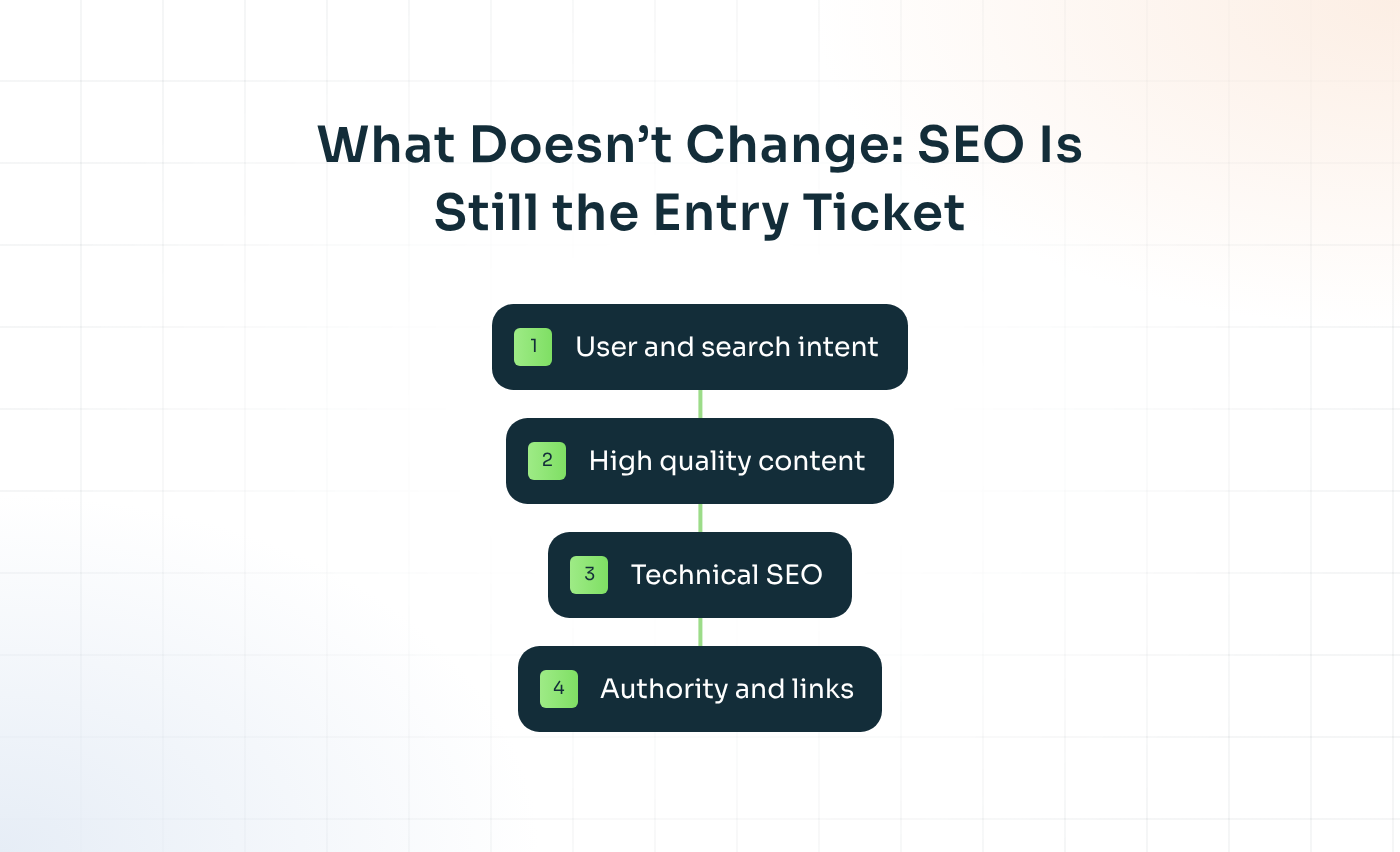
Most of it – but not all of it. GEO does add real work, and the first place you'll feel it is your own website.
What changes on your website: build for bots and agents, not just humans
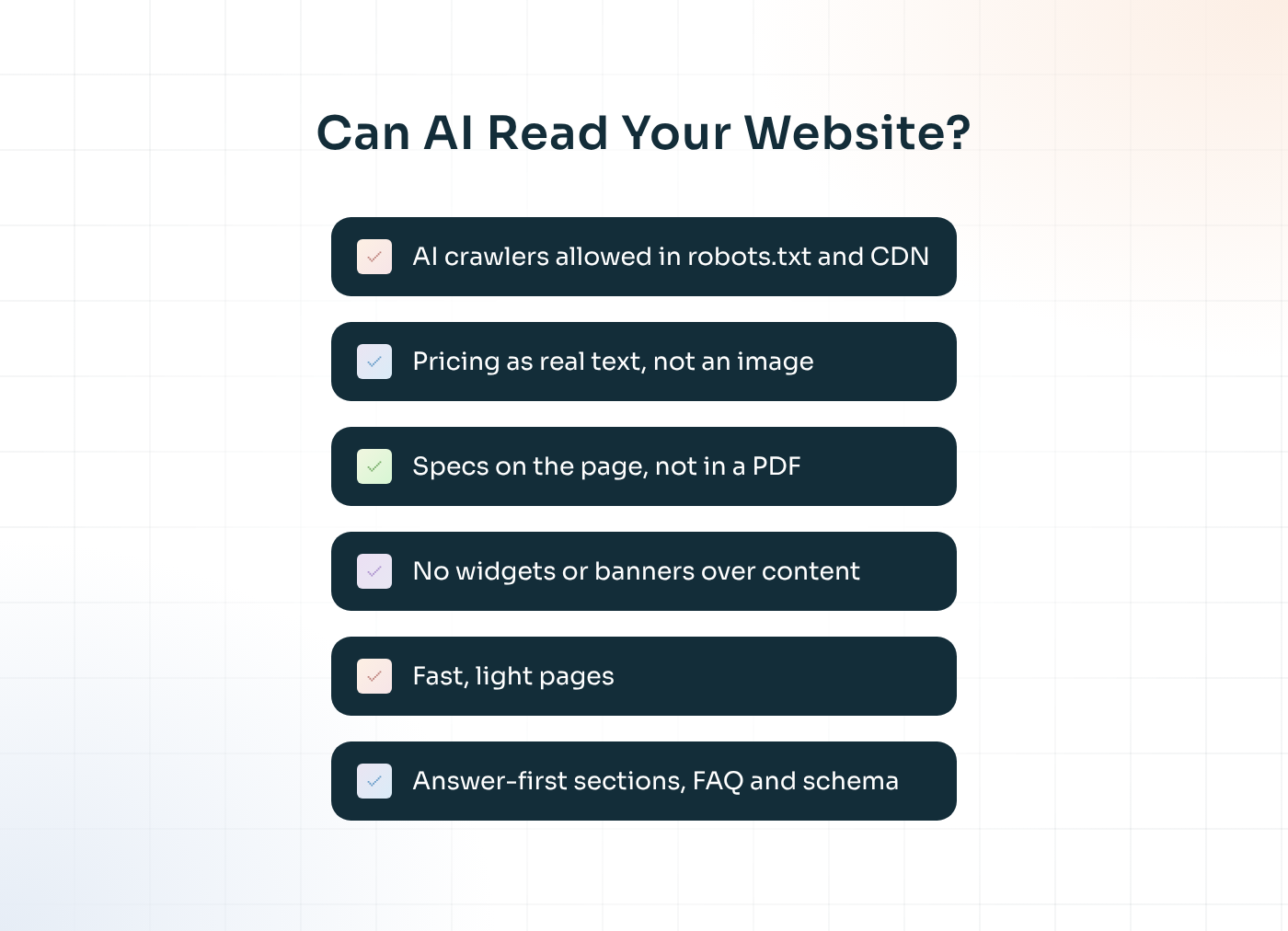
Most B2B SaaS websites were designed for people: beautiful hero sections, animated pricing cards, chat widgets, cookie banners, specs tucked away in a PDF. AI crawlers and AI agents experience those same pages very differently, and that's where GEO adds specific, practical work to your site.
Let AI crawlers in
The first check is the simplest one, and it's surprising how often it fails. Look at your robots.txt and your CDN settings. We regularly find SaaS sites where GPTBot, ClaudeBot or PerplexityBot are blocked, often by a default bot-protection setting nobody remembers switching on. If AI crawlers can't access your site, you won't be cited from it. Our robots.txt guide explains what to check.
Make your pricing and product details readable
Once crawlers can get in, the next question is whether they can understand what they find. A pricing table as an image, with no description, is invisible to most AI systems. The same goes for specs locked in a PDF, buttons with no label and "click here" links with no context.
According to Google's own guidance, browser agents read your site through screenshots, the page structure and the accessibility tree – the same layer screen readers use. So a pricing page that looks perfect to you can look almost empty to an agent.
"Your pricing exists, yes, but the agent just can't find it." – Romana Kuts
And this isn't theoretical anymore. One of our clients recently had a demo booked by Claude. Not a lead who found them through Claude – Claude itself went to the website, filled in the form and booked the slot. The prospect never opened the site. If an agent can't find your pricing or book your demo, it will happily recommend a competitor whose site it could read.
Keep widgets out of the way and pages fast
The same logic applies to everything that sits on top of your content. Chat widgets covering the CTA, cookie banners filling the screen and content that only loads after JavaScript runs all hurt AI readability, because agents take screenshots, and if your banner is in the screenshot, your content isn't. Site speed matters for the same reason: AI crawlers working at scale are more likely to skip or only partly read slow, heavy pages.
Structure content so it can be lifted
Finally, think about how your content gets quoted. AI engines don't cite whole pages; they lift passages from your website content. So when you create content, structure it to make that easy: answer-first paragraphs that answer the question in the heading, self-contained sections, clear headings often phrased as questions, short definitions and tables, and FAQ sections with structured data and schema markup. This is what answer engine optimization is really about, and it's on-page work any good SEO team should already be doing.
Getting your own site right is the part you fully control. The bigger shift, though, happens on pages you don't own.
What changes off your website: GEO is your reputation
This is the biggest difference between GEO and SEO, and the one most teams underestimate. In traditional SEO, the page that ranks is usually yours. In AI search, the answer about you is often written from other people's pages: G2 and Capterra reviews, "best X software" listicles, Reddit threads, comparison articles and industry press.
When we started tracking AI-sourced pipeline properly across clients, the split surprised us. One client gets most of its AI pipeline from Claude. Some get almost everything from ChatGPT. A couple are heavy on Gemini. And the reason is usually off-site: ChatGPT trusts review sites and Reddit, so a thin G2 profile can keep you out of its answers no matter how good your blog is.

So GEO adds a layer of off-site work that classic SEO only partly covered. It means keeping a healthy, recent G2 and Capterra profile, with reviews that mention the use cases you want to be known for. It means getting included in the third-party "best X" lists that AI engines cite, not just your own self-promotional ones. It means a genuine, helpful presence in the Reddit threads LLMs pull from – our Reddit SEO playbook covers how – and digital PR that earns brand mentions from sources AI systems already trust.
And it means one consistent narrative. If your site, your G2 profile and three listicles describe your product three different ways, AI tools will describe it three different ways too, or call you "the budget option" when you're not.
Here's the trap, though: most teams start here. They buy a few listicle placements, post on Reddit, and wonder why nothing moves. Off-site GEO efforts work, but only when they point to a website AI can actually read and trust.
"Read it top to bottom, but build it bottom to top." – Romana Kuts
Once you're doing work on and off your site, the next question is obvious: how do you know any of it is working?
What changes in measurement: from rankings to mentions, citations and pipeline
Traditional SEO metrics like rankings, organic traffic and click-through rate still matter. But they no longer show the full picture, because with AI summaries and AI powered search answering questions on the spot, a lot of AI influence never shows up as a click.
Picture this. A demo request lands on Monday with the source "Direct". Three weeks earlier, the buyer asked ChatGPT for the best tools in your category and you were in the answer. She didn't click. She double-checked in Claude, found a Reddit thread recommending you, read your G2 reviews and saw your founder's LinkedIn post. Then she typed your URL straight into the browser and booked. Ten-plus touchpoints, zero tracked clicks, one "Direct" visit.
That's why GEO success needs a wider set of metrics. You want to track brand mentions in AI answers for the prompts your buyers actually use, the citations AI engines link to (yours and third-party ones), your share of voice and sentiment against competitors, and whether AI is describing you correctly. Then you connect that to AI referral traffic in GA4, a self-reported attribution field on every demo form, and pipeline and revenue in your CRM.
We track AI visibility for every client with dedicated tools – we compared the main ones in our AI visibility tools guide. But visibility is a means, not the goal. A visibility score that goes up while pipeline stays flat is a vanity metric with a new name.
Measurement is also where the acronym soup gets most confusing, so let's clear that up.
GEO vs AEO vs SEO: one system, not three teams
Alongside GEO, you'll hear AEO (answer engine optimization), AI SEO, LLMO and AI search optimization. They sound like separate disciplines, and some agencies sell them that way, but in practice they describe overlapping parts of the same work.
The simplest way to think about it: SEO helps you rank in traditional search and earn the click. AEO structures your content so it becomes the direct answer, in featured snippets, AI Overviews and voice. GEO gets your brand mentioned and cited across generative engines, on and off your site.
The same content, technical setup and authority work serves all three. Splitting them into separate teams or separate agencies usually means three versions of your story and nobody owning the pipeline. If you want to go deeper on the answer side, our LLM optimisation guide is a good next read.
Which leaves the question most of our calls actually end on: where should the money go?
How to split your budget between SEO and GEO
The question we get most isn't "what is GEO?" It's "where do I put the money?" The honest answer depends on where you're starting from, so here's how we think about it by stage.
If your SEO foundation is still weak – a newer site, few rankings, technical issues – put almost everything into SEO first: technical fixes, bottom-of-funnel pages, comparison pages and core content. Then add the GEO quick wins that cost almost nothing, like unblocking AI crawlers, putting pricing in text and adding FAQs and schema.
If your SEO is solid but your AI visibility is low, keep SEO running and shift a meaningful part of the effort to off-site authority – reviews, listicles, Reddit and PR – alongside proper AI visibility tracking.
And if you're strong in both, the work moves to narrative consistency, content refreshes, and tying AI visibility to pipeline so you can defend the budget at the next board meeting.
Notice there's no stage where you stop SEO. It's one content strategy, not two, because the moment your pages stop ranking, your AI visibility follows. So where do you actually start?
Where to start: a 30-day GEO and SEO checklist
If all of this feels like a lot, it doesn't need to happen at once. Here's how we'd sequence the first month for most B2B SaaS teams, moving from your own site outwards.

Week 1 – Can AI read your site? Check robots.txt and CDN bot settings for AI crawlers, make sure pricing, features and specs are real text rather than images or PDFs, check that chat widgets and cookie banners don't cover key content, and run a speed and indexability check on your top 20 pages.
Week 2 – What do buyers ask? Pull the most common questions from your sales calls, turn them into 30–50 real prompts to track in an AI visibility tool, and map each prompt to an existing page or a gap.
Week 3 – Fix the pages that matter most. Add answer-first intros, FAQs and schema to your bottom-of-funnel pages, build or improve comparison and alternatives pages, and make sure your positioning reads the same on every page.
Week 4 – Look outside your website. Audit your G2 and Capterra profiles, list the listicles and Reddit threads AI cites for your top prompts, and add a "How did you hear about us?" field to your demo form.
The bottom line
The GEO vs SEO debate is the wrong framing. It's not either/or, and it's not two budgets.
SEO is still the entry ticket, because AI engines read what ranks. GEO adds two things on top: a website that bots and agents can actually read, and a reputation outside your website that backs you up. Get a solid SEO foundation right, then build outwards. That's how we run it for every client – one team covering SaaS SEO and AEO and GEO, one strategy, one goal: pipeline.
00:00
/
00:00
Want to know where your SEO and GEO stand today? Book a call with us and we'll walk you through what we'd fix first.
FAQs
Is GEO replacing SEO?

No. GEO builds on SEO. AI engines like ChatGPT, Gemini and Perplexity run searches and pull from pages that already rank in traditional search engines. Without an SEO foundation, GEO has very little to work with.
Do I need both SEO and GEO?
Yes, but not as two separate programmes. Most of the work overlaps: technical health, high quality content and authority. GEO adds AI crawler access, answer-first content structure and off-site reputation work like reviews, listicles and Reddit.
Can you do GEO without SEO?
Not effectively. You can earn some mentions through listicles and reviews, but if your own site doesn't rank or can't be crawled, AI engines can't cite it and often describe you inaccurately. Fix SEO first.
What's the difference between GEO and AEO?
AEO (answer engine optimization) focuses on structuring your content so it becomes the direct answer to a question. GEO is broader: it covers how generative engines mention and cite your brand across your site and third-party sources. They overlap heavily.
Is GEO better than SEO?
Neither is better on its own. In the GEO vs SEO comparison, SEO wins you rankings and clicks in traditional search results, while GEO wins you mentions and citations in AI responses. For B2B SaaS, the two work best as one programme.
How long does GEO take to show results?
Quick technical fixes, like unblocking AI crawlers, can show up in weeks. Building visibility and authority usually takes a few months, and depends heavily on how strong your SEO already is.
How do you measure GEO?
Track brand mentions, citations, share of voice and sentiment for the prompts your buyers use, plus AI referral traffic in GA4 and self-reported attribution on your forms. Then tie it all back to pipeline in your CRM.



“SaaStorm became a key part of our inbound motion. Their SEO and content support helped us scale a consistent flow of high-intent traffic and build a content engine that supported £250K+ in inbound revenue. They plugged into our system and delivered every step of the way.”
Jonny Butler, Head of Marketing at OneUp
Related posts