Back to blog
How Long Does SEO Take for B2B SaaS? Realistic Timelines for Leads, Pipeline and AI Mentions
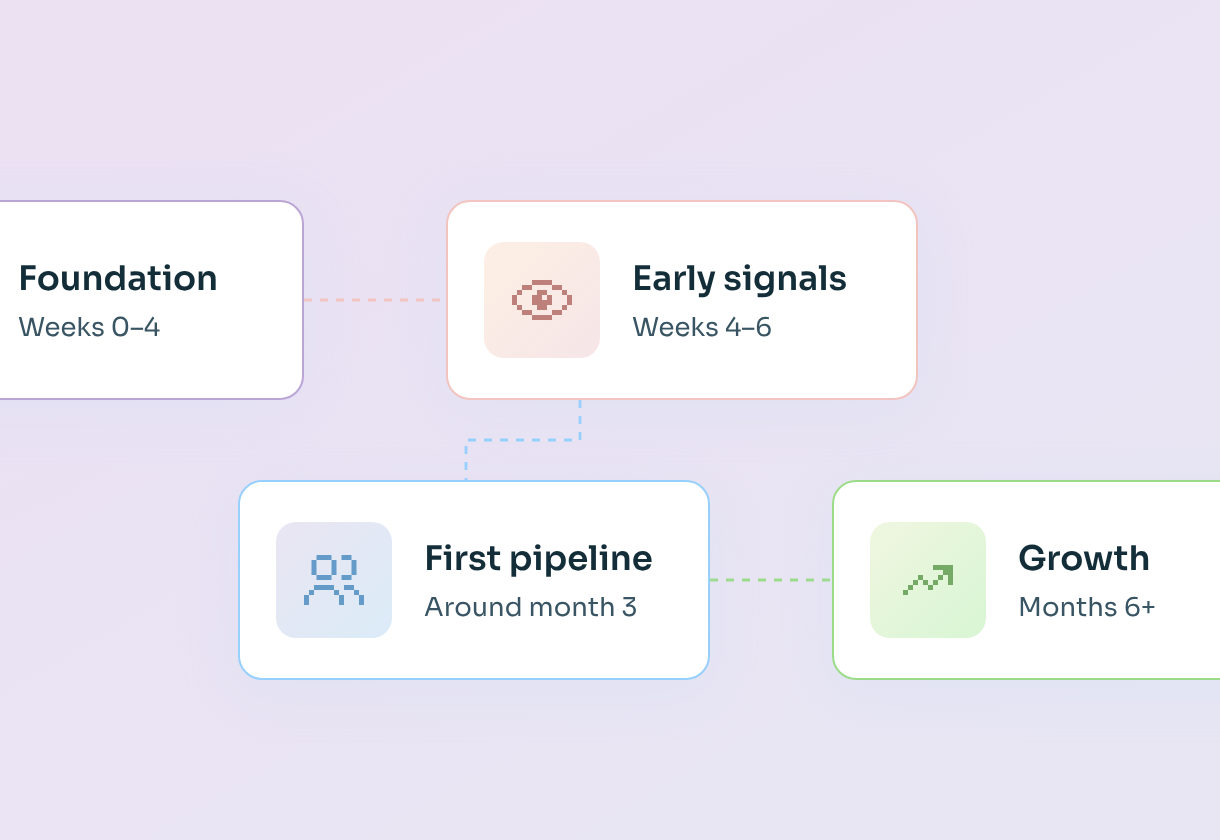

- With a bottom-of-funnel plan, a healthy website and 5–10 pieces of content a month, B2B SaaS teams usually see early SEO signals 4–6 weeks after the first content goes live.
- First MQLs and SQLs often arrive within about three months, but the range is wide: some clients get five MQLs in their first months, others wait six months for the first one. Your sales cycle then sits on top before revenue shows up.
- Traffic and AI mentions usually ramp up between months three and six, and the real compounding starts after that.
- What slows SEO down is rarely Google. It's slow approvals, technical issues, top-of-funnel-first strategies, too little volume and, above all, a crowded category or a product that isn't clearly differentiated. SEO alone can't fix everything.
"How long until we see results?"
It's one of the five questions we hear most on sales calls. When I analysed 1,164 recorded calls in Claap, it came up again and again, right next to "what does it cost?" and "does SEO still work with AI search?". And the answer most people have been given before is some version of "SEO takes six to twelve months, just trust the process."
I don't like that answer, because it isn't true for most B2B SaaS teams, and it gives leadership nothing to hold you to. So in this guide I'll walk you through the SEO timeline the way I explain it on calls: what happens in the first month, when the early signals show up, when you can expect your first leads and pipeline, how AI mentions fit in, and what speeds things up or slows them down. It's written for Heads of Marketing and founders who need to set realistic expectations with their CEO or board, including the part most agencies skip: your category, product and positioning matter as much as your SEO.
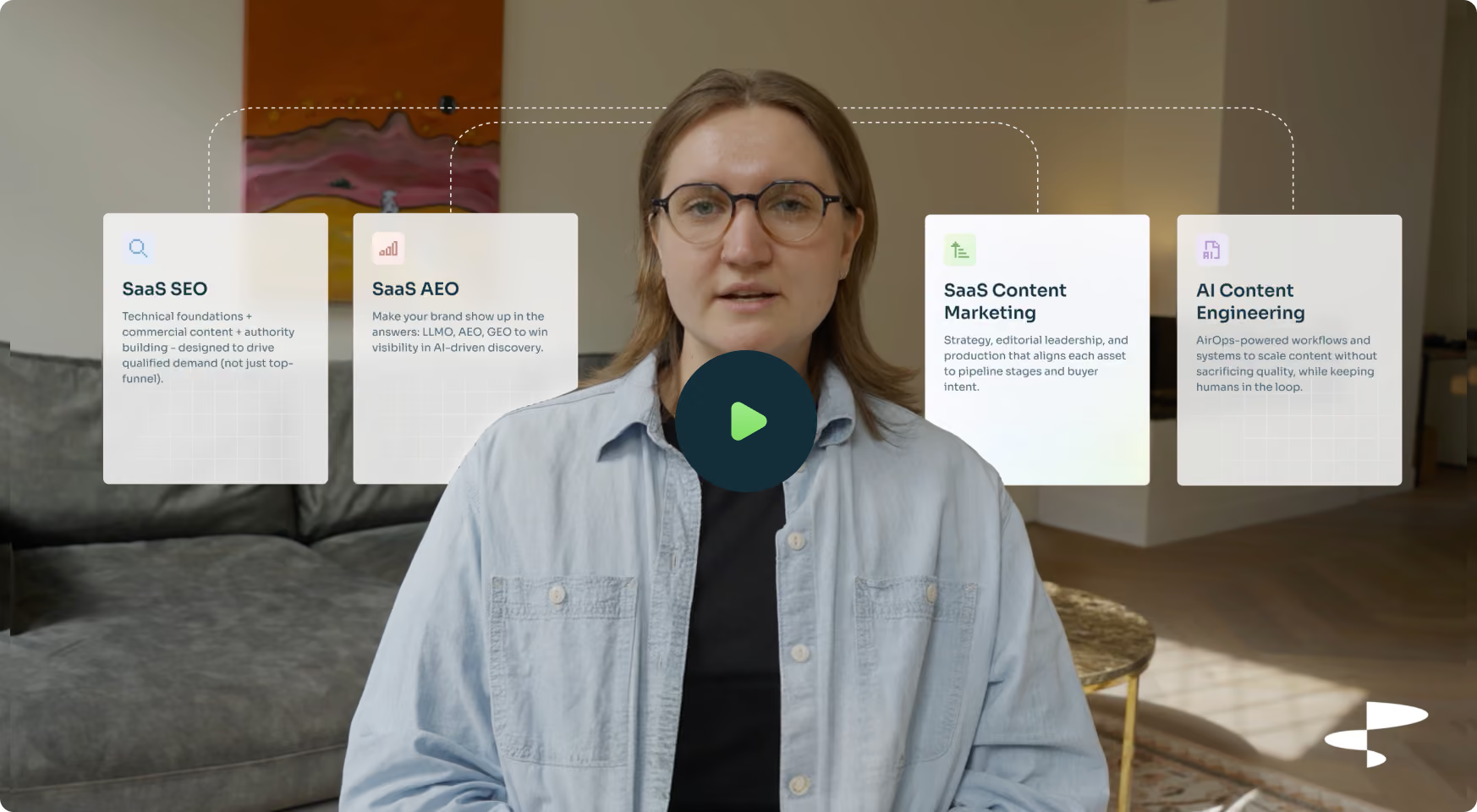
"I'm not gonna be selling you stuff like 'you need to wait for six months or a year'. Early signals come fast, and the first results within three months." – Romana Kuts, Founder at SaaStorm
So, how long does SEO take to work?
The honest answer is: it depends – on where you start, on how crowded your category is, and on how clearly your product stands out. For some of our clients, the first months already brought five MQLs. For another, the first MQL arrived in month six. Both were doing good SEO; they just started in very different places. For most teams, though, it's faster than they think – as long as a few conditions are in place. Before we get into the phases, it's worth being clear on what those conditions are, because every timeline below assumes them.
The timelines we see across our B2B SaaS clients hold when three things are true. The plan starts with bottom-of-funnel and comparison content, so the first pages target buyers rather than students. The website is technically healthy enough for search engines and AI crawlers to read it. And you're publishing consistently, usually somewhere between 5 and 10 pieces a month, human-written or AI-assisted. Take one of those away and every phase below stretches – and even with all three in place, a crowded category stretches it too, as we'll see later.
With those in place, here's what a realistic SEO timeline looks like:
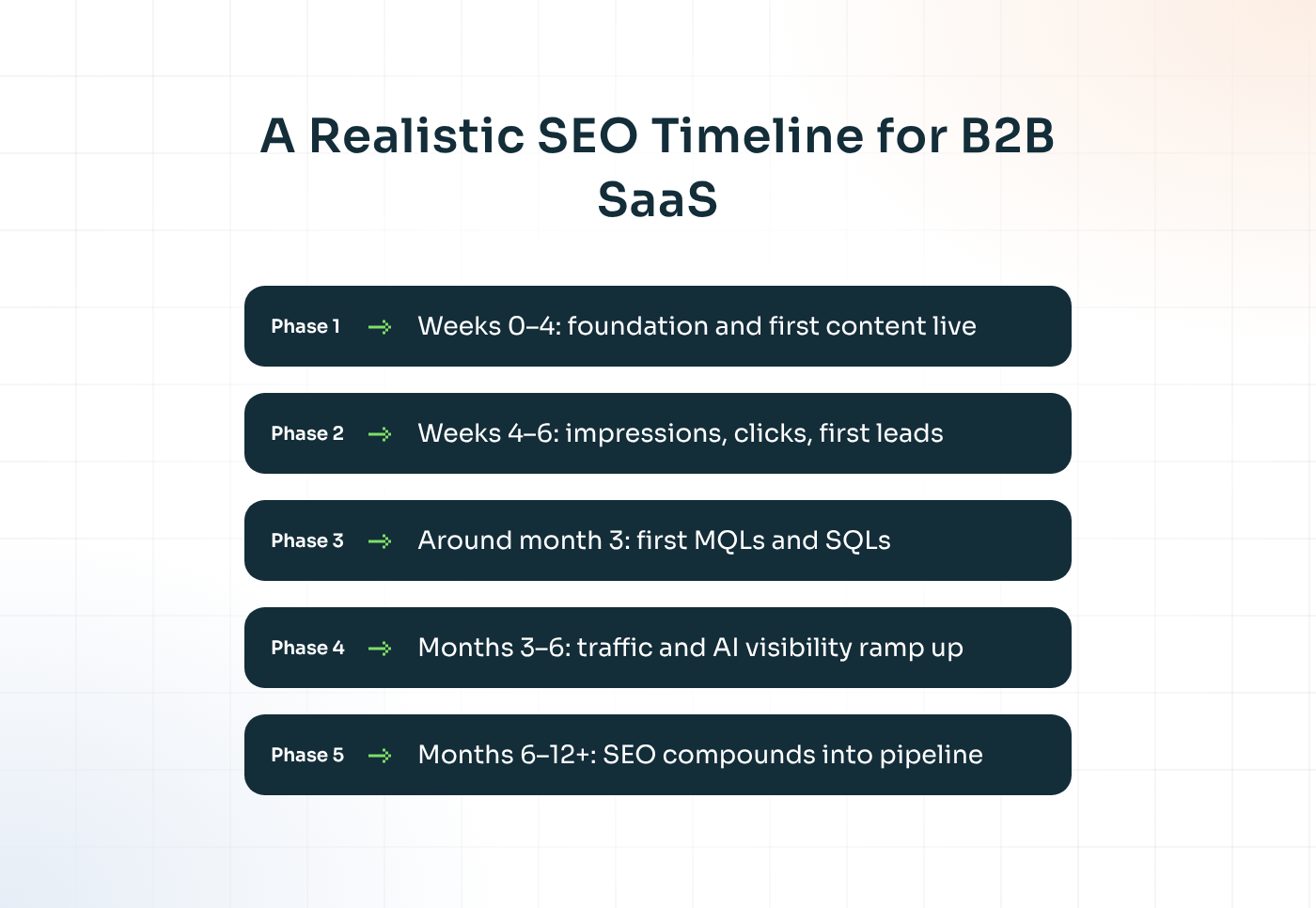
The one thing this table doesn't include is your sales cycle. If your deals take two months to close, revenue from SEO will show up roughly two months after those first SQLs. That's not SEO being slow; that's how B2B buying works. With that in mind, let's walk through each phase.
Month one: building the foundation
The first month rarely produces leads, and that's fine – it's the most important stage of the whole SEO timeline, because it decides how fast everything after it moves. Most of the work here isn't new content at all. It's making sure what you already have can actually perform.
We always start with a 10-day discovery phase: competitor research, keyword research focused on bottom- and middle-of-funnel topics, a technical audit using our SEO tools, an AI visibility snapshot and a revenue forecast. Then the first weeks of execution are about clean-up. On one recent sales call I described the first month to a prospect like this: fix everything that's broken on the website, optimise and republish the important articles that are stuck just outside the top 10, and ship the product pages. New articles usually start landing in the second month.
That order matters. An existing article sitting in position 11 for a buying keyword can move onto page one in weeks after a proper refresh, which is often the fastest win in the whole programme. Realistically, from the day you start, it takes about three weeks before the first new content is published – and that's when the clock for the next phase starts.
Weeks 4–6: the first signals
Once new content is live, the first thing that moves isn't traffic or leads. It's visibility. Google and other search engines need to crawl, index and test new pages, and the first sign they're doing that is impressions.
In Google Search Console, you'll typically see impressions rise first, then clicks follow. A client asked us about exactly this on a monthly review: ten new articles were ranking for plenty of keywords, but clicks were still low. That pattern is normal. We see it across every new project, especially in busy topics, and clicks catch up as pages climb.
Leads can come surprisingly early, too. In less crowded industries, we often see the first inbound lead three to four weeks after the first content goes live. One of our clients had their first demo booked after we'd published just two articles. That's not the norm, but it shows what happens when the first pages you publish are the ones closest to a buying decision.
"From the moment the first content is published, the early signals – more clicks, maybe some first leads – come within four weeks." – Romana Kuts
Early signals are encouraging, but leadership cares about pipeline. That's the next milestone.
Months two to three: first MQLs and SQLs
This is the phase where SEO starts to earn its budget. For most of our B2B SaaS clients, the first MQLs and booked demos from organic and AI search arrive within about three months, as more bottom-of-funnel pages go live and the first ones climb.
What that looks like varies hugely with your category. A niche product with a small competitive set can see qualified demo requests within the first month or two – we've had clients with five MQLs in their first months. A crowded category, where competitors have published for years, needs much longer to break onto page one for the money keywords, and there the first MQL can take six months. But in both cases, three months is the point where you should be able to see a baseline: which pages bring leads, which keywords convert, and where AI tools already mention you.
And this is where your sales cycle comes back in. If your product sells in three weeks, revenue follows quickly. If an enterprise platform has a six-month cycle, the first SQLs in month three might not close until month nine. That's exactly why we connect our reporting to the CRM from day one, so you can see opportunities moving long before they become closed-won ARR.
Once that first pipeline appears, the job shifts from proving SEO works to scaling what works.
Months three to six: traffic ramps up and AI mentions build
Between months three and six, things start to feel different. Traffic usually takes three to six months to ramp up properly, and this is when you see more keywords reach page one, more pages bringing in steady visits, and lead volume becoming more predictable.
This is also when AI visibility grows, both in Google's AI Overviews and in AI assistants. In our accounts, AI mentions in ChatGPT, Claude, Perplexity and Gemini move at roughly the same pace as Google rankings, and that's no coincidence. AI tools run searches and pull from pages that already rank, so as your content climbs in search, it starts showing up in AI answers too. We explain the mechanics in our GEO vs SEO guide, but the short version is that you rarely get AI visibility without the SEO foundation under it.

If you track a set of real buyer prompts in an AI visibility tool, months three to six are when those prompts start returning your brand more often. Combined with a "How did you hear about us?" field on your demo form, that's often where teams first see leads saying "ChatGPT recommended you."
Months six to twelve: where SEO starts to compound
After six months, SEO stops being a project and starts being a channel. Every article, optimisation and link from the first months keeps working, and each new piece builds on the authority of everything before it. I described it once on LinkedIn like this: month after month, the line goes up – slowly, then steadily. The kind of growth that finally starts showing up in pipeline.
Our published success stories show what that looks like by the end of the first year. Lingio started with an empty blog and reached 500% organic traffic growth and 11 times more inbound leads in nine months, with organic search contributing 60% of its sales pipeline. Asora generated €20.15M in qualified pipeline in nine months and appeared in 43% of tracked AI answers. And Reditus, a bootstrapped startup, built a $1.3M ARR pipeline in about twelve months without any external link building.
None of those were overnight results. But none of them took "a year before anything happened" either. They each had early signals in the first weeks, first pipeline within months, and then growth that kept stacking up.
Those results also depended on where each company started, which is worth looking at more closely.
How your starting point changes the SEO timeline
The phases above describe a typical programme, but where you start shapes how quickly you move through them. Website age, domain authority and how competitive your target keywords are all act as a kind of ranking factor for the timeline itself – and so do your category and how you position your product. Here's how we think about each of them, from your website to your product.
A brand new website
A brand new website has no authority yet, so search engines are cautious about ranking it, and nothing will happen overnight. Expect the early signs to take a little longer – often closer to two months than four weeks – and plan for building authority alongside content: high quality backlinks, digital PR and mentions on sites your buyers already trust. Long tail keywords and low competition keywords with clear buying intent are the fastest way in, because you don't need a strong domain to win them.
An established website with some authority
If your site has been live for a few years and already ranks for something, you're usually ahead of the curve. Existing pages can be refreshed, internal links can push authority to new landing pages, and technical SEO fixes like page speed, broken links and crawlability often unlock rankings you were already close to. This is where the fastest SEO results tend to come from, because you're improving what Google already trusts rather than starting from zero.
Crowded versus niche categories
The third factor, and often the biggest one, is your category. In a niche category with a handful of competitors, a few keywords can bring qualified demos within weeks. In a crowded category, it's a different game. If you're launching a customer service tool and competing with Intercom and Zendesk, you're up against domains with years of content marketing, thousands of backlinks and huge brand recognition – in Google and in every AI answer about your category. You can still win there, but usually through long tail and comparison keywords, specific use cases and very sharp positioning, and it takes longer to break into the top search results. Neither situation is better or worse; it simply changes how you plan your SEO strategy and marketing budget.
Your product, positioning and differentiation
The last factor is the one SEO can't control on its own: what you're actually selling, and how clearly you explain why it's different. If your product looks like ten others on the same list, ranking won't make buyers choose you, and AI tools will describe you as just another option. When positioning is sharp, every page converts better, AI tools describe you more accurately, and the same traffic turns into far more pipeline.
"It all depends on your category, your product, and how you position and differentiate yourself. Just SEO can't fix everything." – Romana Kuts
That's why our discovery phase looks at positioning and competitors before a single keyword is chosen. Sometimes the fastest way to speed up SEO is to sharpen the message first.
Whatever your starting point, some SEO journeys still take longer than they should. That's usually down to a handful of avoidable problems.
What makes SEO take longer (and what speeds it up)
When SEO efforts are slower than expected, the cause is rarely the algorithm. In our experience, four things slow programmes down more than anything else, and the good news is that most of them are within your control.

The first is slow approvals. Content that sits in review for three weeks is content that isn't ranking for three weeks, and when every article needs four stakeholders to sign off, the whole timeline shifts. Agreeing a lean review process up front is one of the easiest ways to speed SEO up.
The second is technical issues and migrations. A website that's slow, blocks crawlers or is halfway through a redesign holds everything back. Migrations are the biggest example: between redirects, relinking, republishing and re-indexing, a migration is at least a three-month process, and rankings often dip before they recover. If a migration is on your roadmap, plan your SEO timeline around it rather than through it.
The third is a top-of-funnel-first strategy. Some agencies start with broad, high-volume informational topics to "build topical authority" and only move to buying keywords later. That can grow traffic, but the people reading broad "what is…" definitions are often students and researchers, not buyers. Starting with bottom-of-funnel and comparison content that matches buyer search intent is the single biggest lever for faster pipeline.
The fourth is too little volume. Two articles a month can work in a tiny niche, but in most B2B SaaS categories it simply takes longer to build coverage. When one of our clients wanted a faster start, we ramped from five articles a month to ten, then twenty for a few months, before scaling back down once the foundation was in place. AI-assisted content now makes that kind of front-loading far more affordable, which is covered in our guide to SEO agency pricing.
On the other side, a few things reliably speed SEO up: an existing domain with some authority, a less crowded niche, refreshing pages that already sit just outside the top 10, and other channels that compound with search. When a founder is active on LinkedIn or records short videos for the content, buyers recognise the brand when they find it in Google or ChatGPT – and that tends to shorten the path to a demo. Even timing plays a part: November is usually the last good window to publish before the holidays, while January brings fresh budgets and buyers back at their desks.
Knowing what affects the timeline is useful, but you still need a way to show progress while you wait for pipeline.
What to report to leadership while you wait
The hardest part of any SEO timeline isn't the work. It's the months when leadership is asking whether it's working and the revenue isn't in yet. The way through that is to agree, up front, which metrics matter in which phase.
Think of these as your SEO KPIs per phase. In the first month or two, the honest signals are impressions in Google Search Console, keywords moving into the top 20, and AI visibility for the buyer prompts you're tracking. From month two onwards, add the first organic and AI-sourced leads and booked demos, plus what new leads write in a "How did you hear about us?" field and the organic traffic you see in Google Analytics. From month three, the conversation should move to MQLs, SQLs and pipeline in your CRM, and eventually to closed-won revenue and ROI.

That last part is the one that matters most. When we build a forecast in discovery, the goal is a plan that's ROI-positive – if a client invests €60,000 a year, the aim is to bring back at least that, and ideally two to four times more. Setting that expectation early gives leadership a real number to hold you to, instead of a vague "SEO takes time". It also makes the comparison with paid advertising fairer: Google Ads stop the day you stop paying, while search engine optimization keeps working long after a page is published.
And watch out for the opposite trap. I once spoke to a Head of Marketing whose previous agency had pushed dozens of keywords into the top 10 within six months – but brought in no pipeline. Rankings without leads aren't a slow SEO timeline, and they're not SEO success either. They're a sign the strategy was pointed at the wrong target keywords.
The bottom line
So how long does SEO take? For most B2B SaaS teams with a bottom-of-funnel plan, a healthy website and consistent publishing, you should see early signals within four to six weeks of the first content, first pipeline within about three months, and real compounding from month six onwards – with your sales cycle on top before revenue lands.
But it all depends on your category, your product and your positioning. In a niche category, the first MQLs can arrive in the first months; in a market crowded with the likes of Intercom and Zendesk, the first one can take six. SEO speeds up a good product with a clear story – it can't replace one.
SEO isn't a six-to-twelve-month black box. It's a sequence of phases, each with its own signals, and if you know what to look for in each one, you'll never have to tell your CEO to "just trust the process".
00:00
/
00:00
Want a realistic SEO timeline and forecast for your own business? Book a call with us and we'll walk you through what the first three months could look like.
FAQs
How long does SEO take to show results?

For B2B SaaS companies with a bottom-of-funnel content plan and a healthy website, early results such as rising impressions and first clicks usually appear 4–6 weeks after the first content is published. First MQLs and SQLs typically follow within about three months.
How long does it take to rank on Google?
New pages can start ranking within weeks, but reaching page one for competitive keywords usually takes three to six months. Refreshing existing pages that already sit just outside the top 10 is often the fastest way to rank.
How long does SEO take for a new website?
A brand-new domain usually takes longer, because it has no authority yet. Expect early signals within a couple of months and steady growth from around month six, especially if you combine content with link building and digital PR.
Why do SEO timelines differ so much between companies?
Mostly because of the category, the product and the positioning. In a niche category, some companies see five MQLs in their first months; in a crowded one, like customer service software competing with Intercom and Zendesk, the first MQL can take six months. SEO can speed up a well-positioned product, but it can't fix positioning on its own.
Does AI search visibility take longer than SEO?
In our experience, AI mentions in ChatGPT, Claude, Perplexity and Gemini grow at roughly the same pace as Google rankings, because AI tools pull from pages that already rank. Strong SEO is usually what drives AI visibility.
Why is my SEO taking so long?
The most common reasons are slow content approvals, technical issues or a website migration, a strategy that starts with top-of-funnel content instead of buying keywords, and publishing too little content to build coverage.
How long should you give an SEO agency before judging results?
Give it around three months to see first leads and pipeline, and six months to judge whether the channel is scaling. But you should see clear early signals, like rising impressions and AI visibility, within the first six weeks.



“SaaStorm became a key part of our inbound motion. Their SEO and content support helped us scale a consistent flow of high-intent traffic and build a content engine that supported £250K+ in inbound revenue. They plugged into our system and delivered every step of the way.”
Jonny Butler, Head of Marketing at OneUp
Related posts