Back to blog
How to Choose a B2B SaaS SEO Agency: 15 Questions to Ask Before You Sign


- The best way to choose an SEO agency is to ask questions that are hard to fake: how they measure results, who actually works on your account, what they implement themselves and how they handle AI search.
- A good B2B SaaS SEO agency reports on MQLs, SQLs, pipeline and ROI, not just traffic and impressions, and can explain the payback period before you sign.
- Senior people should stay on your account after the sale, and the founder or a senior lead should still show up for monthly or quarterly reviews.
- For AI search, ask how they'll measure visibility, which tools they use and how they'll work on your narrative and positioning – that's where AI visibility is won or lost.
- Avoid long lock-ins, guaranteed rankings, bulk AI content and agencies that hand you a list of fixes and walk away.
SaaStorm exists because I couldn't find an agency I wanted to hire.
Before I started it, I was Head of Content at a B2B SaaS company, and over the years I worked with a lot of agencies. Every one of them tried to sell me something, then upsell me something else. Most couldn't answer my questions properly, and almost all of them reported on vanity metrics: traffic up, impressions up, a few keywords moved. None of it told me whether we were getting more demos. At some point I just thought: I can do this better. So we built the agency I'd been looking for.
"Every agency would try to sell me, upsell me, couldn't answer my questions, and it was all about vanity metrics. At some point I was just like: I can definitely do this better." – Romana Kuts, Founder at SaaStorm
Now I sit on the other side of the table, and I see the same problem from a new angle. On our sales calls, Heads of Marketing tell us why they're leaving their current agency, and the stories are remarkably similar. One was paying around €9,000 a month for twelve blog posts and no link building, and later realised he could do most of it himself in a few hours. Another had five articles a month going out on broad definition keywords that Google's AI Overviews now answer on their own. A third had an agency that sent a list of redirects to fix – and then couldn't implement them.
So if you're talking to several agencies right now, good. That's the smartest thing you can do. This guide is about how to choose an SEO agency without learning those lessons the expensive way. It gives you 15 questions to ask before you sign, grouped by theme, with what a good answer and a weak answer sound like, and how we answer each one at SaaStorm. It's written for Heads of Marketing, CMOs and founders at B2B SaaS companies from seed to Series C – and it works whether or not you end up working with us.
How to choose an SEO agency when you're a B2B SaaS company
Before we get to the questions themselves, it helps to be clear on why this decision is tricky in the first place. Almost every SEO company says the same things in a sales call: data-driven, results-focused, a proven track record, great communication. The proposals look similar too, and so do the client testimonials on their websites. The differences only show up three months in, when you either have pipeline or you don't.
B2B SaaS adds its own layer on top. Your buyers search for comparisons, alternatives and pricing rather than definitions, your sales cycle can run for months, and a growing share of your buyers now ask ChatGPT, Claude or Perplexity for a shortlist before they ever visit your website. An agency that offers SEO services for small businesses, local SEO or e-commerce SEO can be very good at what it does and still be the wrong fit for you. The right SEO agency for a SaaS business understands long sales cycles, comparison keywords and how traditional SEO now feeds AI search.
It's also worth deciding early whether you need an agency at all, or whether an SEO consultant or a stronger in-house team would serve you better at your stage. If an agency is the right call, the best questions aren't about specific tactics. They're about how an agency thinks, who does the work and what it will hold itself accountable for. We'll start where every conversation should start: results.

Questions about results and reporting
If you only ask one thing in the first call, make it how the agency measures success. Everything else – the strategy, the content plan, the reporting – follows from that answer. These four questions tell you whether an agency is working towards your revenue or towards a nice-looking dashboard.
1. How do you measure results?
This is the no-brainer, and it's still the question that separates agencies fastest. Listen carefully to the first thing they say.
If the answer is organic traffic and impressions, that's a weak answer. Those are useful signals, but they're not results for your business. A good answer covers the usual key performance indicators, like search engine rankings and search visibility, and then goes further: MQLs, SQLs, pipeline and revenue from organic and AI search. The best agencies will bring up ROI on their own, talk about being ROI-positive and explain the payback period they expect for a business like yours.
How we answer it at SaaStorm: we report on SEO metrics, AI visibility, MQLs, SQLs, pipeline and revenue, and we connect to your CRM to see what organic actually drives. In discovery, we build a forecast that starts from your ARR goals and works back to the content plan, so the goal is always an ROI-positive programme with a clear payback period. Our guide to how long SEO takes explains which of those metrics to expect in which month.
"My goal is not to drive more traffic to your website. My goal is to get the people who are booking the first meeting with you." – Romana Kuts, Founder at SaaStorm
2. What will you report on, and how often?
Measuring the right things is one half of it. The other half is how you'll actually see them, because a great strategy with a confusing monthly PDF still leaves you guessing.
A good answer is specific: which key metrics, in which tools (Google Search Console, Google Analytics, your CRM), at which cadence, and who presents them. Ask for a sample report, so you can see what transparent reporting looks like in practice. You want a regular rhythm of updates, plus deeper reviews where you step back and look at pipeline and priorities. A weak answer is "you'll get a monthly report" with no detail on what's in it, or reporting that only covers rankings.
How we answer it at SaaStorm: we work in a shared Slack channel, have weekly calls with every client, and run deeper monthly or quarterly reviews on pipeline, AI visibility and what we're changing next. Reports show organic and AI-sourced leads next to the SEO numbers, so leadership can see the full picture in one place.
3. What will the first 90 days look like?
This question tells you whether an agency has a real process or just a sales deck. It also gives you something concrete to hold them to.
A good answer breaks the first three months into phases with clear outputs. A weak answer is "SEO takes six to twelve months, so be patient". Patience matters, but you should still see progress long before month six.
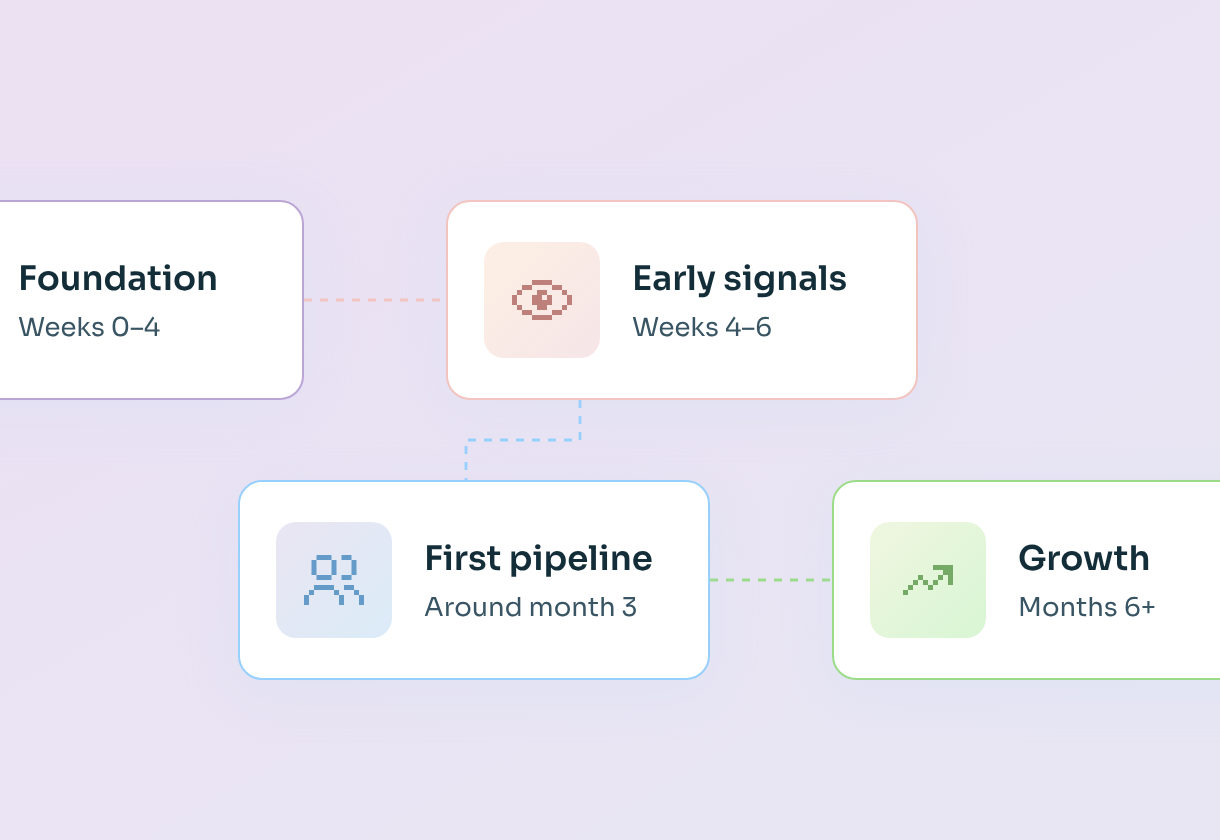
How we answer it at SaaStorm: the first 30 days are discovery plus fixing everything that's holding the website back, from technical issues to pages that are close to ranking. Then we push the first bottom-of-funnel content and website pages live and get the first links and mentions published. By around day 90, the aim is the first MQLs and clear positive signals. If you want the full breakdown, the SEO timeline guide walks through each phase.
4. Can you show results for companies like ours?
Once you know how an agency measures results, ask to see them. Case studies are the obvious answer, but the best proof is specific to your stage, your market and your type of product.
A good answer comes with real numbers from previous clients, ideally B2B SaaS companies at a similar stage, and the agency is open about what didn't work as well. One founder we spoke to did something smart here: before deciding, he researched the SEO growth of the agency's own clients. If an agency's results are real, they'll survive that check. Online reviews and references help too. A weak answer is a logo wall with no numbers, or results that are all from a different industry.
How we answer it at SaaStorm: we share our success stories with the numbers behind them. Lingio went from an empty blog to 500% organic traffic growth and 11 times more inbound leads in nine months. Asora generated €20.15M in qualified pipeline in nine months and appeared in 43% of tracked AI answers. Reditus built a $1.3M ARR pipeline in about a year without external link building.
Questions about the team behind your account
Results come from people, and this is where many agency relationships quietly go wrong. You meet a founder and a senior strategist in the sales call, they understand your business, you sign – and then you never see them again. These three questions help you find out who you're actually hiring.
5. Who will actually work on our account?
This is my second must-ask question, because the answer changes everything about the experience you'll have.
Ask for names, roles and seniority, and ask whether the people in the sales call will be on your account. A good answer introduces the strategist who will lead your work and explains who writes, who handles technical SEO and who does link building. A weak answer is vague, or it turns out the work goes to junior hires who aren't confident on calls in your language, rarely show up and need you to manage them.
How we answer it at SaaStorm: every account is led by a senior organic growth strategist, supported by experienced writers, technical specialists and our link network. You'll meet your strategist before you sign, and they're the person you speak to every week.
6. How involved will you stay after we sign?
This is the follow-up to question five, and it's aimed at the founder or senior lead you're speaking to. In smaller and mid-sized agencies especially, the founder's involvement is often what keeps quality high.
A good answer is concrete: the founder or a senior lead joins monthly or quarterly reviews, stays across the strategy and is reachable when something important comes up. A weak answer is "you'll be in great hands with the team", with no commitment to stay involved at all.
How we answer it at SaaStorm: My co-founder (our CMO) and I still join client reviews and stay close to the strategy on every account. That isn't a favour; it's how we make sure the agency we're building stays the one I wanted to hire.
7. Do you implement the work, or just recommend it?
The last team question is about what happens after the advice. Many SEO providers are excellent at audits and recommendations, and then hand you a spreadsheet of fixes for your own team to find time for.
A good answer is clear about what the agency does itself after the technical audit: technical SEO fixes, site speed improvements, redirects, on-page changes, publishing in your CMS and website work, or close collaboration with your developer if you have one. A weak answer is a long audit with no plan for who implements it. If you don't have a developer in-house, this question matters even more.
How we answer it at SaaStorm: we implement. We don't send you a list of things and tell you to go and do it. We work directly in Webflow, WordPress and other CMSs, handle technical SEO and redirects, and work alongside your developer when you have one.
Questions about strategy and content
Once you trust the team, the next step is understanding how they'll spend your budget. Questions about SEO strategy and content strategy show you whether an agency starts from your buyers or from a keyword list, and whether it knows when to use AI and when not to.
8. How do you decide what to work on first?
Order matters a lot in B2B SaaS SEO. An agency can do good work and still waste months by starting in the wrong place.
A good answer starts from revenue, with keyword research focused on your target audience: bottom-of-funnel pages, comparison and alternatives pages, existing pages that are close to ranking and the technical fixes that unlock them. It also takes your category and positioning into account. A weak answer starts with broad top-of-funnel keywords chosen mainly for search volume – the "what is X" articles that AI Overviews now answer on their own. Be just as wary of an agency that dismisses your niche because the keyword volumes are small. In B2B SaaS, a handful of high-intent keywords often brings more pipeline than thousands of informational visits.
How we answer it at SaaStorm: every engagement starts with a discovery phase, where we audit your content, website, competitors and AI visibility and build a content plan prioritised by how close each topic is to revenue. Bottom-of-funnel content and fixes come first; top-of-funnel comes later, when it supports the rest.
9. How do you use AI in your content?
Every agency uses AI in some way now, so the question isn't whether, it's how. The answer tells you a lot about quality and about what you're really paying for.
A good answer is transparent about which content is human-written, which is AI-assisted and who edits and fact-checks what. It also explains why: buying-stage content that needs expertise and real examples deserves a human writer, while some informational content can be produced faster with AI and a human editor. A weak answer is either "we never use AI" (unlikely, and usually not true) or bulk AI articles published with little editing and sold as "AI SEO".
How we answer it at SaaStorm: bottom-of-funnel and thought-leadership content is written by human writers, with input from your team. Informational content can be AI-assisted through AirOps, always with a human editor and our own quality checks. We show you examples of both before you sign, and we explain what each costs in our guide to SEO agency pricing.
10. How do you handle links and off-site mentions?
Content on your own website is only half the picture. Links, listicle mentions, reviews and community discussions shape how both Google and AI assistants see your brand.
A good answer explains where links and mentions come from, how they're vetted, what they cost and how they tie back to your priority pages. Good SEO here means white-hat link building that follows search engine guidelines. A weak answer is a fixed number of links a month with no detail on quality, or no off-site work at all.
How we answer it at SaaStorm: we work with a network of vetted link building partners and publishers, secure placements on relevant "best of" listicles and track every link against the pages it's meant to support.
Questions about AI search
AI search is where many agencies are still catching up, and it's also where buyers are most likely to be sold something vague. The two questions below help you separate real experience from rebranded SEO. If you want the bigger picture first, our guide to GEO vs SEO explains what changes and what doesn't.
11. How will you measure our AI visibility, and with which tools?
You can't improve what you don't measure, and AI visibility is easy to talk about and hard to track.
A good answer names the tools and explains what they track: which buyer prompts, in which AI assistants, how often, and how mentions and citations are reported over time. It should also cover AI-referred traffic and leads in your analytics and CRM. A weak answer is "we'll check ChatGPT from time to time", or a promise of AI mentions with no way to measure them.
How we answer it at SaaStorm: we track the buyer prompts that matter for your category in Scrunch, our AI visibility tool, across ChatGPT, Claude, Perplexity, Gemini and Google's AI Overviews. We report mentions and citations next to your SEO results and AI-sourced leads, so you can see how both move together.
12. What will you actually do to get us mentioned – and where do positioning and narrative fit in?
Measuring is the starting point; the next question is what the agency will do about it. This is where you'll hear the biggest differences between agencies.
A good answer covers your own website (crawlability, content structure, FAQs, pricing in text), off-site mentions on review sites, listicles and communities, and – most importantly – your narrative and positioning. AI assistants repeat what the web says about you. If your positioning is unclear or your differentiation is weak, no amount of optimisation will make them recommend you for the right reasons. A weak answer focuses only on technical tweaks or "AI-optimised content", and never asks how you want to be described.
How we answer it at SaaStorm: we start with how you want AI tools to describe you and who you want to be recommended to, then work on your website, your off-site presence and the story told about you across the web. Narrative and positioning come first, because they're what AI search repeats.
"In AI search, narrative and positioning are the most important part." – Romana Kuts, Founder at SaaStorm
Questions about the contract and pricing
The last three questions are about the commercial side. They're often left until the proposal stage, but asking them early saves everyone time and tells you a lot about how confident an agency is in its own work.
13. How is your retainer built, and what's included?
Price on its own tells you very little. What you need to understand is what the price buys and how it's calculated.
A good answer explains the pricing model, breaks the monthly retainer into its parts – strategy, content, optimisations, links, website work – explains how each is priced and connects the total to your goals. A weak answer is a single number for a vague package, or a retainer built purely on article volume. We've written a full guide to SEO agency pricing for B2B SaaS if you want to compare quotes in detail.
How we answer it at SaaStorm: we start with a paid discovery phase, then size the retainer to your ARR goals and the plan that comes out of it. Our pricing page shows how human-written articles, AI-assisted content, optimisations and links are priced, so you can see the maths behind any proposal.
14. What's the contract length and notice period?
This one is simple, and it says a lot. An agency that's confident in its results doesn't need to lock you in.
A good answer is a short pilot with an easy exit, followed by a reasonable notice period. A weak answer is a 12-month contract from day one with no way out if the work isn't delivering.
How we answer it at SaaStorm: we don't do yearly contracts. During the first three months, you can cancel with 10 days' notice. After that, the notice period is 60 days. We want you to stay because of the pipeline, not because of a contract.
"We don't do yearly contracts. We want you to have fun and pipeline with us, not be trapped in a contract." – Romana Kuts, Founder at SaaStorm
15. What happens if the results don't come?
The final question is the uncomfortable one, which is exactly why it's worth asking. Every SEO programme hits a slower month or a strategy that needs to change.
A good answer is honest: the agency explains how it spots underperformance early, what it changes and how it communicates it. It might also tell you when SEO alone isn't the answer – for example, when the real problem is positioning or a crowded category. A weak answer is a guarantee. No agency can guarantee rankings or AI mentions, and any agency that does is either not being honest with you or measuring something meaningless.
How we answer it at SaaStorm: we agree on the forecast and the early signals up front, review them every month and change course quickly when something isn't working. And if we think SEO can't fix the problem on its own, we'll say so.
Red flags to watch for in any SEO proposal
The 15 questions above will tell you most of what you need to know. But a few warning signs come up so often in the stories we hear that they're worth calling out on their own. If you spot any of these, ask more questions before you sign.

The most common one is a team that changes after the sale: senior people in the pitch, juniors on the account. Closely related is the "list and leave" model, where you get audits and recommendations but nobody implements them. Then there's reporting that stops at traffic, impressions and rankings, with no link to leads or pipeline.
On the commercial side, watch out for long lock-in contracts and retainers built on volume alone – twelve articles a month sounds like a lot until none of them target your buyers. And be wary of guarantees, whether it's a number-one ranking or a promised mention in ChatGPT, and of "AI SEO" that turns out to be bulk AI content with little editing. Our pricing guide covers the pricing-specific red flags in more detail.
The 15 questions to ask an SEO agency, in one list
Here's the full list to copy into your notes before your next agency call. Use it as a checklist across every agency you're talking to, so you can compare their answers side by side.
- How do you measure results?
- What will you report on, and how often?
- What will the first 90 days look like?
- Can you show results for companies like ours?
- Who will actually work on our account?
- How involved will you stay after we sign?
- Do you implement the work, or just recommend it?
- How do you decide what to work on first?
- How do you use AI in your content?
- How do you handle links and off-site mentions?
- How will you measure our AI visibility, and with which tools?
- What will you actually do to get us mentioned, and where do positioning and narrative fit in?
- How is your retainer built, and what's included?
- What's the contract length and notice period?
- What happens if the results don't come?

The bottom line
Choosing a good SEO agency comes down to a few things that are hard to fake. Does the agency measure what you care about – pipeline and revenue, not just traffic? Will senior people stay on your account after you sign? Will they implement the work, take AI search and positioning seriously, and let you walk away if it isn't working?
Ask all 15 questions, compare the answers side by side and trust the SEO partner that gives you specific, honest answers, even when the honest answer is "it depends". That's how I'd want to be sold to when I was the one hiring, and it's the standard we hold ourselves to now.
00:00
/
00:00
Shortlisting SEO agencies right now? Book a call with us and ask us all 15 questions. We'll answer every one of them.
FAQs
How do I choose an SEO agency for B2B SaaS?

Ask how they measure results, who will work on your account, what they implement themselves and how they handle AI search. A good B2B SaaS SEO agency reports on MQLs, SQLs and pipeline, keeps senior people on your account and offers a short pilot instead of a long lock-in.
What questions should I ask an SEO company before hiring them?
The most important are how they measure results, who will actually work on your account, what the first 90 days look like, how they use AI in content, how they measure AI visibility and what the contract and notice period are.
What should I look for in an SEO agency?
Look for reporting that connects SEO to pipeline and revenue, a senior team that stays involved after the sale, proof from companies similar to yours, clear pricing and a contract that doesn't lock you in for a year.
What are the red flags when hiring an SEO agency?
Common red flags are a junior team after the sale, reporting that stops at traffic and rankings, audits with no implementation, long lock-in contracts, guaranteed rankings or AI mentions, and bulk AI content sold as "AI SEO".
How long should an SEO agency contract be?
A short pilot of around three months with an easy exit is a good start, followed by a reasonable notice period. Be wary of 12-month contracts from day one.
Should an SEO agency also handle AI search?
Yes. AI assistants increasingly shape B2B shortlists, and AI visibility builds on strong SEO. Your agency should measure AI visibility with dedicated tools and work on your positioning, content and off-site mentions.



“SaaStorm became a key part of our inbound motion. Their SEO and content support helped us scale a consistent flow of high-intent traffic and build a content engine that supported £250K+ in inbound revenue. They plugged into our system and delivered every step of the way.”
Jonny Butler, Head of Marketing at OneUp
Related posts