- Bing SEO is no longer the “nice to have” you get round to after Google. Bing still holds about 15% of desktop search worldwide and in Europe, and it’s the index Microsoft Copilot grounds its answers in. If a page isn’t in Bing, Copilot can’t cite it.
- Your B2B buyers probably live in Microsoft all day. Outlook, Teams, Edge, Windows and Copilot are the default set-up in most enterprise companies. That’s why Bing traffic from B2B buyers is often bigger and better quality than marketers expect.
- Bing tells you how it ranks pages, and in what order. Microsoft lists six main parameters: relevance, quality and credibility, user engagement, freshness, location and language, and page load time. Relevance comes first, which is why clear titles, headings and on-page wording matter more on Bing than many teams think.
- Google rankings don’t transfer automatically. Bing crawls and indexes on its own schedule, leans more on sitemaps, lastmod and IndexNow, and responds more visibly to explicit relevance signals. You need to check Bing separately.
- Bing Webmaster Tools is the most underused free tool in B2B SEO. Besides search performance, URL Inspection and Site Explorer, it now has an AI Performance report that shows how often Copilot and Bing’s AI answers cite your pages, which pages, and for which grounding queries.
- Copilot citations are growing fast across our clients. One HR tech client went from 5,791 Copilot citations in April 2026 to 28,100 in October. A climate data SaaS gets about 12,000 a month, and a retail tech SaaS more than doubled its citations in one month. Citations aren’t clicks, though, so we report them as a visibility metric next to clicks and pipeline.
- Bing clicks are small but efficient. Across our clients Bing CTR sits at 1.8% to 3.3%, often higher than on Google, and Bing shows up in pipeline: it touched 6 of 48 organic SQLs for one client this year, and brought 8 of 86 verified sign-ups in one month for another.
- What to do: verify Bing Webmaster Tools, submit sitemaps, switch on IndexNow, make relevance explicit, keep pages genuinely fresh, and write passages Copilot can quote. Then review the AI Performance report every month and build content around the grounding queries you’re missing.
Here’s something I see on almost every discovery call. A B2B SaaS team has Google Search Console set up, a Semrush project for keyword research, maybe an AI visibility tool. And then I ask: “Can we get access to your Bing Webmaster Tools?” Silence. Most of them have never set it up.
That made sense a few years ago. Bing compared to Google looked like a rounding error, the search engine of default browsers and people who didn’t bother to change them. But in 2027 Bing is something else as well: it’s the index behind Microsoft Copilot. And if your buyers work in big companies, they spend their whole day inside Microsoft products.
“I feel like if they are sitting in Outlook, they are also using Bing as their default browser. My prediction is that we will have a lot of insights from Bing, actually.” – Romana Kuts, Founder at SaaStorm
That prediction turned out to be right for more than one of our clients. So in this guide, I’ll explain how Bing ranking works, what’s different from Google, how to set up Bing Webmaster Tools properly, how to read the new AI Performance report, and what we actually do for our B2B SaaS clients to rank on Bing and get cited in Copilot. I’ll use real (anonymised) data from our client reports along the way.
Why Bing matters for B2B SaaS in 2027
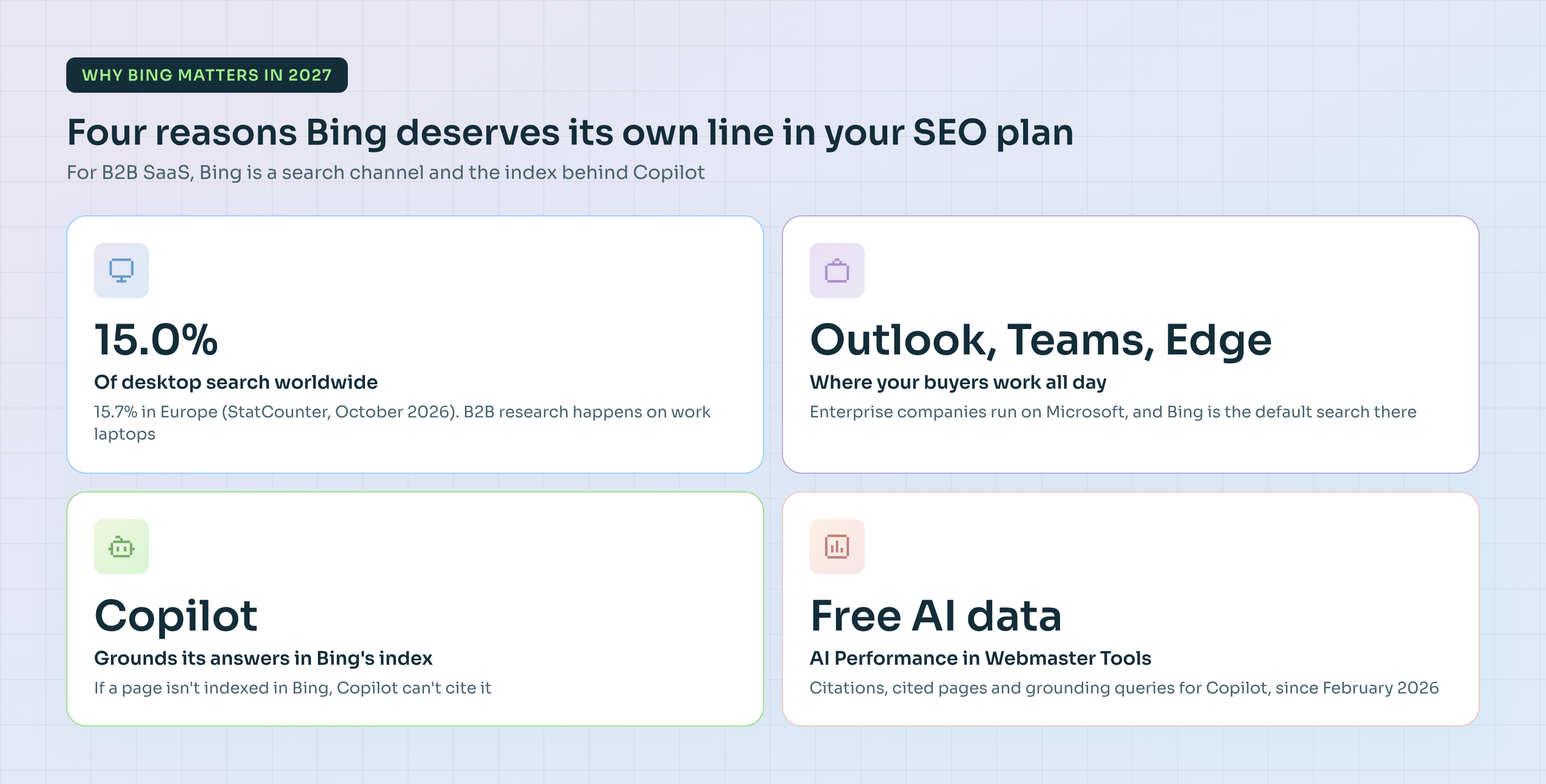
Let’s start with the honest question every CMO asks: does anybody use Bing anymore, and is it actually worth the effort? Google is still the main search engine, and nobody is suggesting you move your SEO budget to Bing. But there are four reasons Bing deserves its own line in your plan, and the last one is the one that changed everything.
Your buyers search on desktop, at work, in Microsoft
According to StatCounter, Bing held 15.0% of desktop search worldwide and 15.7% in Europe in October 2026, against about 78% and 74% for Google. One in seven desktop searches isn’t nothing, and for B2B the share is usually higher. Your buyers research software on a work laptop, inside a company that runs on Windows, Outlook, Teams and Edge, where Bing is the default. That’s targeted traffic: people researching software at work, on the machine they’ll buy it on.
On a kick-off call this summer, a Head of Marketing at an enterprise SaaS company told us that when they looked at their own website traffic, “there’s coming quite a lot from Bing”, more than they were used to. Their clients sit in Outlook and Teams all day. That’s typical for companies that sell into enterprise, manufacturing, food, climate or finance teams.
Copilot answers are built on Bing’s index
This is the big one. Microsoft Copilot grounds its answers in Bing’s search index, and so do Bing’s own AI summaries and some partner experiences. If a page isn’t indexed in Bing, or ranks badly there, it has a much smaller chance of being cited in a Copilot answer.

Bing finally shows you your AI citations
In February 2026 Microsoft launched the AI Performance report in Bing Webmaster Tools as a public preview. It shows how often your pages are cited in Copilot, Bing’s AI summaries and select partner integrations, which pages get cited, and a sample of the grounding queries behind those citations. In June 2026 it added intents, topics, citation share and period comparison. No other search engine gives you this kind of first-party AI citation data for free.
There’s less competition
Most SaaS companies optimise only for Google and treat Bing traffic as a rounding error. Ignoring Bing leaves the field open. A prospect on that same call put it simply: Bing is “so much cheaper and easier still to rank higher” in. For niche B2B queries, a well-structured page can win on Bing long before it wins on Google.
That’s the why. Now let’s look at how Bing actually decides what to rank, because the good news is that Microsoft is unusually open about it.
How Bing ranks pages: Bing ranking factors
Google talks about “hundreds of signals” and rarely tells you what matters most. Bing’s algorithm is easier to read. On its “How Bing delivers search results” page, Microsoft lists its main ranking parameters “in general order of importance”, while noting that their weight can change by query and over time.
Two things stand out when you read this list as a B2B marketer.
First, relevance sits at the top, ahead of authority. That’s why Bing’s algorithm tends to reward pages that say very clearly what they’re about. Not keyword stuffing, just no ambiguity.
Second, user engagement is named explicitly, and click through rates are part of how Bing reads it. If your title promises “pricing” and the page hides it behind a demo form, people bounce back to Bing, and Bing notices. I’ll come back to both points in the on-page section.

So the inputs are similar to Google’s on paper. In practice, though, the two engines weigh them differently, and that’s where most teams lose Bing visibility without noticing.
Bing vs Google: what’s actually different
The practical difference between Bing SEO and Google SEO isn’t “Bing is easy and Google is hard”. Both reward useful, credible, well-structured content. The difference is in how visibly each one responds to certain signals, and in how they find and index your pages.
Unlike Google, Bing also gives you more public detail on what it rewards in its Bing Webmaster Guidelines, so read them once. The row that surprises people most is indexing, because Bing relies more on what you submit. Google and Bing are two separate crawlers with two separate indexes. A page can rank on Google and be missing from Bing, or the opposite.
Knowing the difference is step one. Step two is getting the data, and on Bing that means Bing Webmaster Tools.
Bing Webmaster Tools: set it up properly
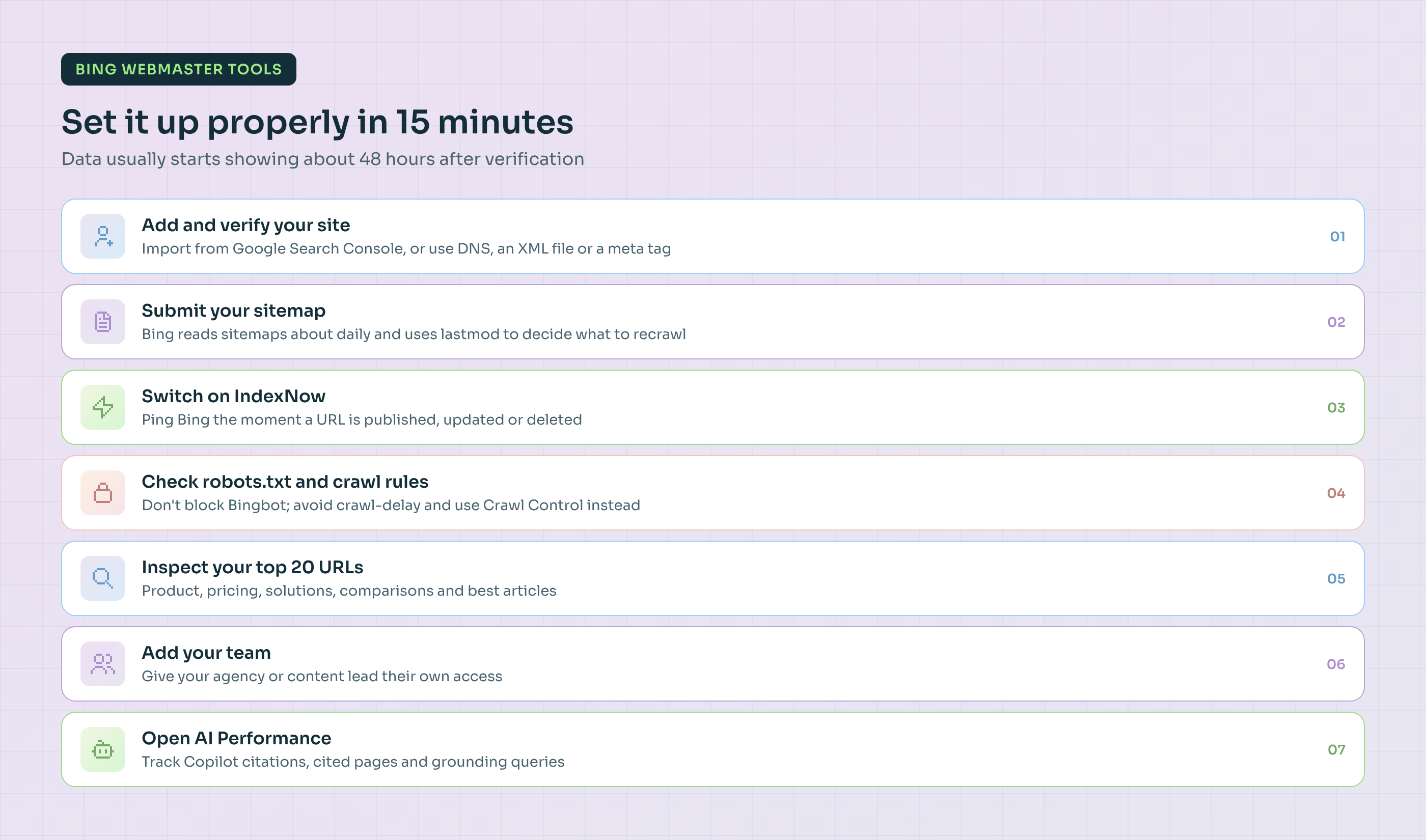
Bing Webmaster Tools is Bing’s equivalent of Google Search Console, and in some ways it’s better. Using Bing Webmaster Tools properly is the single cheapest step in any Bing SEO strategy. It’s free, it takes 15 minutes to set up, and once your site is verified, data usually starts showing in about 48 hours.
The initial setup
Here’s the setup we run for every new client, in this order:
- Sign in and add your site. The fastest route is importing your sites from Google Search Console, which brings verification and sitemaps with it.
- Verify ownership with the GSC import, a DNS record, an XML file or a meta tag.
- Submit your XML sitemap or sitemap index. Bing processes sitemaps about once a day, and it uses lastmod to decide what to recrawl, so make sure those dates are accurate.
- Switch on IndexNow. Many CMSs and CDNs support it out of the box. It pings Bing (and other participating engines) the moment you publish, update or delete a URL.
- Check robots.txt, canonicals and redirects for anything blocking Bingbot. Avoid crawl-delay: Bing warns it can stop effective crawling and recommends its Crawl Control setting instead.
- Run URL Inspection on your 20 most important pages: product, pricing, solution, comparison and your best-performing articles. Confirm each one is indexed.
- Add your team as users, so your SEO agency or content lead can see the data without sharing a login.
The reports we check every week
Once the data is flowing, these are the reports we open first:
- Search Performance: clicks, impressions, CTR and average position by keyword, page, device and country, with date ranges up to 24 months. Use it to track keyword performance and your site’s performance in Bing search results. One detail worth knowing: keyword and page data only covers classic web results, not Copilot chat.
- URL Inspection: whether Bing can crawl and index a URL, and what’s blocking it if not.
- Site Explorer: a tree view of what Bing has crawled. Great for spotting orphan pages, redirect chains and pages you forgot existed.
- Crawl Control and crawl error alerts: 403 blocks, server errors and bandwidth limits that stop Bingbot.
- Keyword Research and Site Scan: Bing’s own keyword research tool shows search volume on Bing for your target keywords and other relevant keywords, and Site Scan is a free SEO analyzer that flags technical issues like missing title tags, short meta descriptions and broken links. Use them to identify underperforming keywords and pages.
- AI Performance: citations, cited pages and grounding queries for Copilot and Bing’s AI answers.
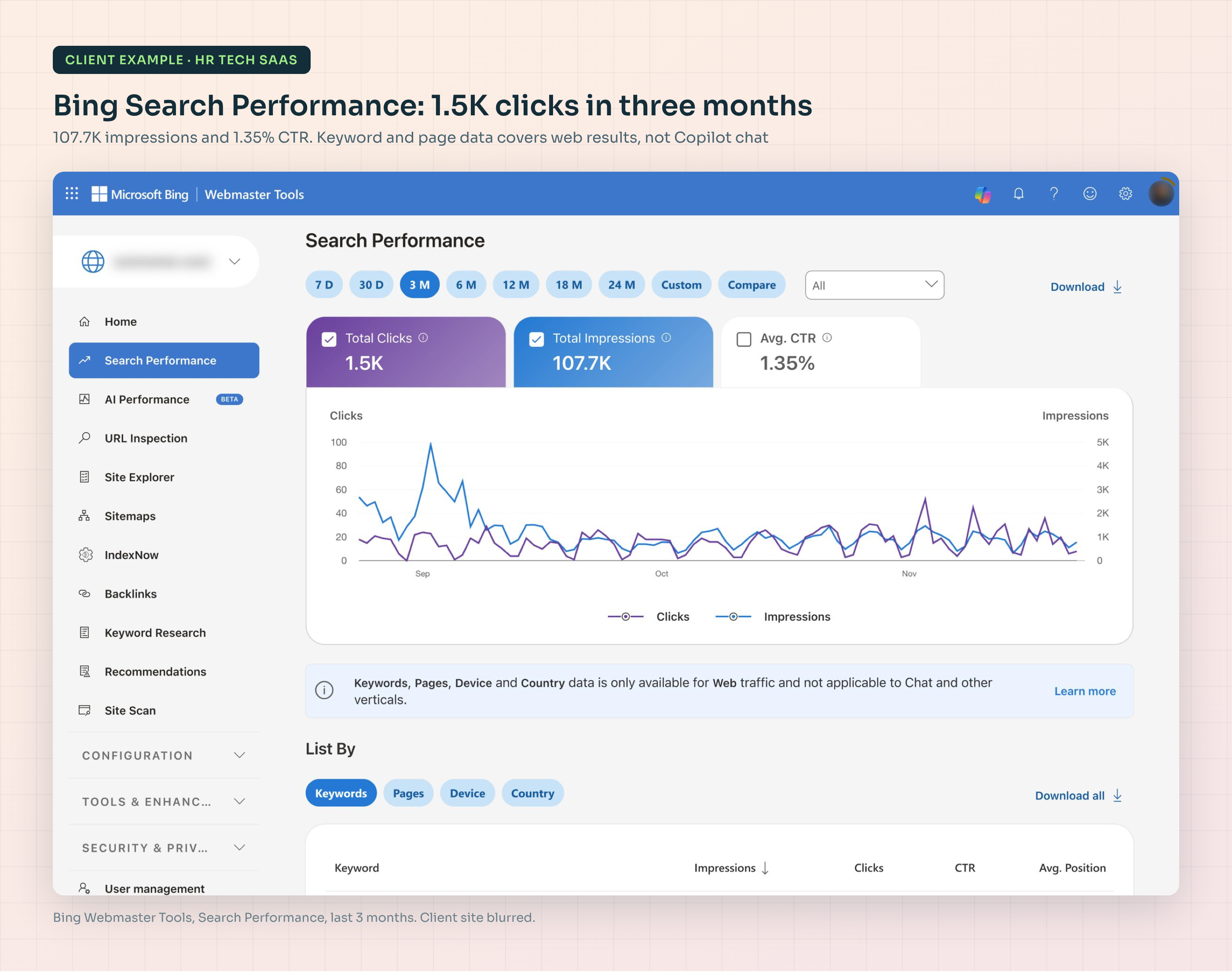
That last report deserves its own section, because it’s the reason Bing Webmaster Tools moved from “someone should set this up” to a standard part of our monthly client reporting.
The AI Performance report: what Copilot actually cites
When you open AI Performance in Bing Webmaster Tools, you see how your site shows up as a source in AI-generated answers across Microsoft Copilot, AI summaries in Bing and select partner integrations. The main metrics are:
- Total citations: how many times your pages were shown as a source in AI answers in the selected period.
- Average cited pages: how many of your pages were cited per day, on average.
- Grounding queries: a sample of the search queries the AI used to retrieve your content.
- Page-level citations: which URLs get cited most.
- Intents, topics, citation share and compare (added June 2026): grounding queries grouped by intent (informational, commercial, research, “learn and solve” and more) and by topic, your share of all citations for a grounding query, and a period-over-period view.
What we learn from it across our clients
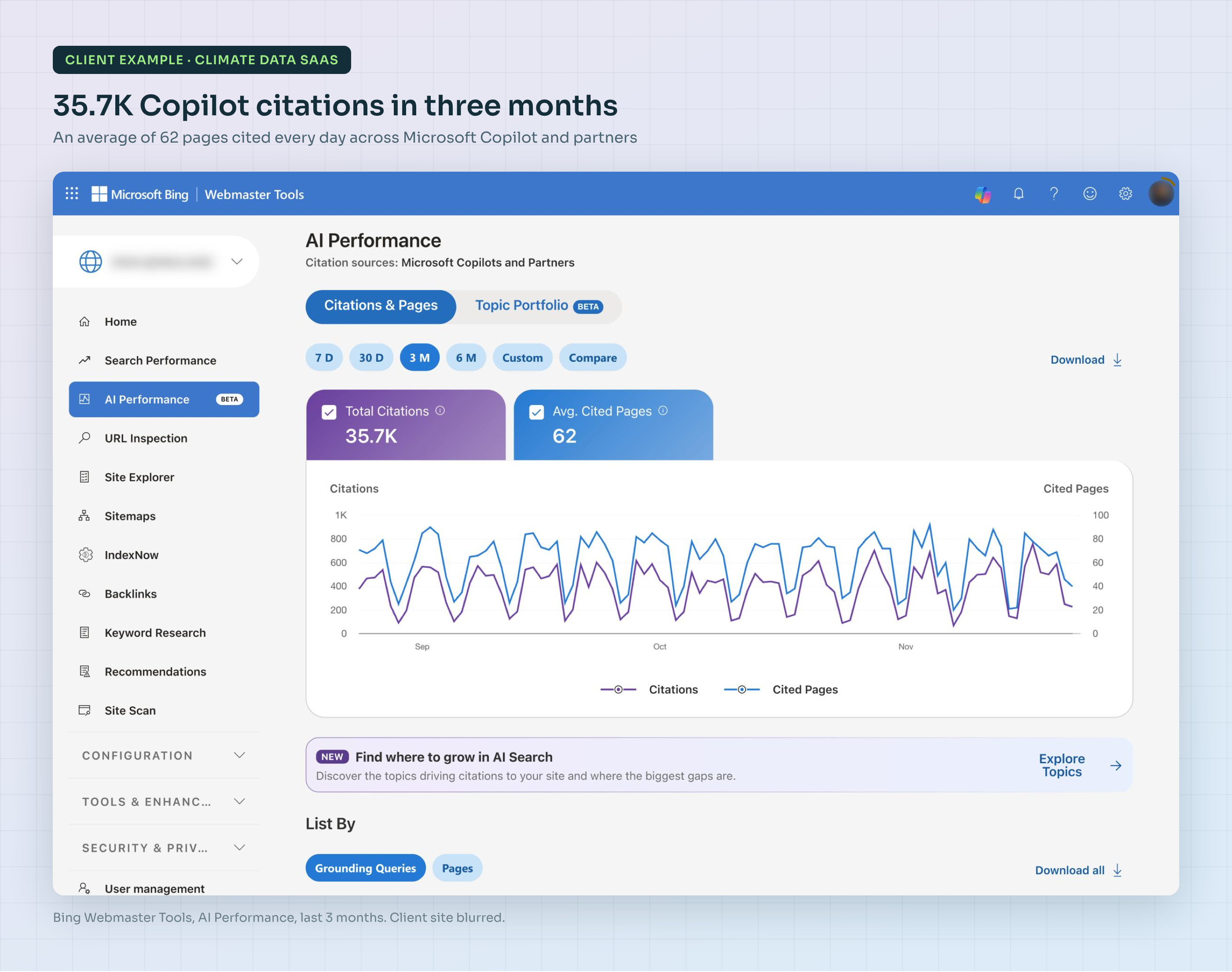
We’ve had AI Performance in our client reports since the start of 2026, and two clients show the patterns especially well: a climate data SaaS and an HR tech SaaS. Here’s what the report looks like for the climate data client over the last three months: 35,700 citations, with an average of 62 of its pages cited every day.
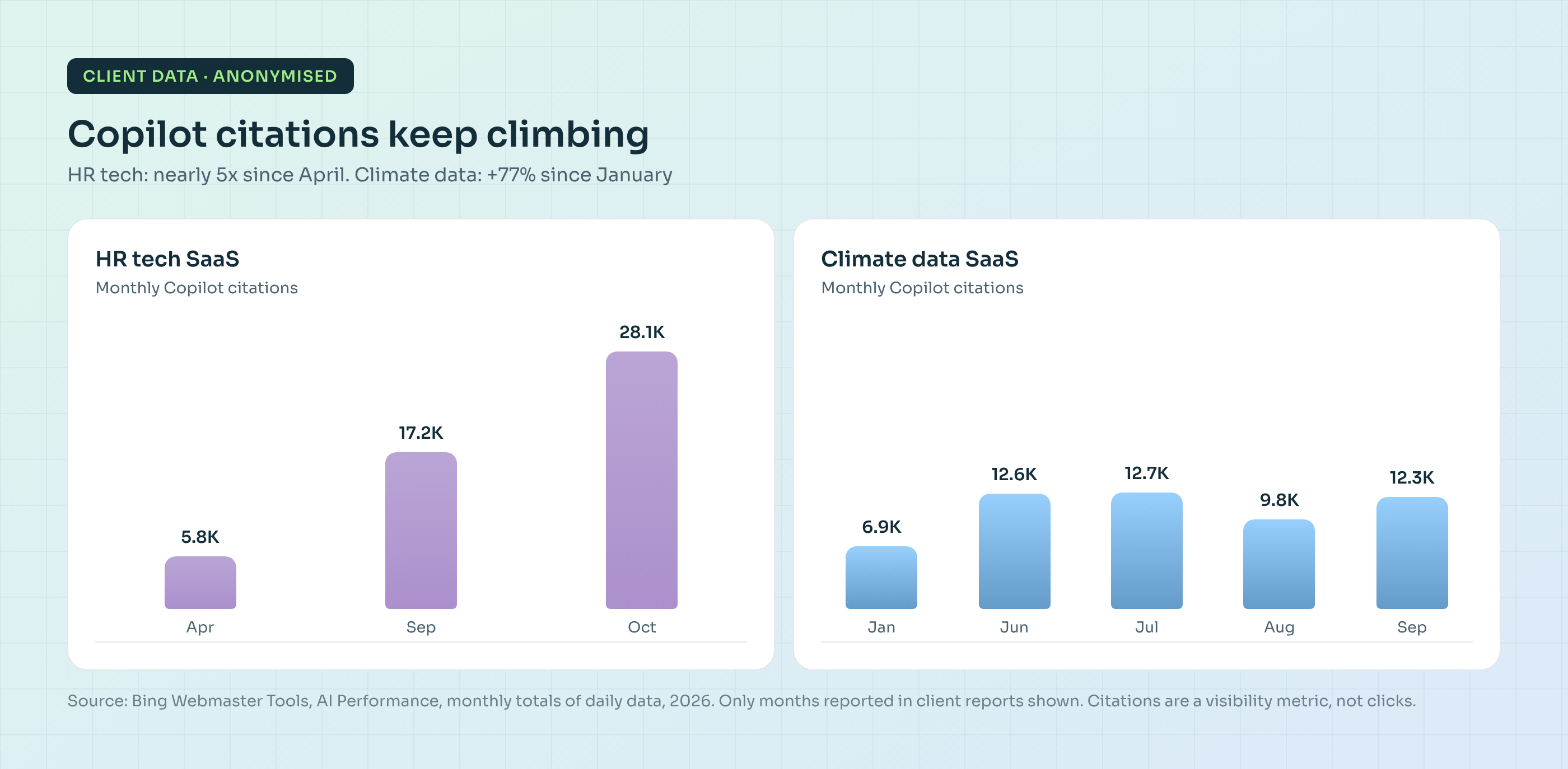
Citations grow fast once the basics are right. For the HR tech SaaS, monthly Copilot citations went from 5,791 in April to 28,100 in October, almost five times as many, and the number of pages cited per day nearly doubled from 27.6 to 54.3. For the climate data SaaS, monthly citations grew 77% between January and September 2026, and Copilot cited their pages 379 times a day in Q3, up from 320 in Q2.
Listicles and in-depth guides do the heavy lifting. For the HR tech client, a single “best software” roundup on their blog earned 9,780 Copilot citations in one month, more than a third of the total. For the climate data client, the most cited pages are all educational blog explainers, each cited 1,100 to 1,500 times in three months. Not the homepage, not the pricing page.

Grounding queries show you real user queries you’d never find in a keyword tool. The Grounding Queries list shows each query with its intent, topic, number of citations and your citation share. For the climate data client, the top queries are short educational topics labelled “Informational”, where it holds 10% to 25% of all citations, while branded product queries hold about 66%. One of the top queries is in Chinese, a “what does it mean” question about a core climate concept, and the client holds a quarter of the citations for it. That’s their localised content at work: translated explainers get cited in their own language.

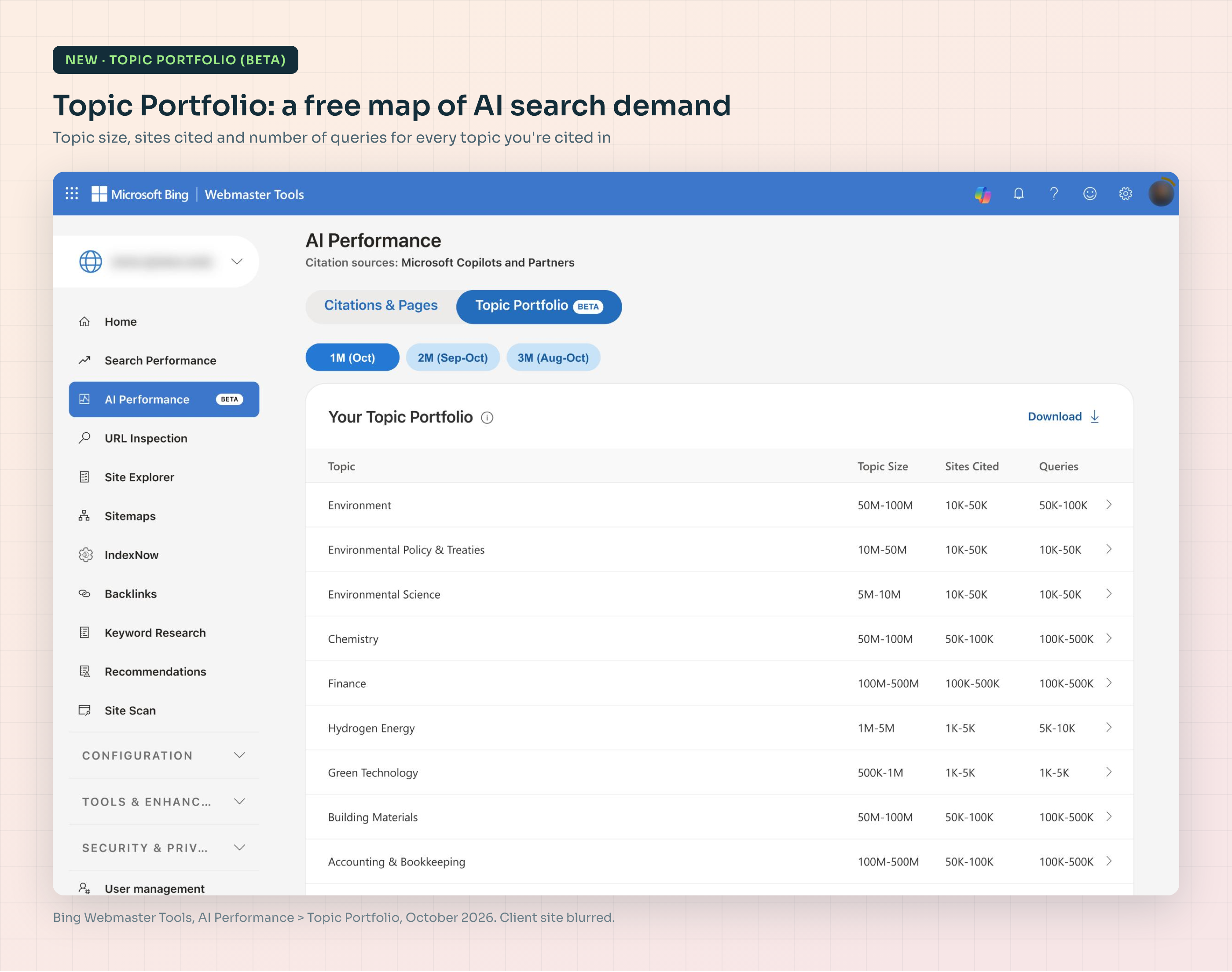
Topic Portfolio shows where to grow next. Microsoft added a Topic Portfolio view in beta in October 2026. It groups your citations into topics and shows how big each topic is, how many sites get cited for it and how many queries sit behind it. For content planning, it’s the closest thing to an AI search demand map you’ll get for free.
Big site changes show up immediately. Citations react to launches, migrations and content freezes within days. For a retail tech client, daily citations peaked at 635 on the day of its website relaunch.
So Copilot is clearly reading these sites. The next question is what you can do on the page itself to rank better on Bing and get picked as a source more often.
On-page SEO for Bing: be explicit
This is where optimising for Bing differs most in day-to-day work. Because relevance comes first in Bing’s ranking parameters, the biggest on-page win is removing ambiguity. Bing tends to reward pages that say very clearly what they are about, so make its job easy.
Here’s the formula we use for every page we want to rank on Bing:
- Put the primary keyword in the title tag and H1. Bing focuses on exact match keywords more than Google does, so use them where they read naturally. “Bing SEO Guide: How to Rank on Bing in 2027” beats a clever title that never says “Bing SEO”.
- Write a meta description that matches the page. Bing still uses meta descriptions for snippets, and they shape CTR. Meta keywords are ignored, so skip them.
- Answer the question in the first 100 to 150 words. This helps engagement and gives Copilot a clean passage to quote.
- Write H2s and H3s that sound like real questions. “How does Bing rank pages?” is better than “Important things to know”.
- Use synonyms and related entities naturally: Bing Webmaster Tools, IndexNow, Copilot, Bingbot. That’s how you show topical depth without repeating one phrase.
- Add a TL;DR, comparison tables and an FAQ. Scannable structure helps readers, and AI systems extract tables and short answers well.
- Use descriptive alt text and file names on your own images and screenshots.
- Link internally with meaningful anchor text, from related articles to the page you want to rank, and from that page to your product and service pages.
High quality content still does the heavy lifting
None of this replaces high quality content. Keyword optimization helps Bing understand the page, but Bing’s algorithm also weighs reputation and the level of discourse, so thin pages stuffed with exact match keywords won’t hold. You also don’t need lists of “LSI keywords”: latent semantic indexing isn’t how modern search engines work. Cover the topic properly, answer the follow-up questions a buyer would ask, and the relevant terms show up on their own.
Freshness: update for real
Freshness is one of Bing’s six named parameters, but “fresh” should mean accurate, not a new date on an old page. For B2B SaaS that means updating pricing, product screenshots, integrations, statistics and competitor details when they change, keeping lastmod honest, and pinging IndexNow when a meaningful update goes live.
Structured data: helpful, not magic
Schema helps Bing understand what a page is, who wrote it and which company is behind it. For a SaaS site we prioritise Organization, Article or BlogPosting with a Person author, BreadcrumbList, FAQPage (only when the questions are visible on the page) and SoftwareApplication or Product on product pages. Don’t mark up content users can’t see. Bing’s guidelines warn that manipulative practices can lead to lower rankings, less visibility in AI grounding or removal from the index.
Page speed, mobile optimisation and engagement
Page load time is a ranking parameter, and mobile optimisation matters even though most B2B Bing traffic is desktop, so treat Core Web Vitals as Bing work too: compress images, lazy-load media, cut render-blocking scripts. And because engagement counts, make sure what’s above the fold matches the promise in your title. Cookie banners, chat widgets and demo pop-ups that cover the answer cost you on both engines.
Good on-page work gets you ranked. Getting cited in Copilot needs one more layer.
How to get cited in Copilot
Think of Copilot optimisation as Bing SEO plus extractability. Copilot can only cite pages that are in its candidate pool, so the order matters: indexed first, ranking second, quotable third.
- Get the page indexed in Bing and check it in URL Inspection.
- Rank it for the cluster of queries around the topic, not one keyword.
- Make the answer clear and factually precise, close to the top and in short, self-contained passages.
- Back claims with evidence: your own data, named sources, dates.
- Use structured data where it fits.
- Keep the page up to date.
- Track it in the AI Performance report and adjust based on grounding queries.
What does a quotable passage look like? Something like this:
Two sentences, specific, verifiable, no fluff. That’s the kind of passage an AI system can lift and attribute to you.
One honest warning: nothing guarantees a Copilot citation. Bing says citation volume moves with user demand, content freshness, model updates and topic shifts. Schema and structure improve your chances. They don’t buy you a place.
Do social media signals matter on Bing?
Many Bing SEO guides list social signals as a ranking factor, usually based on older Bing statements. Microsoft’s current list of ranking parameters doesn’t name them, though.
Third-party pages matter on Bing too
Copilot doesn’t only cite your own website. For “best X software” and “X alternatives” questions, it often cites third-party listicles and reviews. That’s why off-site work matters: authoritative backlinks, backlink quality over volume, site authority built on relevant sites, natural anchors (avoid exact match anchor text at scale) and mentions on relevant, credible sites help Bing’s quality and relevance signals and get your product into the pages Copilot reads. We cover how we run that in our guide to SaaS link building.
What about local SEO on Bing?
Most B2B SaaS companies don’t need much local SEO, but if you have offices or run events, claim your listing in Bing Places (you can import it from your Google Business Profile) and keep your company details consistent across local directories. That’s enough.
Now, how do you know if any of this is working? You need a scorecard that covers both classic search and AI answers.
How to measure Bing SEO efforts
Here’s the KPI set we use in our monthly client reports. It mixes traditional search metrics and user engagement metrics with the new AI ones, and it always ends with business outcomes.
And here’s what those numbers looked like for three of our clients in their latest reports:
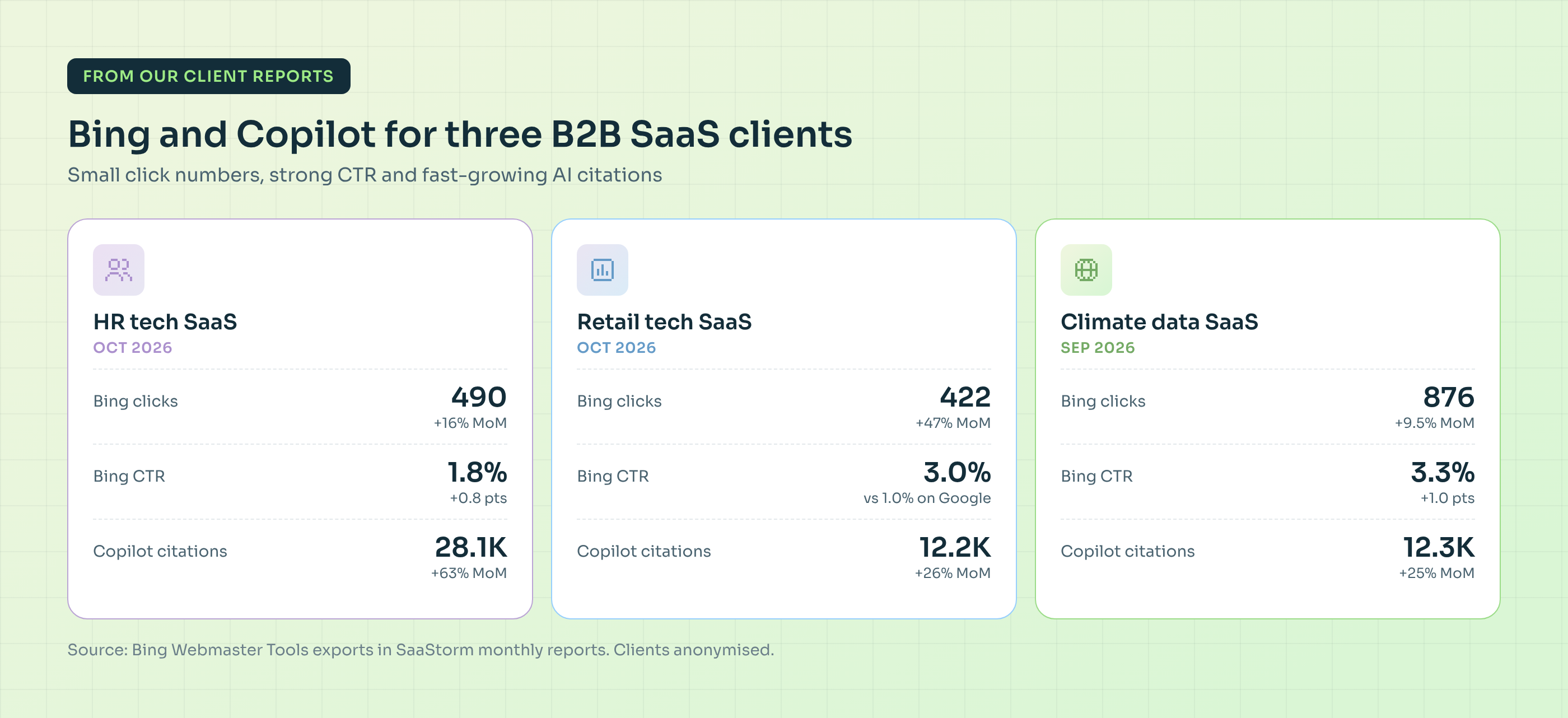
Look at the click numbers and you’ll see Bing search traffic isn’t going to replace Google for any of these companies. But it’s not just traffic. For the retail tech client, Bing touched 6 of 48 organic SQLs this year, and for the climate data client, Google and Bing organic together produced 51% of verified sign-ups in one month. Small channel, real buyers.
If you want to connect these numbers to revenue, our guide to SEO attribution explains how we tie organic and AI search to pipeline in the CRM.
Before the plan, a quick list of the mistakes we see most often, because most of them are easy to fix.
Common Bing SEO mistakes
These are the ones we find again and again when we audit a SaaS site for Bing:
- Assuming Google rankings carry over to Bing. Check Bing separately.
- Never setting up Bing Webmaster Tools, so you have no idea what Bing has indexed or what Copilot cites.
- Treating Bing as a low-priority extra while ignoring its role in Copilot visibility.
- Faking freshness with cosmetic edits and inaccurate lastmod dates.
- Blocking Bingbot by accident with crawl-delay, firewall rules or bot protection that only allowlists Googlebot.
- Over-optimising exact-match keywords. Explicit is good; stuffed is not.
- Reporting AI citations as traffic or rankings. They’re a visibility signal, and Bing says so itself.
- Skipping technical SEO basics: broken redirects, JavaScript-only content and slow templates hurt you on Bing just as much.
- Publishing generic AI content with no first-hand data, authors or sources.
All of these come up in our audits. Here’s the order we fix them in.
A 90-day Bing SEO plan
This is the plan we run when we add Bing to a client’s SEO programme. Most SEO strategies are built for Google only; this one closes the Bing gap without starting over.
Days 1 to 14: foundation. Verify the site in Bing Webmaster Tools (import from GSC), submit sitemaps, switch on IndexNow, crawl the site, fix blocked pages, redirect chains and server errors, and check the 20 most commercially important URLs in URL Inspection.
Days 15 to 45: content and relevance. Review your top Bing queries and pages. Tighten titles, H1s, intros and internal links on priority pages. Consolidate thin or overlapping pages. Upgrade six to ten priority pages with direct answers, comparison tables, FAQs, original images and sources, plus the right schema.
Days 46 to 75: authority and engagement. Earn relevant links and mentions on the sites your buyers and Copilot read. Improve page speed on high-traffic templates. Refresh outdated cornerstone content. Rework titles where CTR is weak.
Days 76 to 90: AI visibility. Review AI Performance: which pages get cited, which grounding queries you appear for, and where your citation share is low. Add clearer answers and data to pages with impressions but few citations. Create new pages for valuable grounding queries you don’t cover. Add Bing and Copilot to your monthly report.

The bottom line
Bing SEO in 2027 isn’t a watered-down version of Google SEO. It’s how you get found by buyers who work inside Microsoft every day, and it’s the foundation for showing up in Copilot. The work is not complicated: get indexed properly, make relevance explicit, keep pages accurate, write passages worth quoting, and measure citations next to clicks and pipeline. Bing isn’t the only index feeding AI answers: our Brave SEO guide covers the search engine behind Claude’s web search.
The teams that do this now get something rare in SEO, and in online visibility in general: a channel with less competition and first-party AI data to steer by. If your Bing Webmaster Tools account still doesn’t exist, that’s your first task for this week.
Want to know how your site shows up on Bing and in Copilot, and which grounding queries your competitors own? Talk to our team and we’ll walk you through your Bing and AI visibility data.
00:00
/
00:00
FAQs
How do I rank on Bing?

Get your site verified in Bing Webmaster Tools, submit your sitemap and switch on IndexNow so Bing can find your pages. Then make each page clearly relevant to one topic, with the main query in the title, H1 and intro, keep content accurate and up to date, make pages fast, and earn links and mentions from credible, relevant sites.
What are Bing’s ranking factors?
Microsoft lists six main ranking parameters, in general order of importance: relevance, quality and credibility, user engagement, freshness, location and language, and page load time. It says their weight can change by query and over time.
Is Bing SEO different from Google SEO?
The fundamentals are the same, but Bing responds more visibly to explicit relevance signals, names freshness and user engagement as ranking parameters, and relies more on sitemaps, lastmod and IndexNow for indexing. It also has its own index, so ranking on Google doesn’t mean you’re indexed or ranking on Bing.
Does Bing SEO help with Microsoft Copilot?
Yes. Copilot grounds its answers in Bing’s index, so a page that isn’t indexed or ranks poorly in Bing has a much smaller chance of being cited. You can track Copilot citations, cited pages and grounding queries in the AI Performance report in Bing Webmaster Tools.
What is IndexNow?
IndexNow is a protocol that lets your website notify Bing and other participating search engines as soon as a URL is added, updated or deleted. It speeds up discovery, but it doesn’t guarantee indexing: pages still have to meet Bing’s quality guidelines.
Does anybody use Bing anymore?
Yes. Bing holds about 15% of desktop search worldwide and in Europe (StatCounter, October 2026), it’s the default search engine in Edge and Windows, and it powers Microsoft Copilot’s answers. For B2B companies that sell into enterprises running on Microsoft, Bing traffic is often more valuable than its size suggests.
How long does it take to rank on Bing?
Bing Webmaster Tools data usually appears about 48 hours after verification, and with IndexNow new pages can be crawled within hours. Rankings take longer: for most B2B SaaS sites we see meaningful movement on Bing in two to three months, often faster than on Google for niche queries.



“SaaStorm became a key part of our inbound motion. Their SEO and content support helped us scale a consistent flow of high-intent traffic and build a content engine that supported £250K+ in inbound revenue. They plugged into our system and delivered every step of the way.”
Jonny Butler, Head of Marketing at OneUp
Related posts