Back to blog
SEO Attribution for B2B SaaS: Connecting Organic and AI Search to Pipeline

- SEO attribution is about evidence, not one perfect model. In B2B SaaS, it means connecting what you can observe (referrers, sessions, CRM source fields) with what buyers tell you, and reporting both honestly. No model can give organic search “the right amount of credit” if the data it needs never reaches your CRM.
- AI search broke last-click thinking. A buyer asks ChatGPT, double-checks in Claude, types your URL a few days later and books a demo. Your CRM says Direct or branded search, but the decision was made inside two AI answers. That’s why Direct keeps growing while organic search looks flat.
- The fix is mostly not technical. Map AI referrers (chatgpt.com, claude.ai, perplexity.ai, Gemini, Copilot) to their own CRM sub-source, add a required “How did you hear about us?” field to every form, have sales confirm the source on the first call, and analyse your call recordings for discovery stories.
- Self-reported attribution is the only signal for the no-referrer visit. Name the AI tools in the dropdown, store the buyer’s own words, and keep the answer next to the digital source, never instead of it. When the two disagree, you’ve found pipeline your dashboards were missing.
- Choose models by question. Use a stable original-source rule for monthly reporting, add an influence view and self-reported discovery, and keep one multi-touch model as a sensitivity check. Native HubSpot or Salesforce reporting is enough to start; Dreamdata or HockeyStack pay off once you have RevOps and long multi-stakeholder journeys.
- Report without double counting. Sourced, influenced and self-reported pipeline overlap, so show them as separate views and only add up sources that are mutually exclusive.
- It works. In our own HubSpot, AI-sourced deals went from zero before March 2025 to 20 in a single month in July 2026, AI-sourced SQLs from two to ten a month, and AI-sourced pipeline from €15K to €220K a month. The pipeline was always there. It was sitting in Direct.
Open HubSpot, filter your deals by original source and you’ll probably see the same thing we saw a year and a half ago: a big, growing pile of deals marked “Direct”. Nobody wakes up and types your URL out of nowhere. Those buyers found you somewhere, and in 2027 that somewhere is very often an AI assistant that never sent a referrer.
That’s the real SEO attribution problem for B2B SaaS today. It’s not a lack of attribution models or tools. It’s that a growing share of your organic and AI search demand lands in a bucket that says “already knew us”, while your CEO asks why organic traffic is flat and whether SEO still deserves its budget. That attribution gap hurts marketing and sales teams alike: marketing can’t prove which SEO efforts drive revenue, and the sales team can’t see what a buyer read or asked before the first call.
“Direct is not a channel. Direct is where you put the traffic you didn’t bother to explain.” – Romana Kuts, Founder at SaaStorm
In this guide, I’ll show you how we connect organic and AI search to pipeline for our clients and for SaaStorm itself: what SEO attribution can and can’t measure, why AI search changes the problem, the four sources of evidence we use (including self-reported attribution and sales calls), which attribution models and tools make sense at which stage, and how to report pipeline without double counting.
What SEO attribution measures (and what it doesn’t)
Before you set up a single report, it’s worth agreeing on what “SEO attribution” actually means, because most arguments about it come from people using the same words for different things.
Sourced, influenced, attributed and incremental
SEO attribution connects search activity to commercial outcomes in your CRM: leads, MQLs, SQLs, pipeline and closed-won revenue. But “SEO generated this deal” can mean four different things:
The first three are attribution questions. The fourth is an incrementality question, and no attribution model answers it on its own. That’s not a reason to give up on attribution. It’s a reason to label each number for what it is, so nobody in the boardroom mistakes influenced pipeline for SEO revenue.
In B2B attribution, the unit that matters is the deal, not the session. A B2B buying process involves a buying committee of multiple stakeholders, a long sales cycle and dozens of marketing touchpoints, so the customer journey rarely fits into a single click path.
Channel versus content
There’s one more distinction most SEO reporting skips. “SEO influenced this deal” can mean the buyer arrived through organic search, or it can mean the buyer read an article your SEO programme created, even though they clicked it in a sales email. The first is channel contribution. The second is content contribution. Both matter, and both deserve their own view rather than one blended “SEO revenue” number.
First touch is not first discovery
HubSpot defines a contact’s first interaction as the first one it recorded, usually a website visit. That’s a measurement boundary, not proof that nothing happened earlier. If a buyer heard about you in ChatGPT three weeks before their first visit, first-touch attribution will never know. Keep that in mind every time someone says “but first touch says it was Direct”.
That last point is exactly where AI search comes in.
Why AI search breaks B2B marketing attribution
Classic B2B marketing attribution assumed a buyer’s journey left a trail of clicks and that the sales cycle started with a tracked visit. AI search removed most of the clicks, and with them most of the trail.
The invisible buyer journey
Here’s a journey we hear about on sales calls every week:
- A Head of Marketing on a B2B marketing team asks ChatGPT for the best tool in your category for a team like theirs. Your name is in the answer. No click.
- They double-check in Claude. You show up again. Still no click.
- A few days later they open Chrome and type your company name into the address bar, or Google it.
- They fill in the demo form and show up on the call already half-convinced.
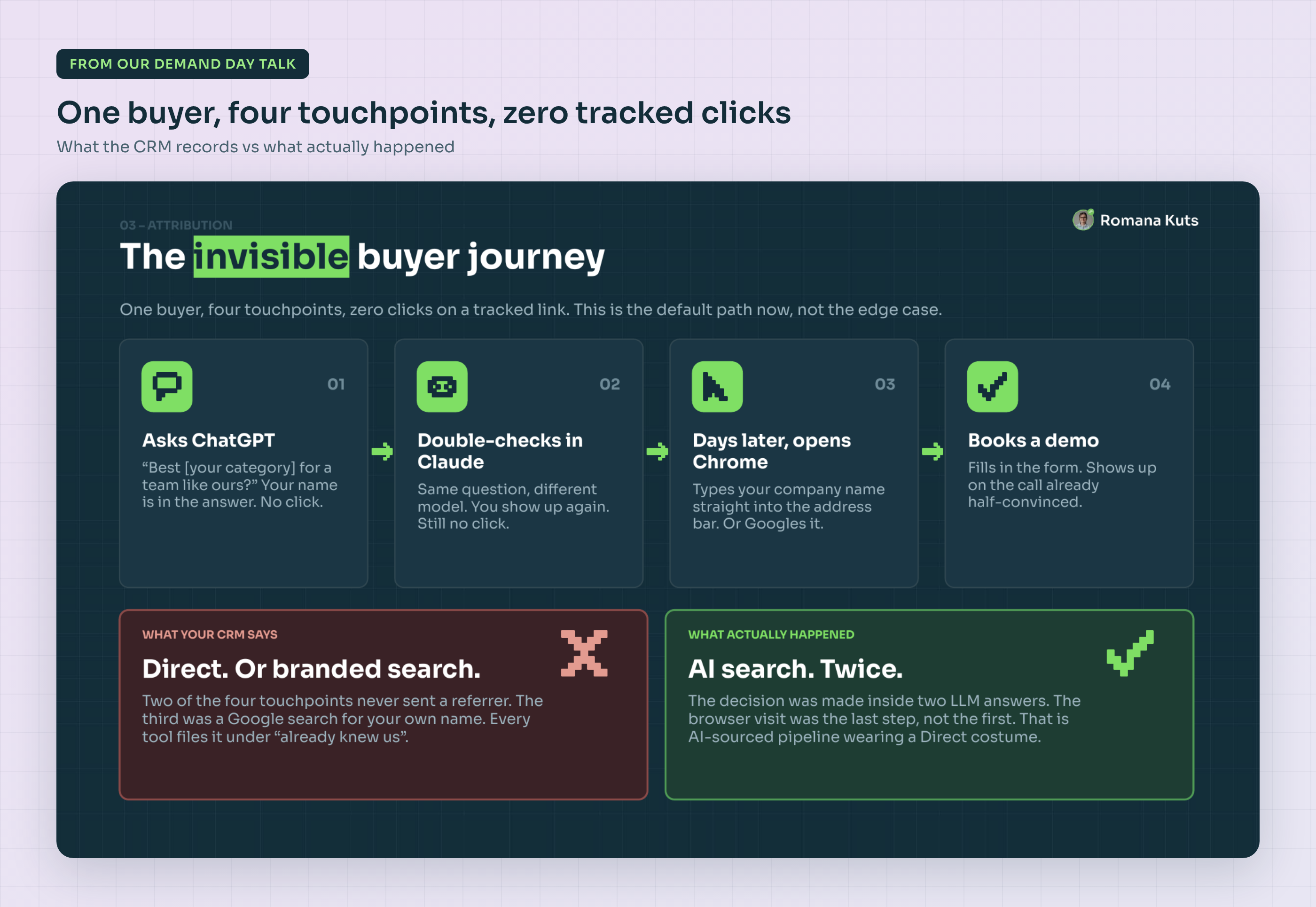
Your CRM records that deal as Direct or branded search. Two of the four touchpoints never sent a referrer, and the third was a search for your own name, so every tool files it under “already knew us”. What actually happened is AI search, twice. The browser visit was the last step, not the first. That’s AI-sourced pipeline wearing a Direct costume.
A crawl is not a citation, a citation is not a visit
AI search also produces new kinds of data, and it’s easy to treat them as if they measure the same thing. They don’t:
A crawl is not a citation. A citation is not a visit. A visit is not pipeline. AI visibility tools such as Scrunch, Google’s new generative AI reporting in Search Console and Bing’s AI Performance report are valuable, but they measure visibility. They belong in your visibility dashboard, not in your revenue ledger.
When Direct grows and organic looks like it’s falling
This isn’t theoretical. One of our sales-tech clients saw direct traffic grow while organic search looked like it was dropping. On paper, SEO was getting worse. Once we added self-reported attribution and AI sub-sources in their CRM, the picture flipped: AI assistants, Claude in particular, were driving around 70% of their AI-sourced pipeline. The demand had always been there. It had just been landing in Direct.
Here’s what their deals look like now that search engines and AI search are tracked as separate sources in HubSpot:
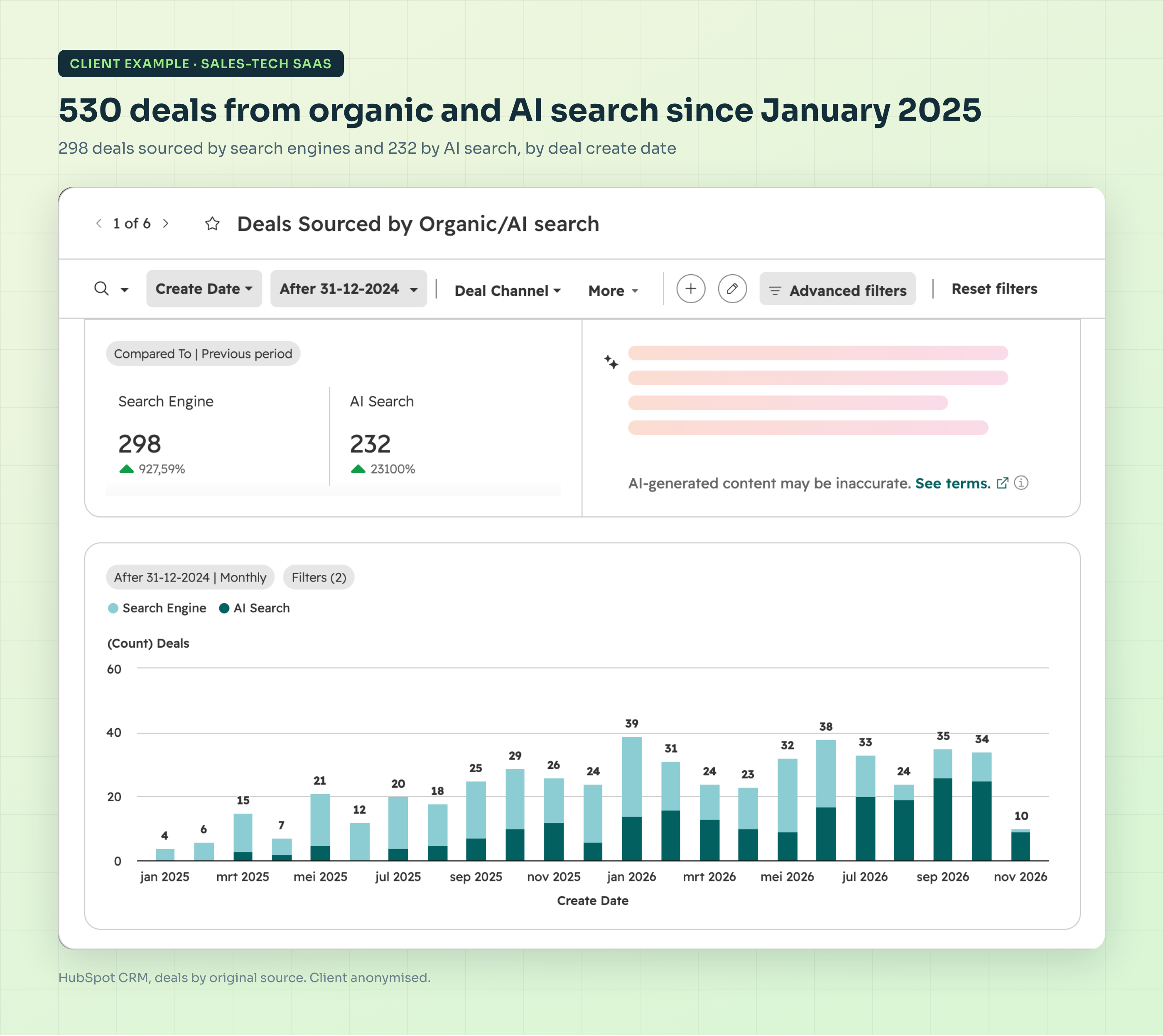
If they had judged SEO on Google sessions alone, they would have cut the channel that was becoming their biggest source of deals. So how do you get that pipeline out of Direct?
The four sources of evidence we use to connect search to pipeline
There’s no single tool that sees the whole journey. What works is combining four kinds of evidence, each covering a gap the others leave. None of them is very technical: setting up the first two takes an afternoon.
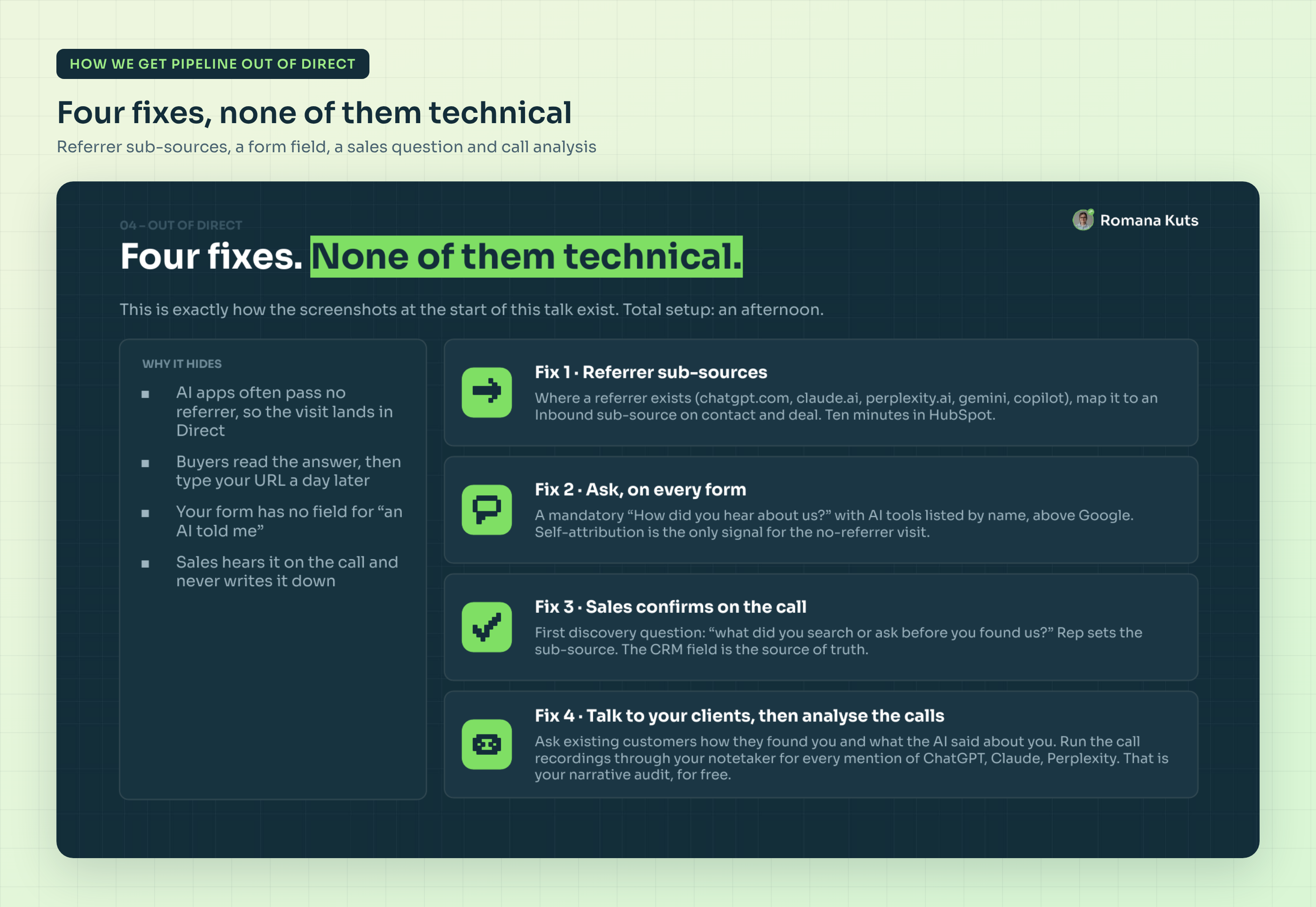
1. Referrer sub-sources in your CRM
Where a referrer does exist, capture it properly. Map visits from chatgpt.com, claude.ai, perplexity.ai, gemini.google.com and copilot.microsoft.com to an “AI search” source with the platform as a sub-source, on both the contact and the deal. HubSpot now has an AI Referrals category in its traffic sources, so start by checking what your CRM already classifies natively, then add the granularity you need. Keep the raw referrer and UTM values as well, so you can re-classify later when platforms change their tracking (ChatGPT’s UTM parameters briefly disappeared in October 2026, which made AI traffic look like it had dropped overnight).
This is how we track it at SaaStorm. Before March 2025, we had zero deals sourced by AI search. Not because there were none, but because we weren’t measuring them. Three months after we set up AI sub-sources, it was our fastest-growing source, and in July 2026 AI search alone brought 20 deals in a single month.

2. Self-reported attribution on every form
Referrers only capture the visits that send one. For the buyer who read an AI answer and typed your URL a day later, there’s only one way to find out: ask. That’s self-reported attribution, and it’s the single highest-impact change most B2B SaaS companies can make to their SEO attribution this quarter. More on how to set it up in the next section.
3. Sales confirms the source on the first call
Forms get skipped, answered in a hurry or filled in by an assistant. So the first discovery question on every sales call should be some version of “What did you search for or ask before you found us?”. The rep then sets or corrects the source in the CRM. That field, not the form answer alone, becomes the source of truth.
It also gives you something no dashboard can: the actual words buyers used, which prompts they typed, which competitors the AI listed next to you, and what it said you were good (and not good) for.
4. Analyse your call recordings
Most B2B SaaS teams already record their calls in Gong, Claap, Fathom or a similar tool, and most never look at those recordings again. They’re the best attribution data you own. We connect our call recordings to Claude and ask it to pull every answer to “How did you find us?”, plus every mention of ChatGPT, Claude, Perplexity or Google, across hundreds of calls. In a few minutes you get a list of real discovery stories, including the ones that never made it into the CRM.
When we did this across our own calls, the answers were a mix of LinkedIn, Google, referrals from people we’d worked with and, more and more often, “Claude recommended you”.
These four sources overlap, and that’s the point. When the referrer, the form and the call all say AI search, you can be confident. When they disagree, you’ve learned something about the journey.
Self-reported attribution: why it’s needed and how to set it up
Self-reported attribution is simply asking buyers how they found you, usually with a “How did you hear about us?” field on your demo or contact form. It sounds old-fashioned. In the AI search era, it’s become the most important field in B2B SaaS attribution.
Why software-based attribution can’t do it alone
Every attribution tool, from GA4 to HubSpot to Dreamdata, works with the touchpoints it can record. Online and offline touchpoints like AI conversations, podcasts, events, LinkedIn posts read on a phone or a colleague forwarding a Claude answer in Slack leave no cookie. These offline interactions are exactly what attribution systems miss. Software attribution tells you how buyers arrived. Self-reported attribution tells you why they came. You need both.
It’s also the cheapest attribution data you’ll ever collect, and one of the fastest ways to improve attribution accuracy. One form field, no tool, no implementation project. Your customer success team can ask the same question of existing customers, which gives you your own data on how paying customers found you.
How we set it up on our own website
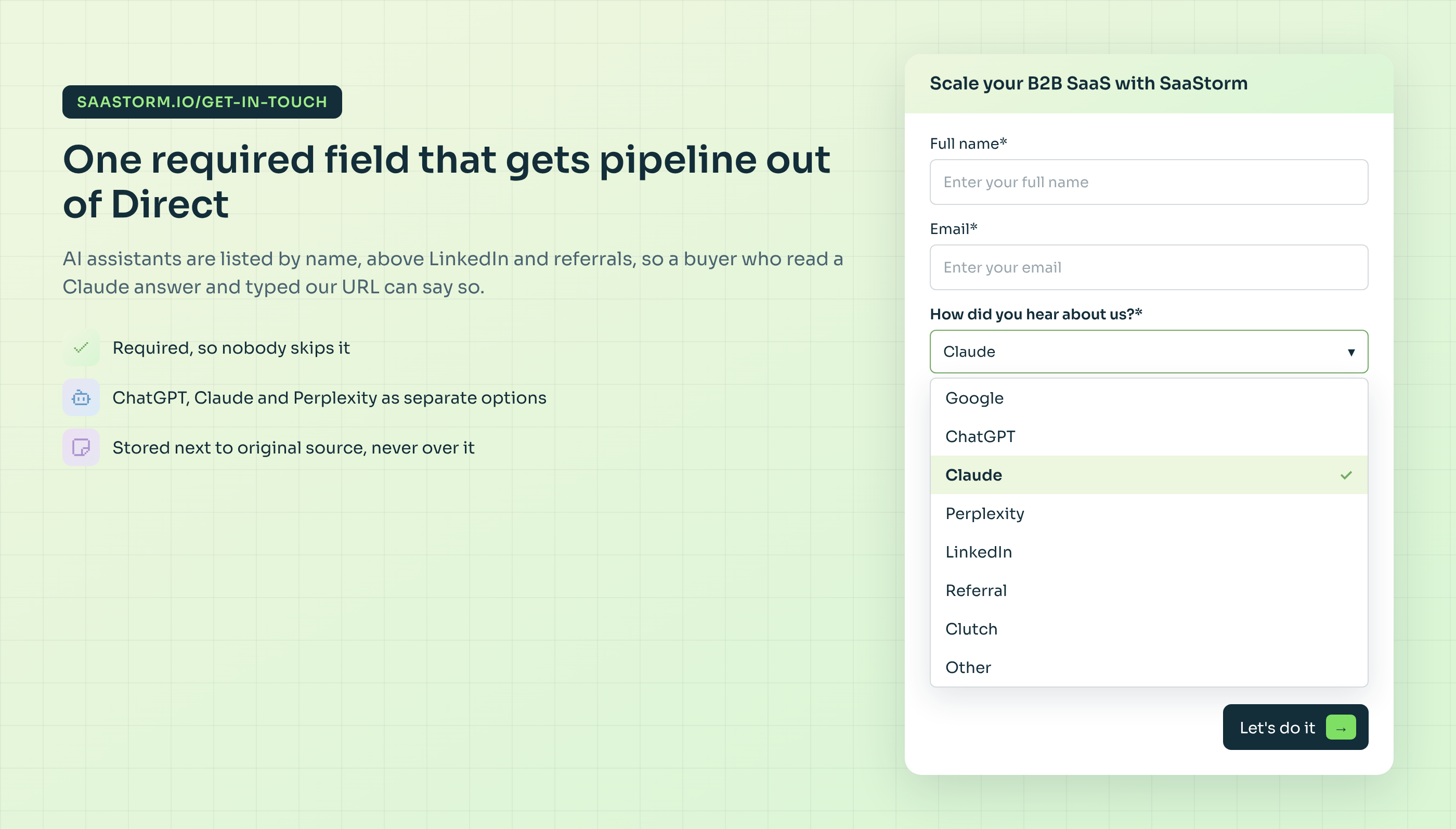
Here’s the field on SaaStorm’s own get-in-touch form. It’s mandatory, and it lists ChatGPT, Claude and Perplexity by name, right next to Google:
A few rules we follow, and recommend to clients:
- Make it required. An optional field gets skipped by exactly the buyers you most want to understand.
- Name the AI tools. List ChatGPT, Claude, Perplexity and Gemini as separate options. “AI tools” as one option hides which platforms actually work for you, and “Other” becomes a black hole.
- Keep the list short and balanced. Six to nine options plus “Other” with a free-text box. Don’t steer buyers towards AI by listing it first in bold.
- Ask about discovery and research separately if you can. “How did you first hear about us?” and “Which sources helped you evaluate us?” are different questions. One field often tries to capture both.
- Store the raw answer. Keep the buyer’s own words alongside a normalised value, so you can regroup later.
- Never overwrite the digital source. Store the self-reported answer in its own CRM property, next to original source, not instead of it.
When the form and the data disagree
They will, often. A buyer’s first recorded visit might be Google organic, while they report that a colleague sent them a ChatGPT recommendation. Neither is wrong; they describe different moments. One of our clients, a retail tech SaaS that tracks journeys in Dreamdata, put it well on a monthly review: they have a self-reported layer next to the tool, sometimes the two differ, “and that’s just how it is”. With 20 to 40 touchpoints in a B2B journey, buyers simply can’t remember everything.
The useful move is to read the two together:
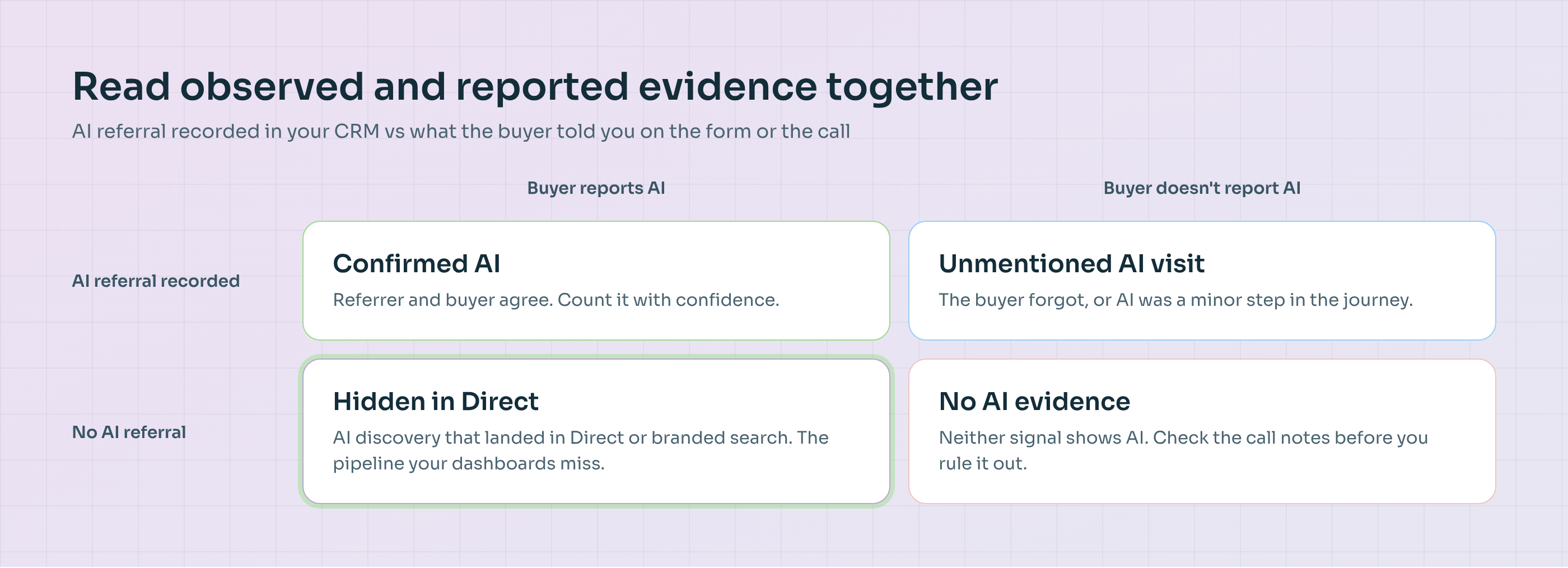
The bottom-left cell is the pipeline your dashboards are missing. In most accounts we work with, it’s bigger than the top-left one.
Once you have clean evidence, the next question is how to give credit across it.
Choosing an SEO attribution model
Every SEO attribution model, like every B2B attribution model, answers a slightly different question. The mistake is picking one model and treating its output as the truth, rather than as one view of it.
Single-touch models are simple but blind to most of the journey. Multi touch attribution models spread revenue credit across touches, which suits B2B better, but every one of these standard attribution models still assigns credit based on rules someone chose. So instead of hunting for the best attribution model, we recommend comparing different attribution models side by side. For most B2B SaaS companies, the right attribution model is really a simple bundle:
- A stable sourcing rule for accountability: original source on the deal, with AI search as its own source. This is the number you report every month.
- An influence view that shows how many deals had at least one organic or AI search touch, clearly labelled as overlapping.
- Self-reported discovery shown next to the digital source.
- One multi-touch model, such as W-shaped, as a sensitivity check. If search’s share changes dramatically between models, that’s worth explaining, not hiding.
And remember: no attribution model can fix missing data or make missing interactions visible. If AI discovery never reaches your CRM, a smarter model only distributes credit more precisely across the wrong data. Fix the evidence first, then choose the model.
The model also depends on the tools you have, which brings us to the stack.
The attribution tool stack: HubSpot, Dreamdata and HockeyStack
You don’t need an attribution platform to start. You need a CRM that records original source properly and reliable data on form submissions, deals and revenue. The right stack depends on your data maturity and how mature your RevOps set-up is.
HubSpot or Salesforce first
For most of our clients, HubSpot is where attribution lives, with Google Analytics feeding conversion data from the website and marketing automation platforms feeding email activity. Its native reports separate first interaction, lead creation, deal creation and closed-won touches, and they now recognise AI platforms as a traffic source. One thing to know: the full deal-create and revenue attribution reports are Marketing Hub Enterprise features, and they only work if deals are associated with the right contacts and have amount, create date and close date filled in. Missing associations look exactly like channel performance problems.
When Dreamdata or HockeyStack make sense
Dreamdata and HockeyStack are built for the problem native CRMs struggle with: complex customer journeys with long sales cycles, several people from the same account, dozens of touchpoints and multiple channels. They stitch website visits, ad platforms such as Google Ads and LinkedIn, emails, meetings, intent data and CRM stages into one account-level timeline. That’s account level attribution (sometimes called account based attribution): you can see that an article was read by three people at a target account before anyone booked a demo. Some teams add marketing mix modeling on top to judge their marketing investments, but that needs years of historical data and solid data infrastructure first.
Our most mature clients, mostly Series A and B companies with dedicated RevOps teams, use them, and it shows in their reporting. One retail tech SaaS we work with tracks organic influence in Dreamdata alongside sourced pipeline, which let us show how many sales-accepted leads organic search touched each month (three SALs worth €199K in a single month) even when the deal was ultimately sourced elsewhere.
But these platforms only add value on top of clean basics. Before you buy one, check whether your CRM already records original source, deal associations and amounts consistently. If it doesn’t, a new tool will give you better-looking charts of the same gaps.
Whatever stack you use, the hardest part comes when you put the numbers in front of leadership.
How to report pipeline without double counting
The most common way SEO attribution loses credibility is simple addition. Sourced, influenced and self-reported pipeline overlap, so adding them together inflates the result.
Here’s a made-up example. A SaaS company creates ten qualified opportunities worth €500,000 in new ARR:
- Organic search is the original source of four deals worth €180,000.
- AI referrals are the original source of one deal worth €40,000.
- Organic search influenced six deals worth €300,000.
- Buyers reported AI as their discovery source on three deals worth €160,000.
The company can’t claim that search generated €680,000 of pipeline. The honest version is:
Sourced numbers can be added up if the sources are mutually exclusive. Influenced and self-reported numbers stay as parallel views.
It also helps to report the trend, not only the total. These are the SQLs and the pipeline behind them that AI search sourced for SaaStorm itself, from the same HubSpot set-up described above:
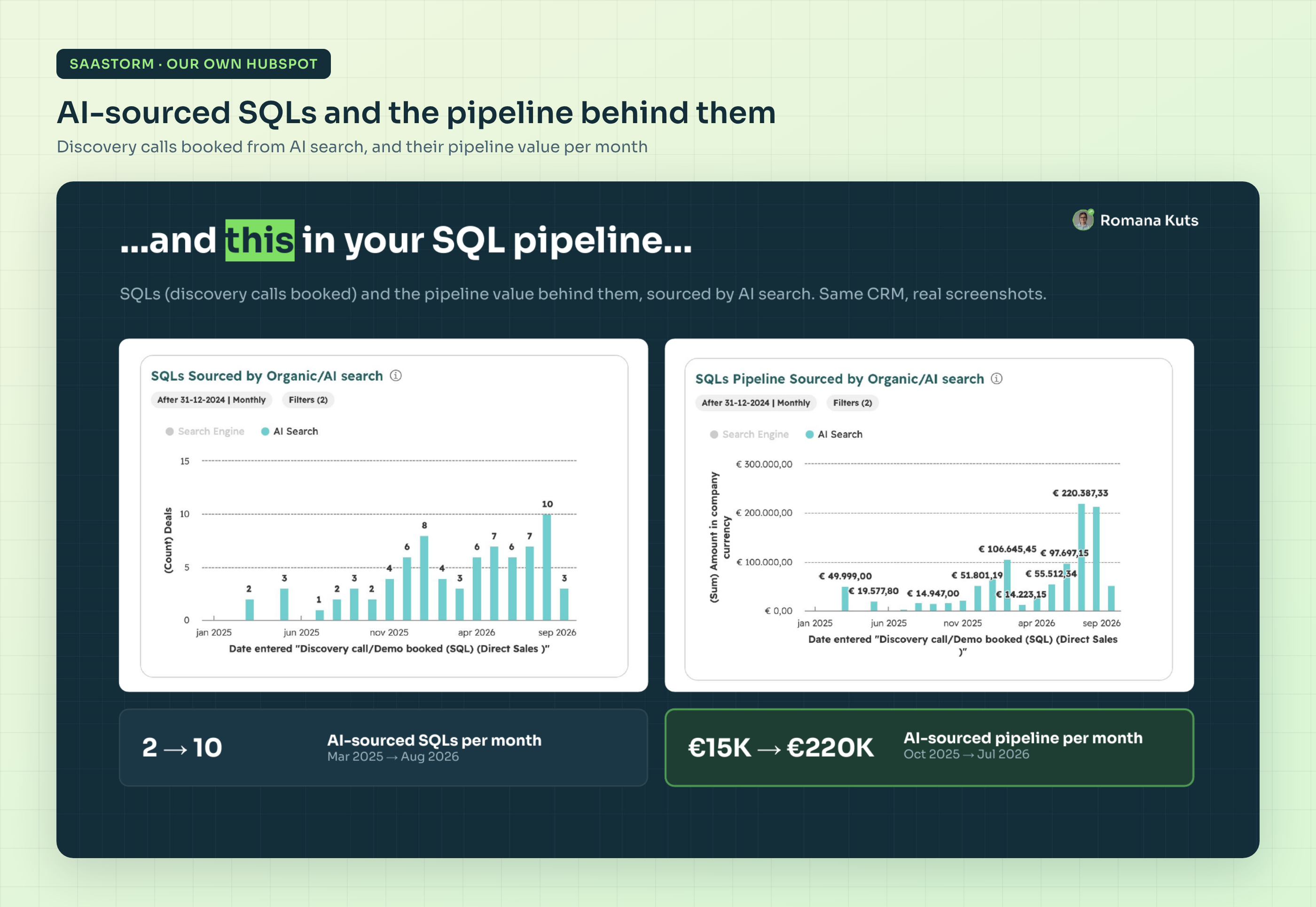
AI-sourced SQLs grew from two a month in March 2025 to ten a month by August 2026, and AI-sourced pipeline from €15K a month in October 2025 to €220K in July 2026. And because AI search has its own sub-sources on every deal record, we can see exactly which platform sent each closed-won deal:
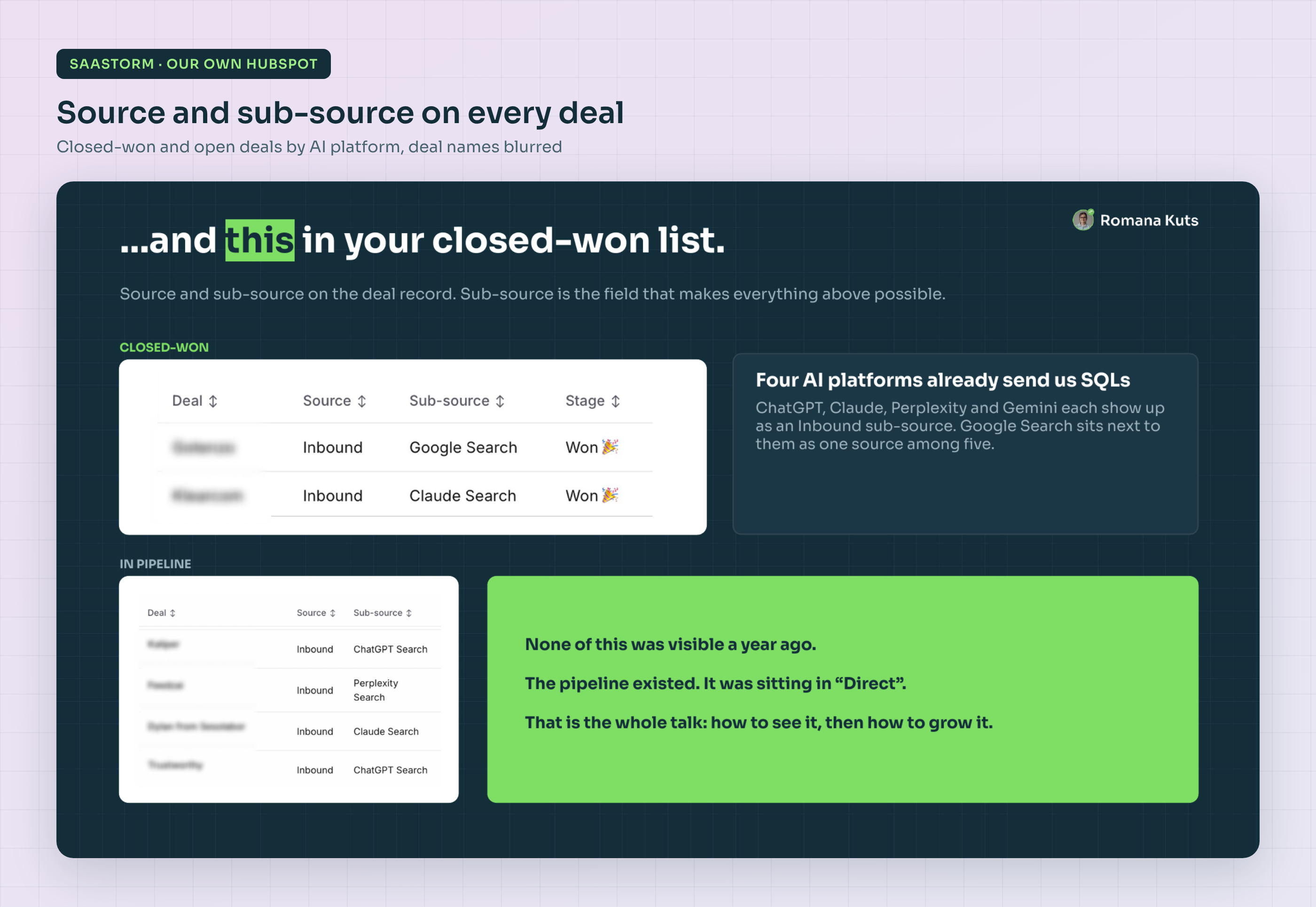
Our clients see the same shift once it’s measured. Introw, one of the companies that has shared its results publicly, describes it like this:
“AI search has been the biggest shift. AI assistants went from zero to the main driver within search, accounting for 71% of our search-sourced deals and 76% of our search-sourced demos in the third quarter of 2026.” – Stijn Provoost, Marketing Strategy & GTM Lead at Introw (Clutch review)
Two more reporting habits make attribution reporting far more trustworthy, and help you prove marketing’s contribution to revenue generated by search:
- Separate pipeline created this month from revenue closed this month. Deals closing today often came from content published a year ago. If you’re unsure how long that lag is for you, our guide to how long SEO takes breaks it down.
- Keep an “Unknown” category. Don’t let missing sources silently become Direct or Organic. A shrinking Unknown share is itself a sign that your attribution is improving.
Once the reporting is honest, you can use it to calculate a return. Our guide to SEO ROI for B2B SaaS shows how to turn sourced pipeline and ARR into an ROI figure your CFO will accept.
A 90-day SEO attribution set-up checklist
You don’t need a big project to fix SEO attribution. This is the order we follow with new clients, usually in the first three months after the discovery phase. It focuses on data collection and the sales process first, and marketing campaigns and the marketing funnel second:
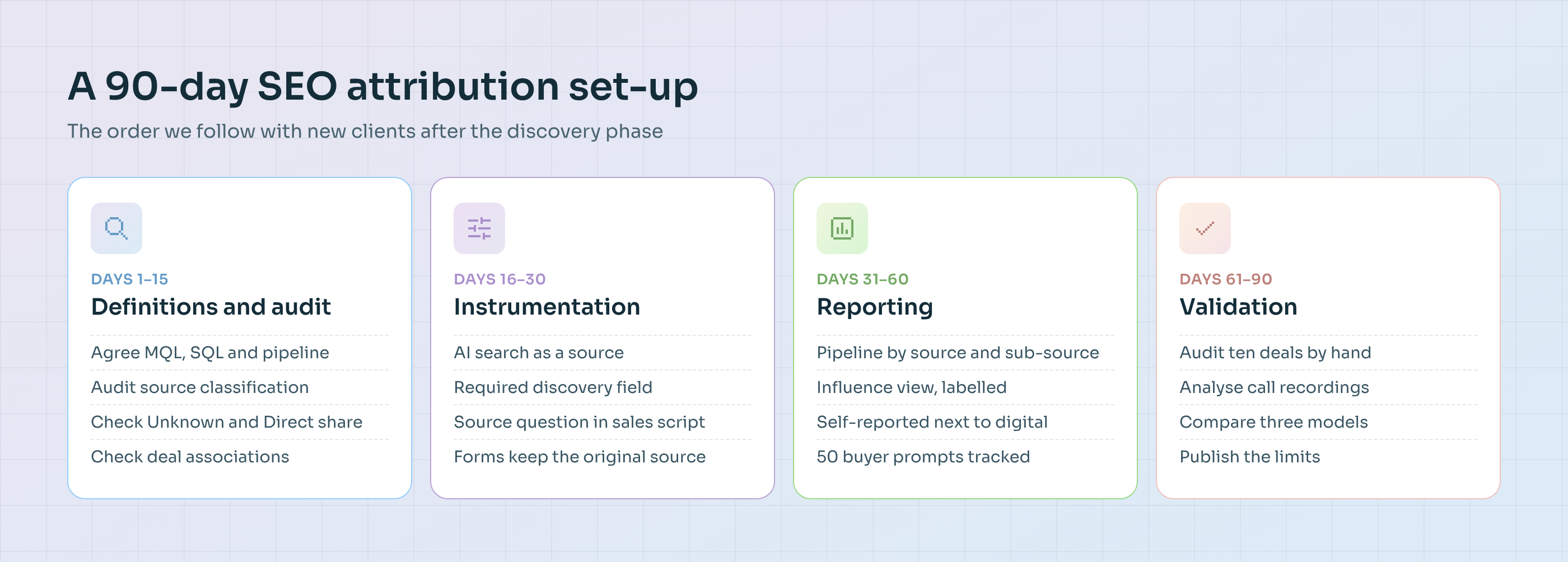
Days 1–15: definitions and audit
- Agree what counts as an MQL, SQL and pipeline, and which value you report (new-business ARR, not a mix of ARR and contract value).
- Check how your CRM classifies sources today, including AI platforms.
- Look at the share of deals with Unknown or Direct as their source.
- Check that deals are associated with the right contacts and companies.
Days 16–30: instrumentation
- Add AI search as a source, with ChatGPT, Claude, Perplexity, Gemini and Copilot as sub-sources.
- Add a required “How did you hear about us?” field to every demo, trial and contact form.
- Add the source question to your sales discovery script.
- Make sure scheduling tools and embedded forms don’t lose the original source.
Days 31–60: reporting
- Build reports for MQLs, SQLs, pipeline and won deals by original source and sub-source.
- Add an influenced-pipeline view, clearly labelled as overlapping.
- Put self-reported discovery next to the digital source.
- Track AI visibility for 50 real buyer prompts, grouped into topic clusters.
Days 61–90: validation
- Review ten recent deals by hand, from first touch to close.
- Run your call recordings through an AI tool to pull every discovery story.
- Compare first touch, last touch and one multi-touch model.
- Present the numbers with their limits written down.
Jimo is a good example of what this makes visible early on. With AI referrals tracked as their own source from the start, we could show that 17 of the 43 MQLs generated in the first seven months came from LLM referrals, and two of their first three new customers found them through AI assistants. Without that set-up, most of those MQLs would have looked like Direct.
The bottom line
SEO attribution and B2B attribution in general aren’t about proving that every euro of pipeline came from SEO. They’re about making the link between search and revenue clear enough to audit, compare and improve.
In practice, that means capturing AI referrers as their own source, asking every buyer how they found you, having sales confirm it on the call, listening to your recordings, and reporting sourced, influenced and self-reported pipeline side by side. Do that, and the deals hiding in Direct start showing up where they belong. In our case, that turned a channel we couldn’t see into our fastest-growing source of pipeline.
00:00
/
00:00
Want to see how much of your pipeline is hiding in Direct? Book a call with us, and we’ll show you how we’d set up attribution for organic and AI search in your CRM.
FAQs
What is SEO attribution?

SEO attribution is the process of connecting organic and AI search activity to business outcomes such as leads, MQLs, SQLs, pipeline and revenue in your CRM. In B2B SaaS, it combines recorded touchpoints (referrers, sessions, form fills) with buyer-reported evidence, because many AI search journeys leave no click to track.
Which attribution model is best for SEO?
There isn’t one best model. For B2B SaaS, use a stable original-source rule for monthly reporting, add an influence view and self-reported discovery, and use one multi-touch model such as W-shaped as a sensitivity check. If search’s credit changes a lot between models, report that rather than picking the most flattering one.
How do you track AI search traffic in your CRM?
Map visits from chatgpt.com, claude.ai, perplexity.ai, gemini.google.com and copilot.microsoft.com to an “AI search” source with the platform as a sub-source, on contacts and deals. Because many AI visits arrive without a referrer, add a required “How did you hear about us?” field that lists AI tools by name, and confirm the source on sales calls.
What is self-reported attribution?
Self-reported attribution means asking buyers directly how they found you, usually through a “How did you hear about us?” field on your forms or a question on the first sales call. It captures discovery that software can’t see, such as AI answers, podcasts, communities and word of mouth.
Why is so much of my B2B pipeline marked as Direct?
Because many buyers now discover vendors in AI assistants or other places that don’t pass a referrer, then type your URL or search your brand later. Analytics and CRMs file those visits as Direct or branded search. Self-reported attribution and sales-call confirmation are the most reliable ways to get that pipeline out of Direct.
Do I need Dreamdata or HockeyStack for SEO attribution?
Not to start. Most seed to Series A companies get what they need from HubSpot or Salesforce with clean source fields and a self-reported question. Dreamdata or HockeyStack make sense once you have a RevOps team, long multi-stakeholder sales cycles and enough volume to analyse account-level journeys across many channels.



“SaaStorm became a key part of our inbound motion. Their SEO and content support helped us scale a consistent flow of high-intent traffic and build a content engine that supported £250K+ in inbound revenue. They plugged into our system and delivered every step of the way.”
Jonny Butler, Head of Marketing at OneUp
Related posts