Back to blog
SEO Discovery Phase: How We Plan B2B SaaS Growth Before Publishing a Single Article


- Every SaaStorm engagement starts with an SEO discovery phase: a one-hour kickoff call, a two-week research sprint and a 90-minute presentation of the full strategy.
- In those two weeks, we research your whole keyword universe, map it into topic clusters and a prioritised content plan, audit your existing content, links and technical SEO, check your visibility in AI search, and build a forecast and three budget options tied to your revenue goals.
- Three senior people work on every discovery: me, our CMO, and the organic growth strategist who will run your account.
- You get two deliverables you keep, whatever you decide next: a detailed discovery workbook and a presentation deck.
- Because the strategy is ready before execution starts, we can start working from day one of the pilot – instead of spending your first paid month on "strategy".
When a B2B SaaS company signs with a new SEO agency, the first month usually goes on getting ready. The agency learns the product, does some keyword research, writes a strategy document and eventually starts producing content. You're paying a retainer, but nothing that moves rankings or pipeline happens for weeks.
We do it the other way round. Every SaaStorm engagement starts with a discovery phase: a short, high-intensity sprint where we do all the strategic work up front. By the time the retainer starts, the content plan, the priorities, the audits and the forecast are already done, so we can start executing straight away.
"Clients who started with a discovery phase have had so much better results than clients who didn't, simply because we could plan everything properly from the start and avoid cannibalisation." – Romana Kuts, Founder at SaaStorm
In this guide, I'll walk you through exactly how our SEO discovery phase works: what happens on the kickoff call, what we analyse in the two weeks, what you get at the end, what it costs and what happens next. It's written for Heads of Marketing, CMOs and founders at B2B SaaS companies who want to know what a proper discovery looks like – whether they work with us or not.
What an SEO discovery phase is (and why we never skip it)
Before getting into the steps, it's worth explaining what we mean by discovery, because the word gets used for anything from a sales call to a 50-slide audit.
For us, an SEO discovery phase is a fixed, two-week research project that turns your product, your market and your data into a complete organic growth plan. It covers SEO and AI search together: what to publish, in which order, what to fix on your existing site, which links to build, how visible you are in ChatGPT and other AI assistants, and what results to expect for the budget you have.
We never skip it, for three reasons. First, it prevents expensive mistakes, especially keyword cannibalisation – two of your own pages fighting for the same keyword – which is far easier to avoid in a plan than to fix later. Second, it means the content plan starts with bottom-of-funnel topics that buyers search for when they're close to a decision, not with whatever has the most volume. And third, it ties everything to revenue: the forecast and budget come out of your ARR goals, not out of a standard package.
So what does it look like in practice?
How our discovery phase works: kickoff, two weeks, presentation
The format is the same for every client, and it's deliberately simple. There are three steps, and you're only needed for two of them.
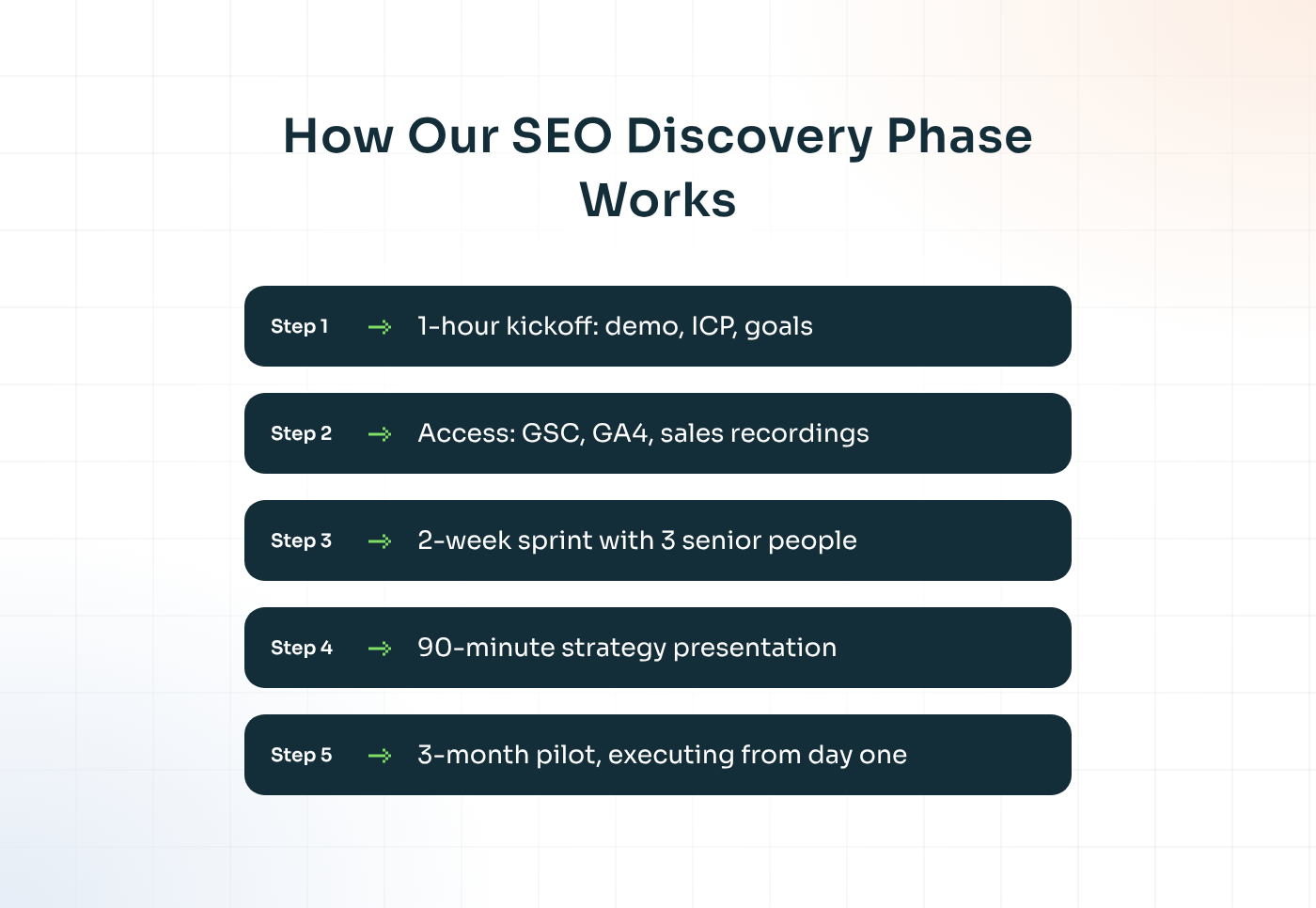
The kickoff call (1 hour)
Discovery starts with a one-hour kickoff call. You show us a product demo, and we ask about everything that shapes the strategy: your ICP and the customers you don't want, your industry and competitors, your positioning, your sales cycle, your revenue goals and what you've tried before.
After the call, we ask for three things. Ideally, some recordings of your sales calls, because they show us how your buyers actually describe their problems. Access to Google Search Console. And access to Google Analytics 4. That's it – we take it from there.
The two-week discovery sprint
Then we go away for two weeks and do the work. This is a high-intensity sprint, not a side project: I'm involved, our CMO is involved, and so is the organic growth strategist who will lead your account. That's three senior people on your strategy from the very first day.
We also use our own automations wherever they let us go deeper than manual work would. For example, we pull your Search Console data directly from BigQuery, which gives us far more queries and pages than the Search Console interface shows. The goal is simple: the most thorough analysis we can do in two weeks.
The presentation (90 minutes)
At the end of the two weeks, we come back with a 90-minute presentation. We walk you through every finding, the content plan, the audits, the forecast and the budget options, and answer your questions as we go.
If you have comments afterwards, or want us to quickly check something, that's covered once we're working together – we don't charge anything extra for it.
What we analyse during the two weeks
This is where most of the value sits, so it's worth going through each part. Every discovery covers the same ten areas, in roughly this order, because each one builds on the last.
1. Your business, ICP and positioning
We start with everything you've shared: the kickoff call, sales recordings, decks, documents and your website. From that, we write a brief covering your positioning, ICP, anti-ICP, personas, products, markets and main competitors. Every later decision – which keywords to keep, which topics to prioritise, how each article positions your product – goes back to this brief.
2. Your full keyword universe, bottom-up
Most keyword research starts with a few topic ideas and looks for keywords around them. We do it the other way round. We pull the whole keyword universe first, and only then group it into topics and clusters.
That universe comes from several sources at once: 30–50 seed terms covering your category, capabilities, use cases and personas; your competitors' rankings, including their blogs; keyword gaps where competitors rank and you don't; your own rankings and non-branded Search Console queries; brand patterns such as "alternatives", "vs", "pricing" and "reviews" for every competitor; and industry terms nobody else has surfaced yet.
Then we clean it. We remove navigational searches, job-seeker and consumer terms, keywords that only fit your anti-ICP, and suspicious "fake volume" keywords that look big but have no real buyers behind them. Finally, we collect volume and keyword difficulty for every market you sell into, so the plan reflects the US, the UK or wherever your buyers are.
3. Topics, clusters and the content plan
With a clean keyword set, we group keywords into topics. One topic is one article with one search intent: if Google would rank the same page for two keywords, they belong together. Every competitor gets an alternatives article, and every "A vs B" comparison is one article covering all its wordings. Topics then become clusters, usually somewhere between 7 and 25 for a SaaS company.
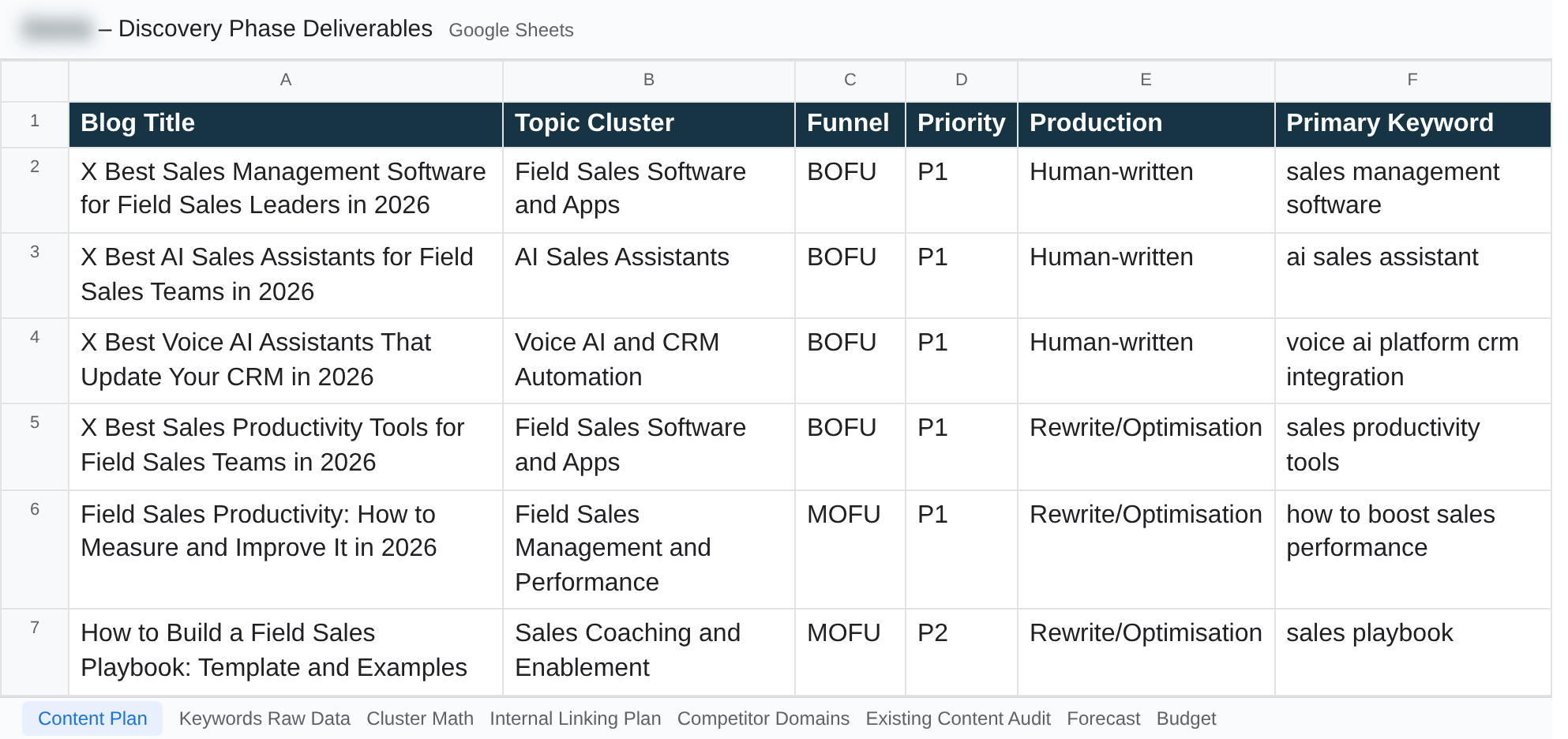
Here's what that looked like in a recent discovery for an AI sales assistant built for enterprise field sales teams: 182 topics across 14 clusters, researched across five markets, with more than 377,000 monthly searches in total. The client's name is blurred.
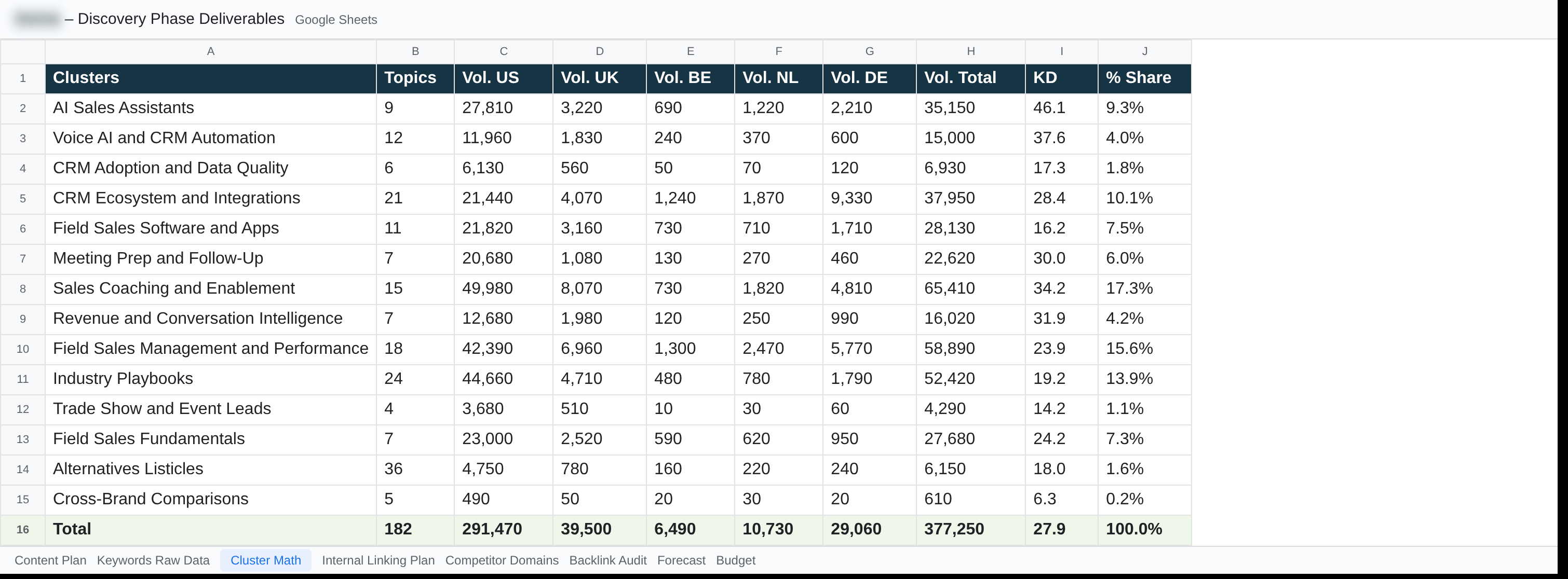
Every topic in the plan gets a title, the audience searching for it, their pain point in their own words, your product's role in the article, a funnel stage, a priority and a production type: human-written for high-value bottom-of-funnel and pillar pieces, AI-assisted with a human editor for the rest, and a rewrite for anything that already exists. We then pre-select the first months of the plan based on your budget, with priority topics and bottom-of-funnel content first.
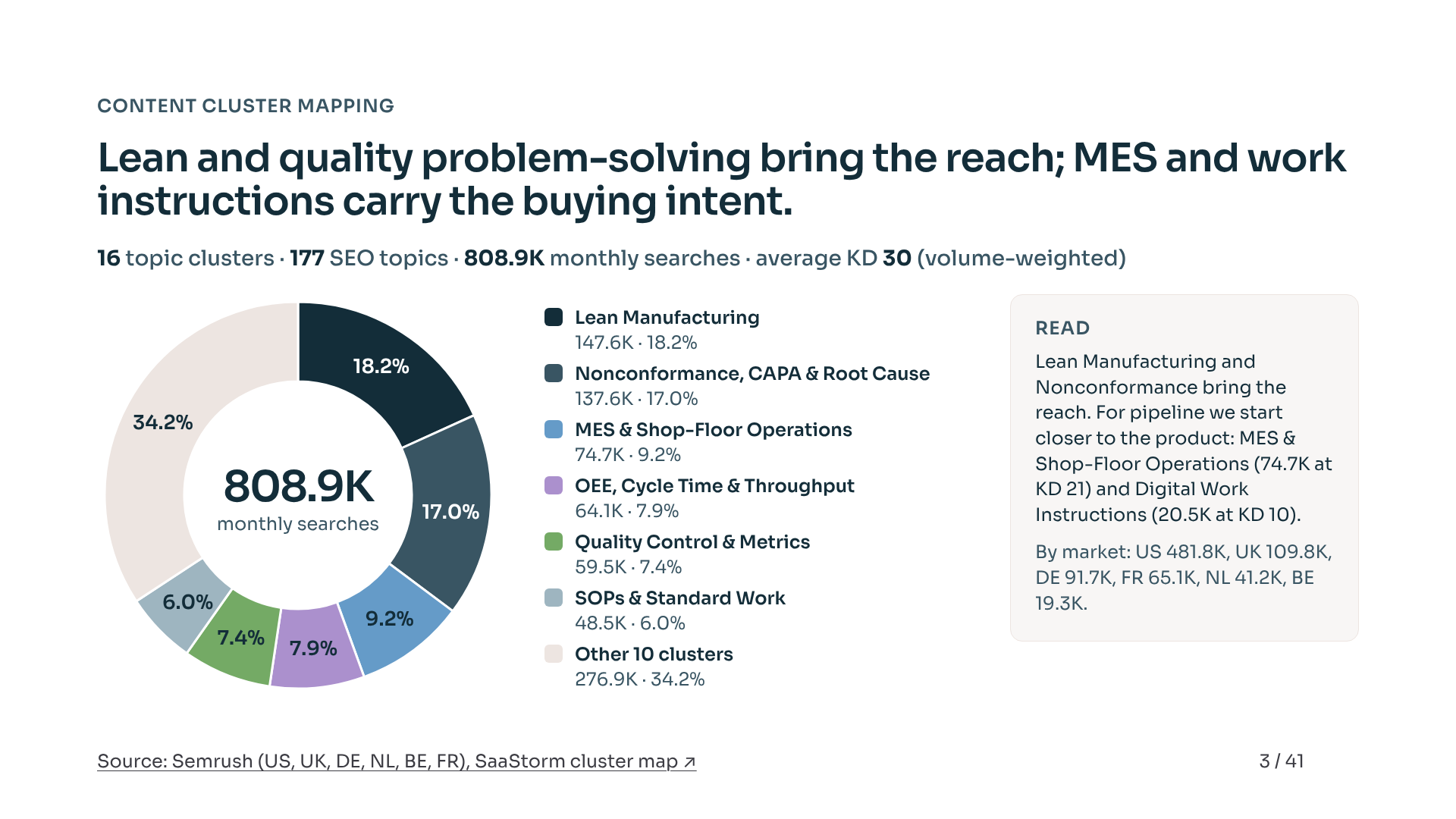
In the presentation deck, the same work becomes slides like the one below. It's the cluster map from another recent discovery, for a connected-worker platform in manufacturing (name blurred too): 16 clusters, 177 topics and 808.9K monthly searches across six markets, with the clusters that bring reach separated from the ones that carry buying intent.
4. Competitor gap analysis
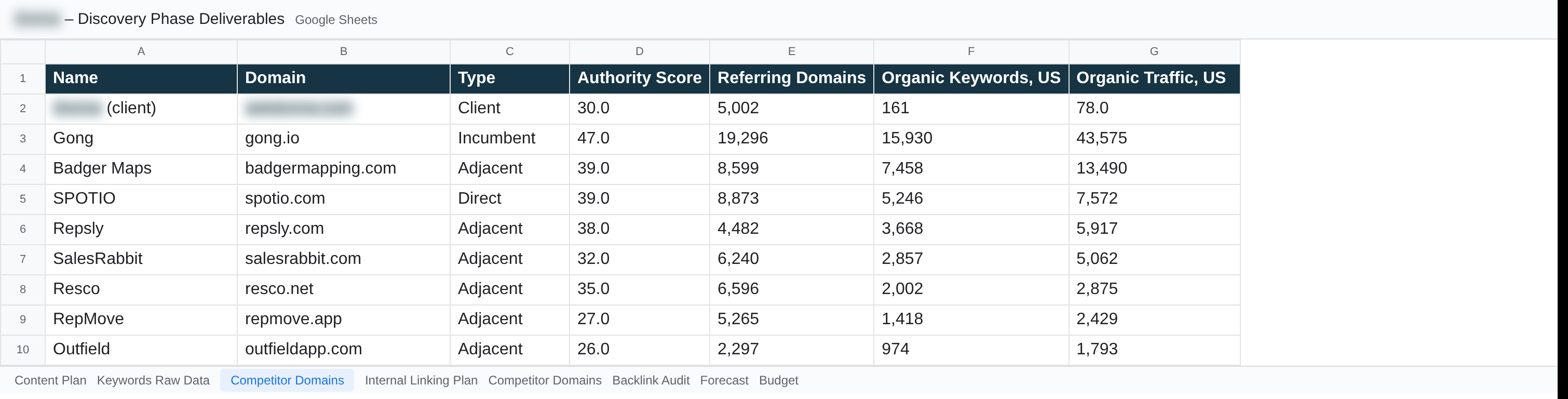
Alongside the plan, we benchmark you against your competitors: their Authority Score, referring domains, organic keywords and traffic, the page types that win in your category and the topics they rank for that you don't. The most useful output is usually the uncontested ground – topics with real buyer intent and low difficulty that nobody in your space has covered well yet.
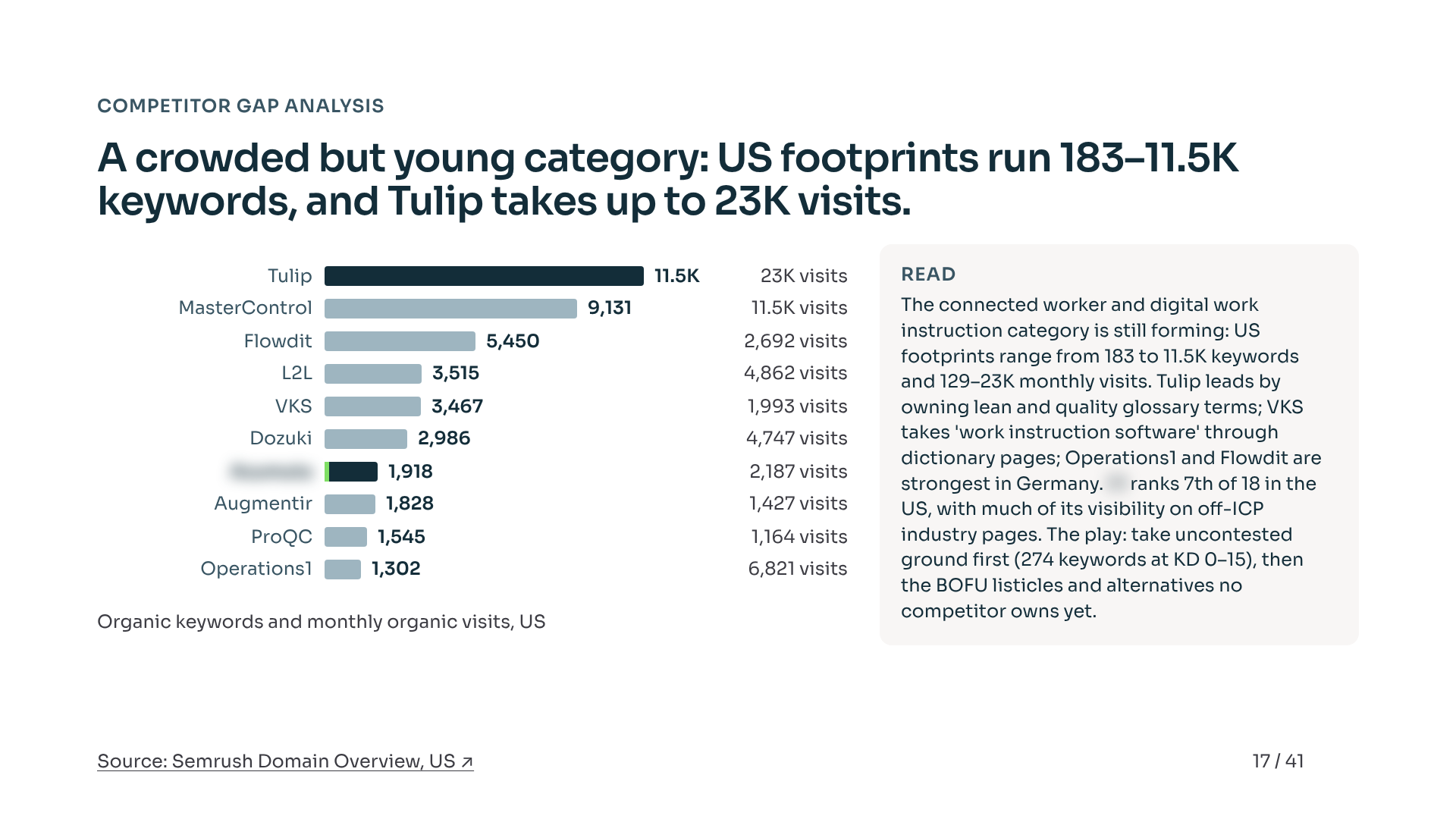
And this is how the competitor gap reads in that manufacturing deck. The category turned out to be young: the biggest player held 11.5K US keywords, and much of the opportunity was low-difficulty ground (KD 0–15) that no competitor owned yet.
5. Existing content audit
If you already have a blog, we audit every SEO page. Each one gets a Surfer content score, Search Console performance for the last three months against the three before, a matched topic from the new plan and an action: optimise, merge, keep or remove. We explain how we make those calls in our guide to content pruning, and how we update the pages we keep in our guide to content refresh.

In the discovery above, several posts already ranking around positions 6 to 9 had Surfer scores as low as 2 to 5 – exactly the kind of page where a proper optimisation can move rankings quickly. Pages worth optimising go straight into the plan with their live URL, so you never end up with a new article competing against an old one.
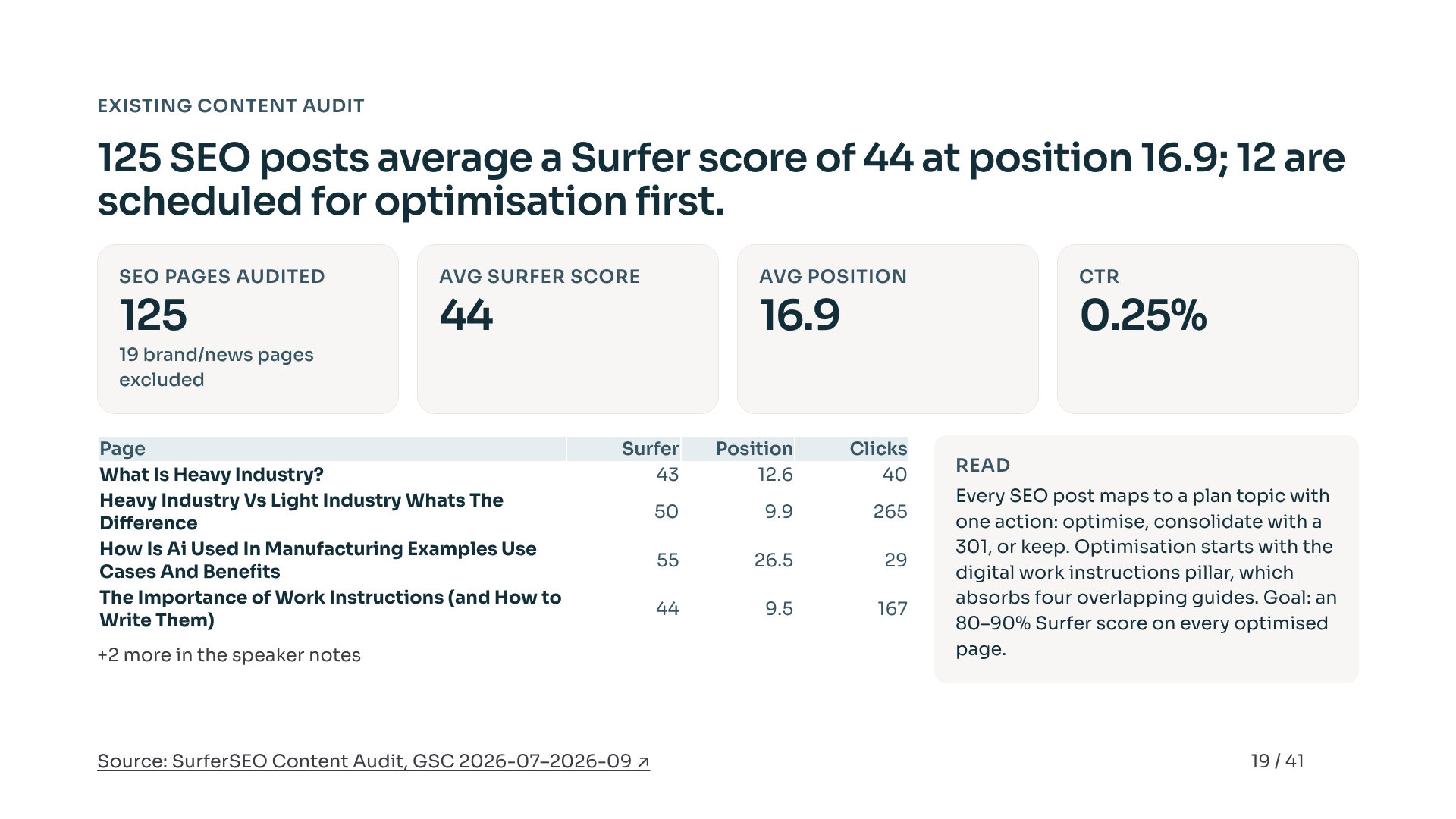
In the deck, the audit gets its own summary slide: how many SEO pages we audited, their average Surfer score, position and click-through rate, and which pages we'd optimise first.
6. Internal and external linking
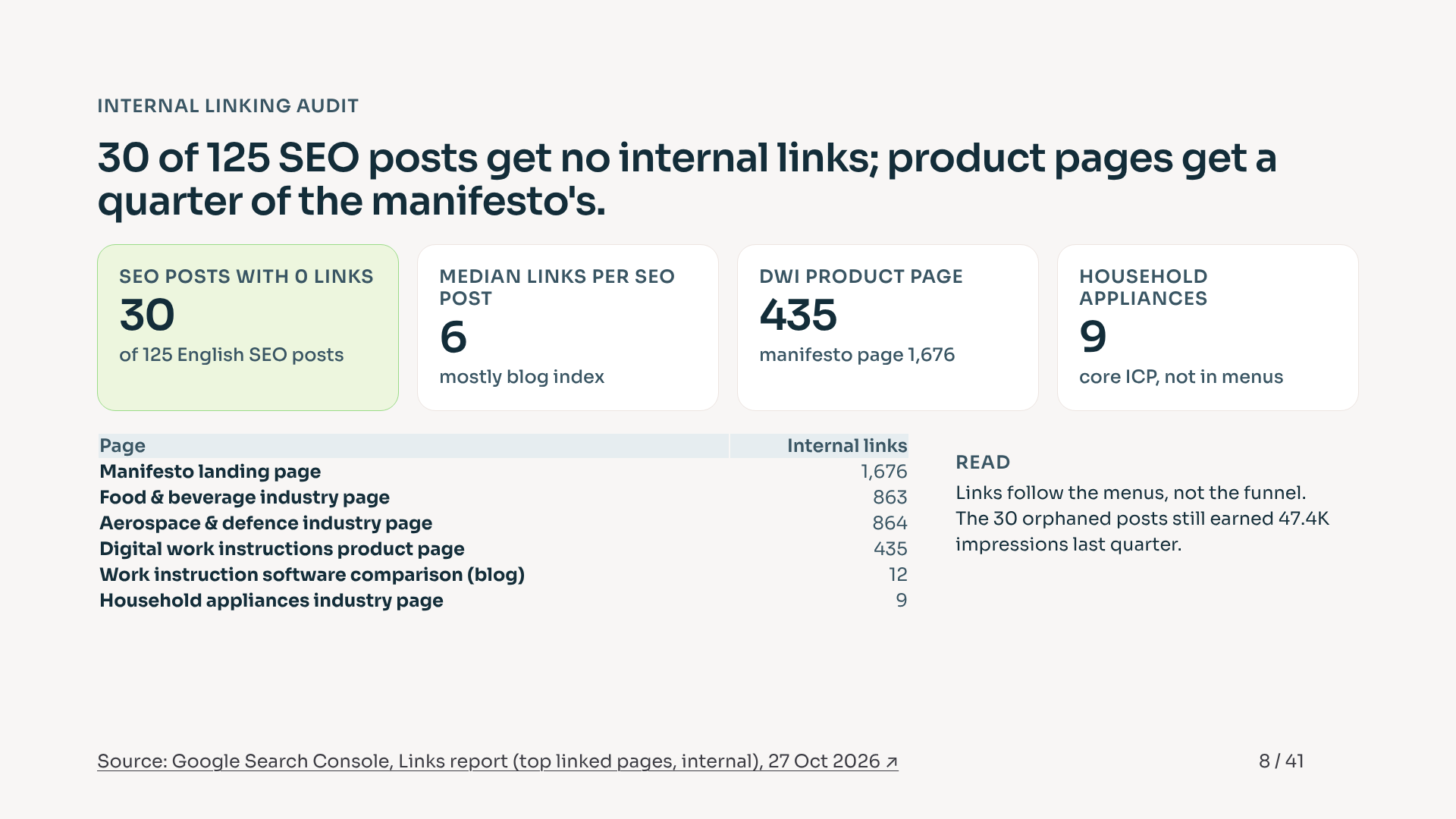
For internal links, we look at how your pages link to each other today: which posts have no internal links at all, where links concentrate and whether your money pages get enough of them. Then we plan the structure going forward, with hub articles that pass authority to your bottom-of-funnel pages.
Here's a real example. In the manufacturing discovery, 30 of 125 SEO posts had no internal links at all, while most links followed the menus and pointed at pages that rarely convert.
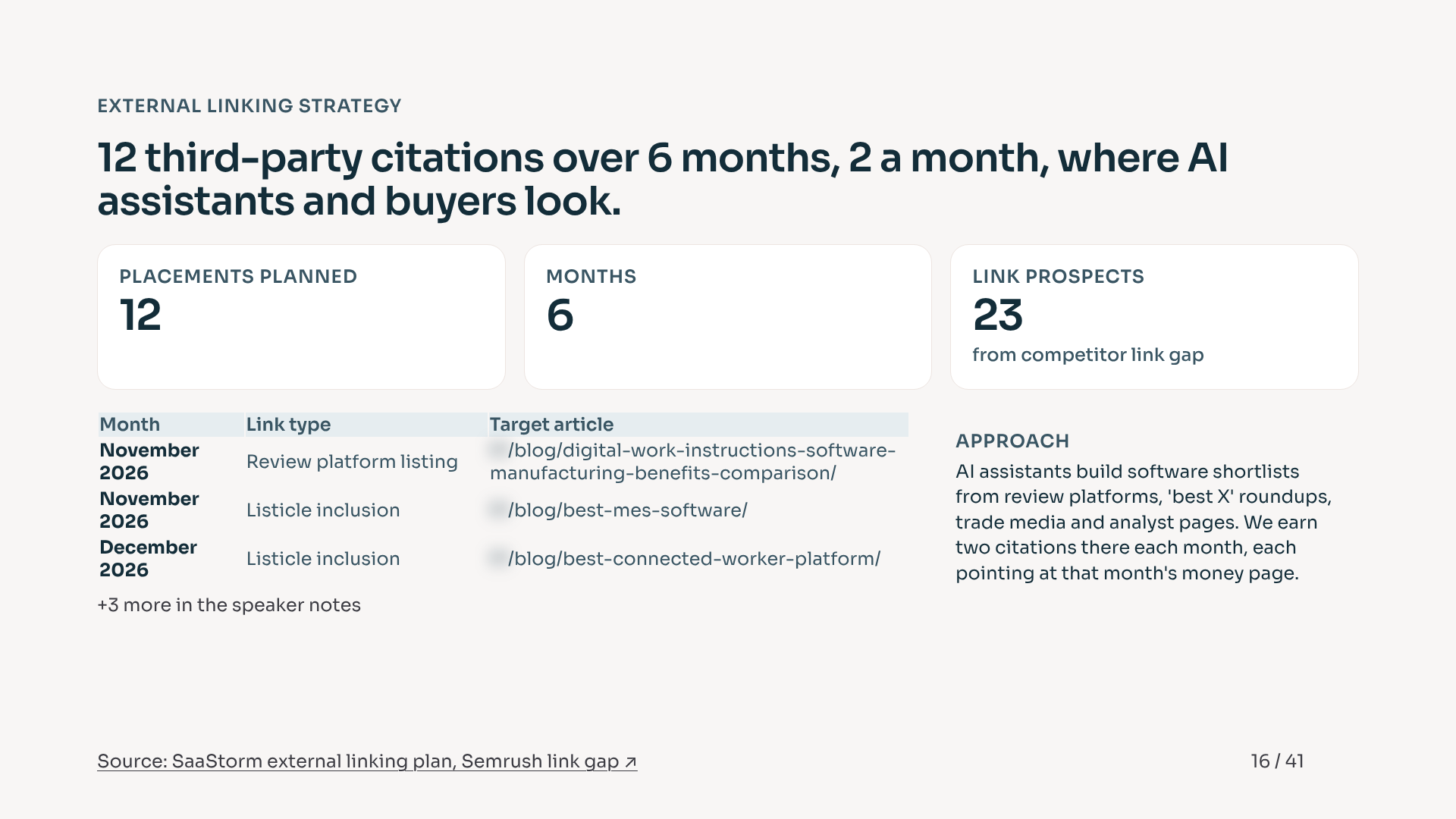
For external links, we review your backlink profile, anchors and the pages other sites link to, compare it with your competitors and build a month-by-month link plan. That includes link prospects – sites that link to two or more of your competitors but not to you – and the third-party sources AI assistants cite most often in your category.
The external plan then turns into placements by month, each one pointing at the article that needs the authority most:
7. Technical audit
We check page speed on desktop and mobile, Core Web Vitals and the top issues from a full site audit, and turn them into a short list of priority fixes. We also flag which fixes need your developer and which we can handle ourselves.
8. AI search visibility
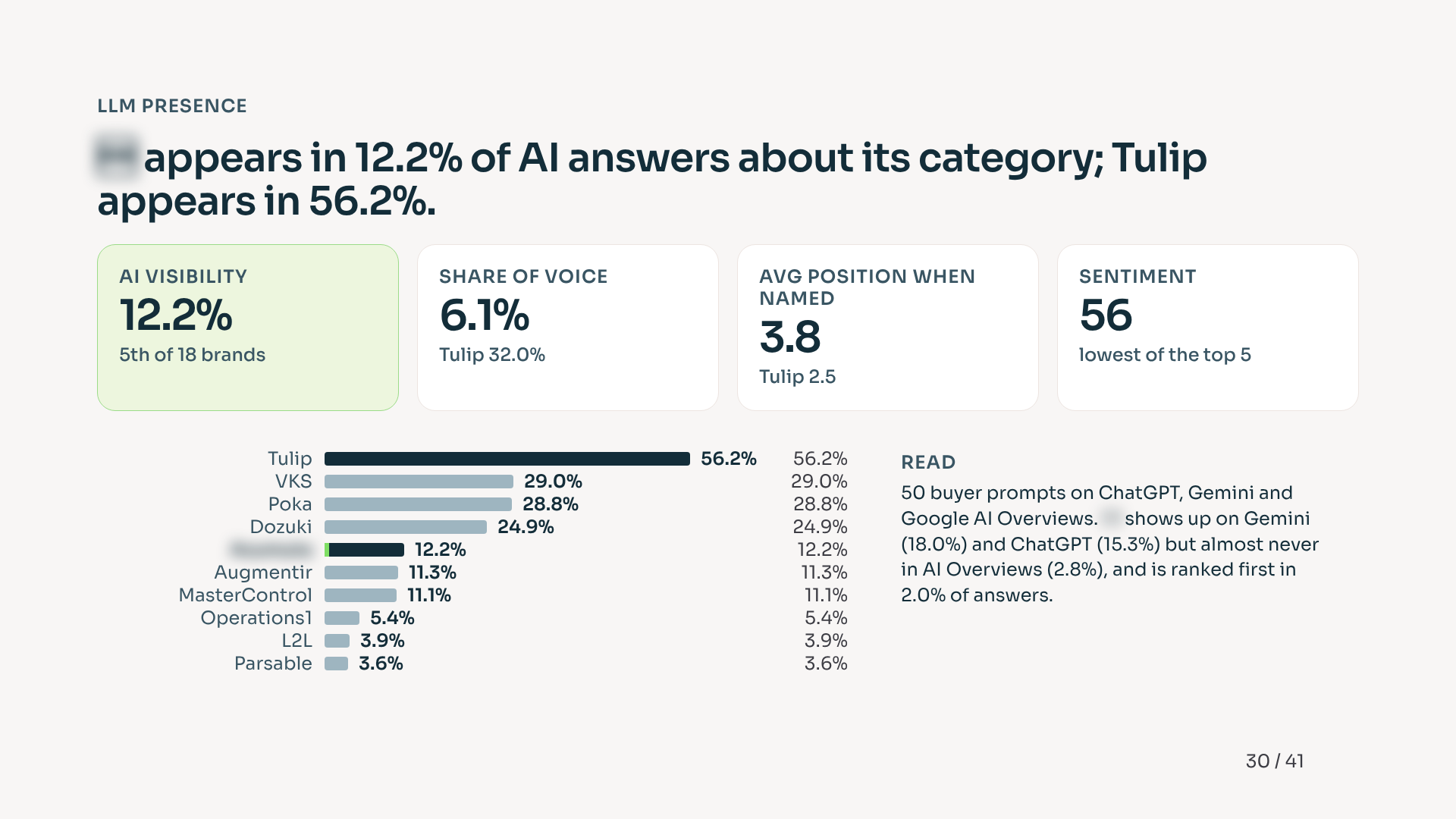
Discovery always covers AI search, not just Google. We set up tracking for 30 to 50 bottom-of-funnel prompts in Scrunch – the questions a buyer asks ChatGPT, Perplexity, Gemini or Google's AI Overviews when they're comparing tools – and look at how often you appear, where you appear, who gets mentioned instead and which sources the answers cite. If you want the bigger picture on how SEO and AI search relate, our guide to GEO vs SEO covers it.

Once the prompts have run, the deck shows where you stand. In the manufacturing discovery, the client was named in 12.2% of AI answers about its category, against 56.2% for the category leader – a clear gap, with a clear list of sources to win.
9. Website and blog improvements
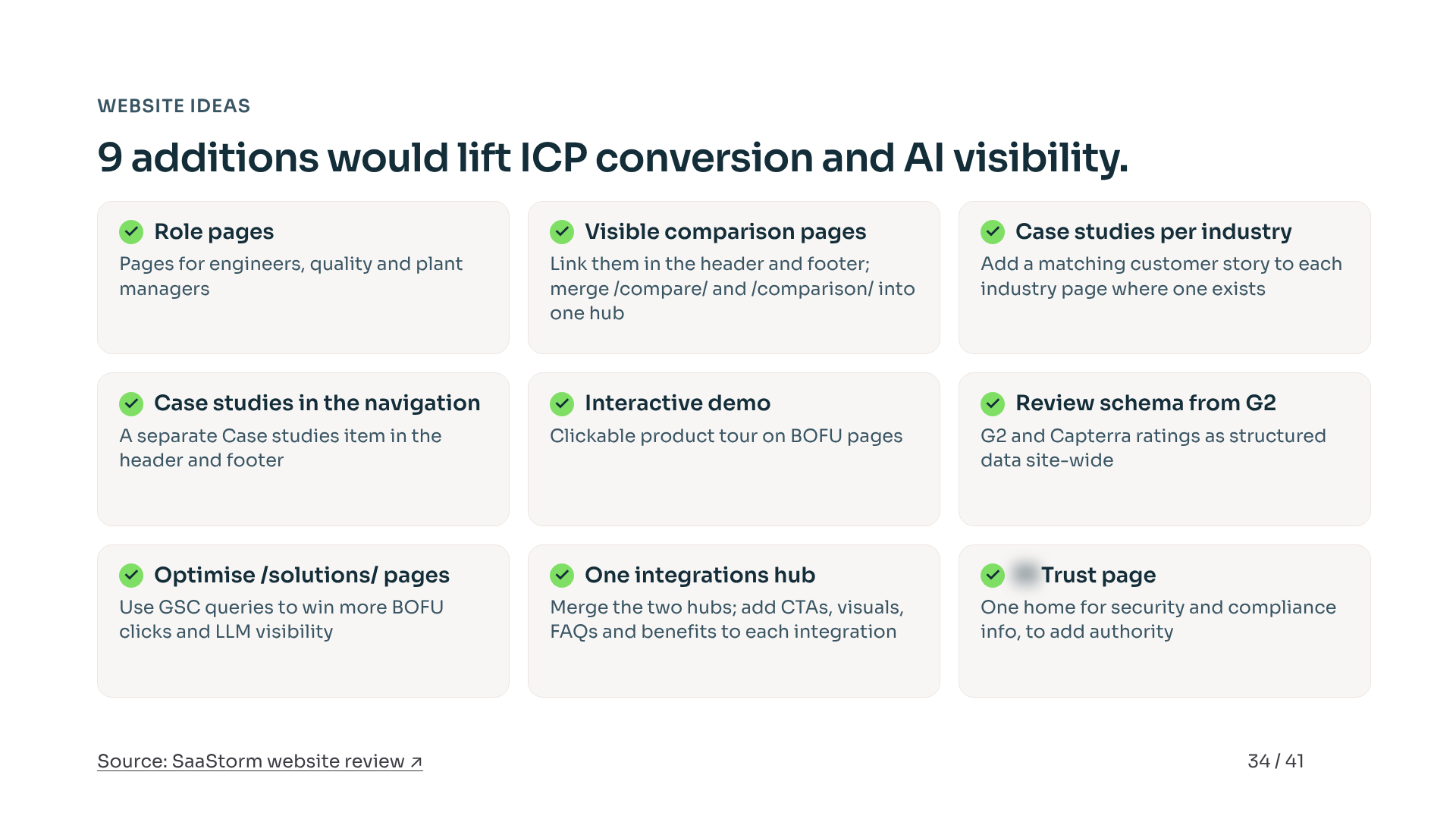
We also review the website itself, because content only converts if the pages around it do. That usually means ideas for comparison and alternatives pages, blog templates, CTAs, trust signals, FAQs and TL;DRs, demo flows and anything that makes it easier for a visitor to become a lead.
In practice, that turns into a slide of concrete ideas, each one a single change your team can ship:
10. Forecast and budget options
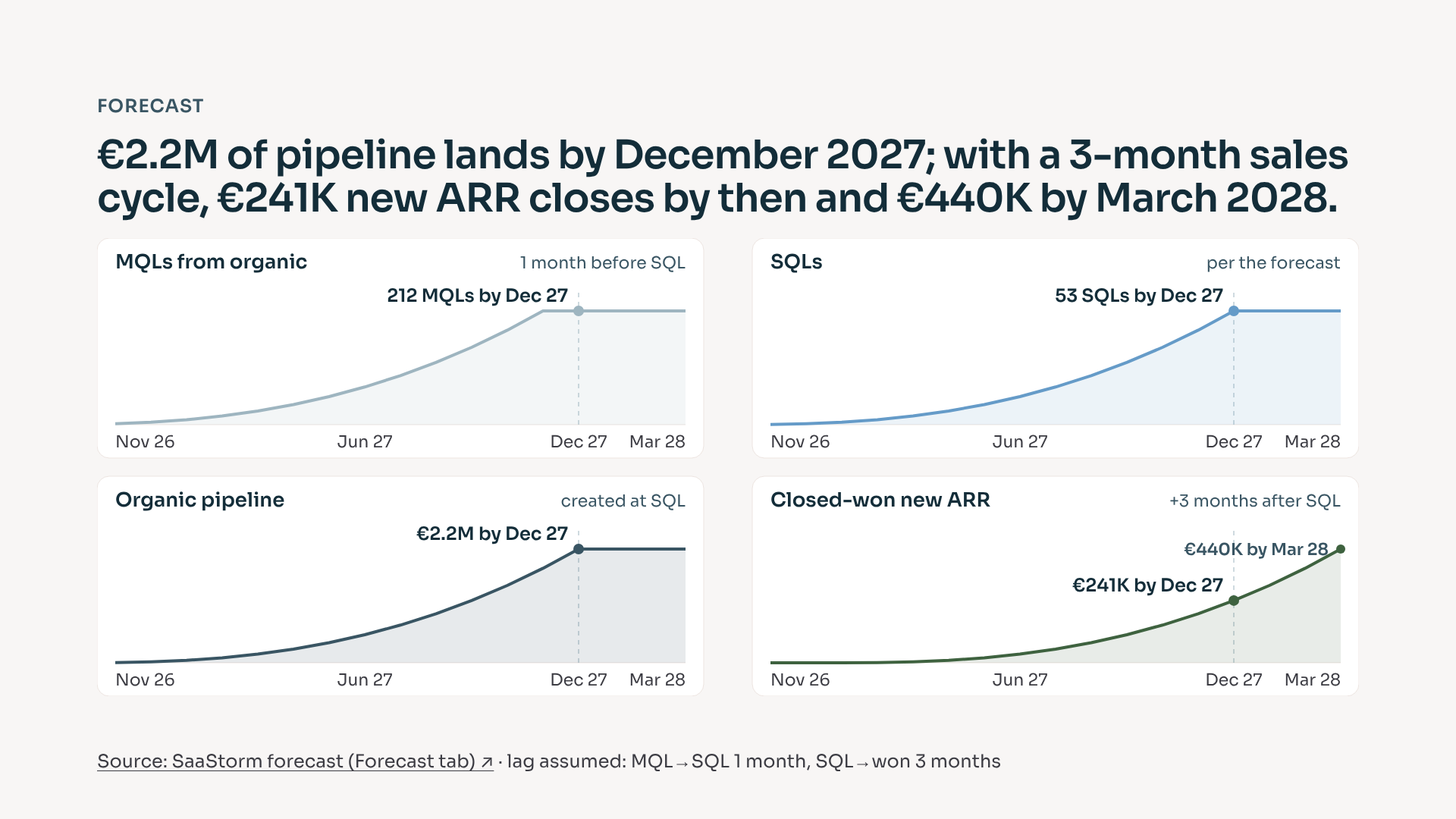
Finally, we build a forecast from your revenue goals: how much organic traffic, how many MQLs and SQLs and how much pipeline it takes to get there, based on your conversion rates, deal size and sales cycle. Next to it, we build three budget options – for example around €6,500, €8,000 and €10,000 a month, depending on your goals and what you can invest – so you can choose how fast you want to move. Our guide to SEO agency pricing explains how each option is put together.
Here's the forecast slide from the same manufacturing discovery: organic MQLs, SQLs, pipeline and closed-won ARR month by month, built from the client's own conversion rates and sales cycle. We always present it as a draft to review together.
What you get at the end of discovery
All of this ends up in two deliverables, and both are yours to keep, whether or not you continue working with us.

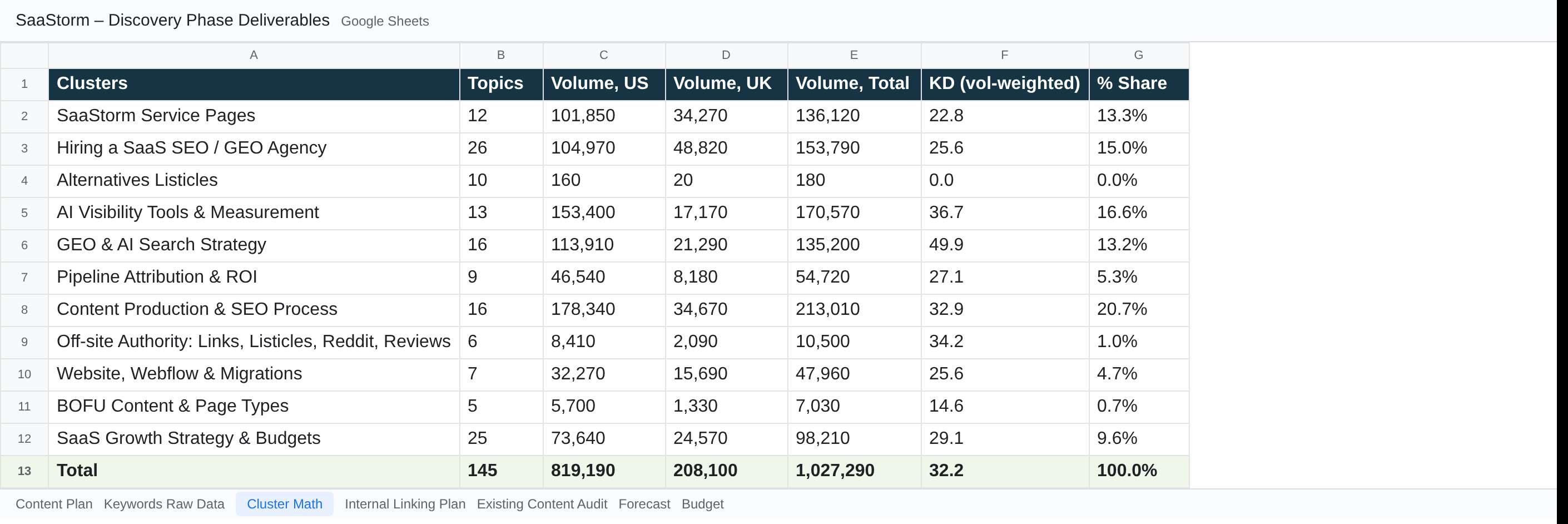
The first is the discovery workbook: a detailed spreadsheet with your full content plan, the raw keyword data behind it, the cluster breakdown, the internal and external linking plans, backlink audit, link prospects, competitor benchmarks, existing content audit, Search Console analysis, AI search prompts and citation sources, the forecast and the budget options. It becomes your team's working content plan from day one.
The second is the presentation deck we walk you through on the 90-minute call. It turns the workbook into a story: where the opportunity is, what we'll do first, what needs fixing, how visible you are in AI search, what results to expect and what it will cost.
You've seen several of its slides throughout this article, all taken from real client discoveries with the client names blurred.
To give you an idea of the scale, our own discovery for saastorm.io mapped 145 topics across 11 clusters, with over one million monthly searches across the US and UK.
What discovery looks like in practice
The best way to show what discovery leads to is with real examples. Here's what it produced for some of the B2B SaaS companies we've worked with, and what happened after.
Asora, a wealth platform for single family offices, started with a two-week discovery that benchmarked them against 30+ competitors, mapped 7 clusters with 41K+ monthly US searches into a 114-topic plan and audited 100 existing pages. Nine months later, organic search had generated €20.15M in qualified pipeline and €2.2M in new ARR.
For Stravito, discovery mapped 12 clusters representing 130K+ monthly US searches into 165 topics, analysed 20+ competitors and flagged 73 toxic domains to disavow. That plan contributed to a €5.5M organic pipeline.
At OneUp Sales, the blog had almost no visibility. Discovery identified 500+ sales keywords and 140+ recruitment keywords, two clusters, 40 topics, a three-month backlink plan and a six-month roadmap. That plan became the foundation for £250K+ in inbound revenue.
"The depth of SaaStorm's strategy blew me away. It wasn't just a list of tasks – it was a well thought-through strategy that connected to our revenue goals." – Jonny Butler, Head of Marketing at OneUp Sales
And for Jimo, discovery ran in January, execution started in February, and seven months later organic and AI search had produced €100K in qualified pipeline – with 17 of its 43 MQLs coming from LLM search.
Why discovery means we can start on day one
There's one more benefit that's easy to miss. With most agencies, the strategy is part of the retainer: you sign, and the first month goes on research and planning. It's often another month before anything is published, and even longer before you see results.
With us, that work is already done when the pilot starts. The content plan is prioritised, the first topics are chosen, the optimisations are scheduled and the link plan is ready. So on day one of the pilot, writers start writing, strategists start optimising and the technical fixes go into the queue.
That matters, because SEO compounds. Our guide to how long SEO takes explains why the first signals usually show up four to six weeks after content goes live – so every week you save at the start is a week earlier for leads and pipeline.
What it costs and what happens next
Our discovery phase costs €4,000 (or £3,500), as a one-off fee. You can see how it fits into the rest of our pricing on our pricing page.
After the presentation, you choose one of the three budget options and we kick off with a three-month pilot. During those first three months, you can cancel with 10 days' notice. If everything works – which is the goal – we simply keep going. And if you decide not to continue after discovery, you keep the workbook and the deck, and your team can implement the plan in-house.
If you're comparing agencies right now, our guide on how to choose a B2B SaaS SEO agency lists the questions worth asking each of them – including what their first 90 days look like.
The bottom line
A good SEO discovery phase does all the thinking before the spending starts. In two weeks, it should tell you what to publish and in which order, what to fix, which links to build, how visible you are in AI search and what results to expect for your budget.
That's how we start every engagement at SaaStorm: a one-hour kickoff, a two-week sprint with three senior people, a 90-minute presentation and a plan you keep. It's also why we can start executing from the first day of the pilot, and why clients who start with discovery tend to see better results.
00:00
/
00:00
Want to see what a discovery phase would uncover for your business? Book a call with us and we'll walk you through how it works and what we'd look at first.
FAQs
What is an SEO discovery phase?

An SEO discovery phase is a fixed research project at the start of an engagement that turns your product, market and data into a complete organic growth plan. At SaaStorm, it takes two weeks and covers keyword research, a content plan, content, linking and technical audits, AI search visibility, a forecast and budget options.
How long does SaaStorm's discovery phase take?
It starts with a one-hour kickoff call, followed by a two-week discovery sprint and a 90-minute presentation of the results.
What do you need from us for discovery?
A kickoff call with a product demo, access to Google Search Console and Google Analytics 4 and, ideally, a few sales call recordings. We handle the rest.
How much does the discovery phase cost?
Our discovery phase costs €4,000 or £3,500 as a one-off fee, separate from the monthly retainer that follows.
Do we keep the deliverables if we don't continue?
Yes. The discovery workbook and the presentation deck are yours to keep, and your team can implement the plan in-house if you decide not to continue.
What happens after the discovery phase?
You choose one of three budget options and we start a three-month pilot, which you can cancel with 10 days' notice. Because the plan is already done, we start executing from day one.
Who works on our discovery phase?
Three senior people: our founder, our CMO, and the organic growth strategist who will lead your account.



“SaaStorm became a key part of our inbound motion. Their SEO and content support helped us scale a consistent flow of high-intent traffic and build a content engine that supported £250K+ in inbound revenue. They plugged into our system and delivered every step of the way.”
Jonny Butler, Head of Marketing at OneUp
Related posts