Back to blog
SEO ROI for B2B SaaS: How to Calculate It from Your ARR Goals


- The basic SEO ROI formula is simple: (revenue from SEO − SEO costs) ÷ SEO costs × 100. The hard part in B2B SaaS is getting honest numbers into it.
- Don’t start with traffic. Start with your ARR goal and work backwards: new ARR → customers → pipeline → SQLs → MQLs → the organic traffic you need.
- Judge SEO ROI over 24 to 36 months, not 12. Content takes months to rank and deals take months to close, so year one almost always looks negative before the compounding kicks in.
- It can be done. In 19 months, organic and AI search became Introw’s #1 source of deals, with SQL pipeline at more than 20x their investment and a 4x+ return in closed-won ARR – and AI assistants drove 71% of search-sourced deals in Q3 2026.
- Proving SEO ROI comes down to tracking: costs, MQLs, SQLs, pipeline, ACV and the original source of every deal in your CRM.
“What are we actually getting back for this?” Sooner or later, every Head of Marketing hears that question about SEO from their CEO or CFO. And in B2B SaaS, it’s a fair one. You’re paying every month for content, links and an agency or in-house team, while the revenue arrives months later, through long sales cycles, often after several touchpoints.
That’s why so many teams fall back on SEO metrics like web traffic, search rankings and keyword rankings. They’re easy to report, but they don’t show how much revenue your SEO efforts generate. In our experience across 30+ B2B SaaS companies, the teams that can answer that question all do the same thing: they plan SEO backwards from their ARR goal, and they track every step between a search and a signed contract.
“SEO ROI is hard to prove if you don’t track your numbers. But if you track your expenses, your MQLs and SQLs, your ACV and what’s happening in your pipeline – if you have a proper tracking set-up – it’s possible.” – Romana Kuts, Founder at SaaStorm
In this guide, I’ll show you how we calculate SEO ROI for our clients: the formula, the reverse-funnel forecast we build in every discovery phase (with a real, anonymised example), how to measure ROI once the work is running, and what a realistic payback timeline looks like. You can also plug in your own numbers with our two free calculators along the way.
What SEO ROI means for a B2B SaaS company
Before getting into forecasts, it’s worth agreeing on what we’re measuring, because “SEO ROI” means very different things to different people – and in B2B SaaS, the standard definition needs a few adjustments.
The SEO ROI formula
To measure SEO ROI, use the following formula. At its simplest, the ROI of SEO (return on investment) compares the revenue generated by organic search with the money you spent on search engine optimization to get it:
SEO ROI (%) = (Revenue from SEO − SEO costs) ÷ SEO costs × 100
So if you invest €80,000 in SEO over a year and organic search brings in €200,000 in new revenue, your ROI is (200,000 − 80,000) ÷ 80,000 × 100 = 150%. Every euro you put in brought €2.50 back – a clearly positive ROI.

Why B2B SaaS needs a different SEO ROI calculation
The formula is the easy part. Filling it in honestly is harder in B2B SaaS, for four reasons.
First, revenue is recurring. A customer who signs a €20,000-a-year contract is worth far more than €20,000 if they stay for three years, so you need to decide whether you count first-year ARR, total contract value or lifetime value. Second, sales cycles are long. A demo booked from a blog post in March might close in July, so revenue always lags the SEO investment. Third, buyers rarely convert on one visit: they read a comparison page, come back via a branded search, ask ChatGPT and finally book a demo. And fourth, a growing share of that journey now happens in AI search, which most analytics set-ups don’t track properly.
That’s why we look at SEO ROI at three levels, each useful at a different stage:
Pipeline ROI tells you early whether SEO is working. ARR ROI is what your CFO cares about. Lifetime ROI is the most accurate picture of SEO’s real value, because organic customers keep paying long after the content that brought them in was written.
Isolating SEO efforts from other marketing channels
There’s one more complication: SEO rarely works alone. A buyer might first see you in a LinkedIn post, then search your category, read three of your articles and book a demo after a sales email. Isolating SEO efforts relative to other marketing channels will never be perfect, so be consistent instead. We count a deal as search-sourced when organic or AI search is its original source in the CRM or the buyer names it in self-reported attribution, and we report branded searches separately so SEO doesn’t take credit for demand your brand already created. That keeps the number conservative – and credible when your CFO compares marketing spend across channels.
Knowing what you’ll measure is step one. Step two is deciding what result you need before you spend anything.
Start from your ARR goal, not from traffic
Most attempts to forecast SEO ROI start with keywords: “these terms have 50,000 monthly searches, so if we rank, we’ll get X visits”. That’s backwards. Traffic is an output, not one of your SEO goals, and it says nothing about revenue.
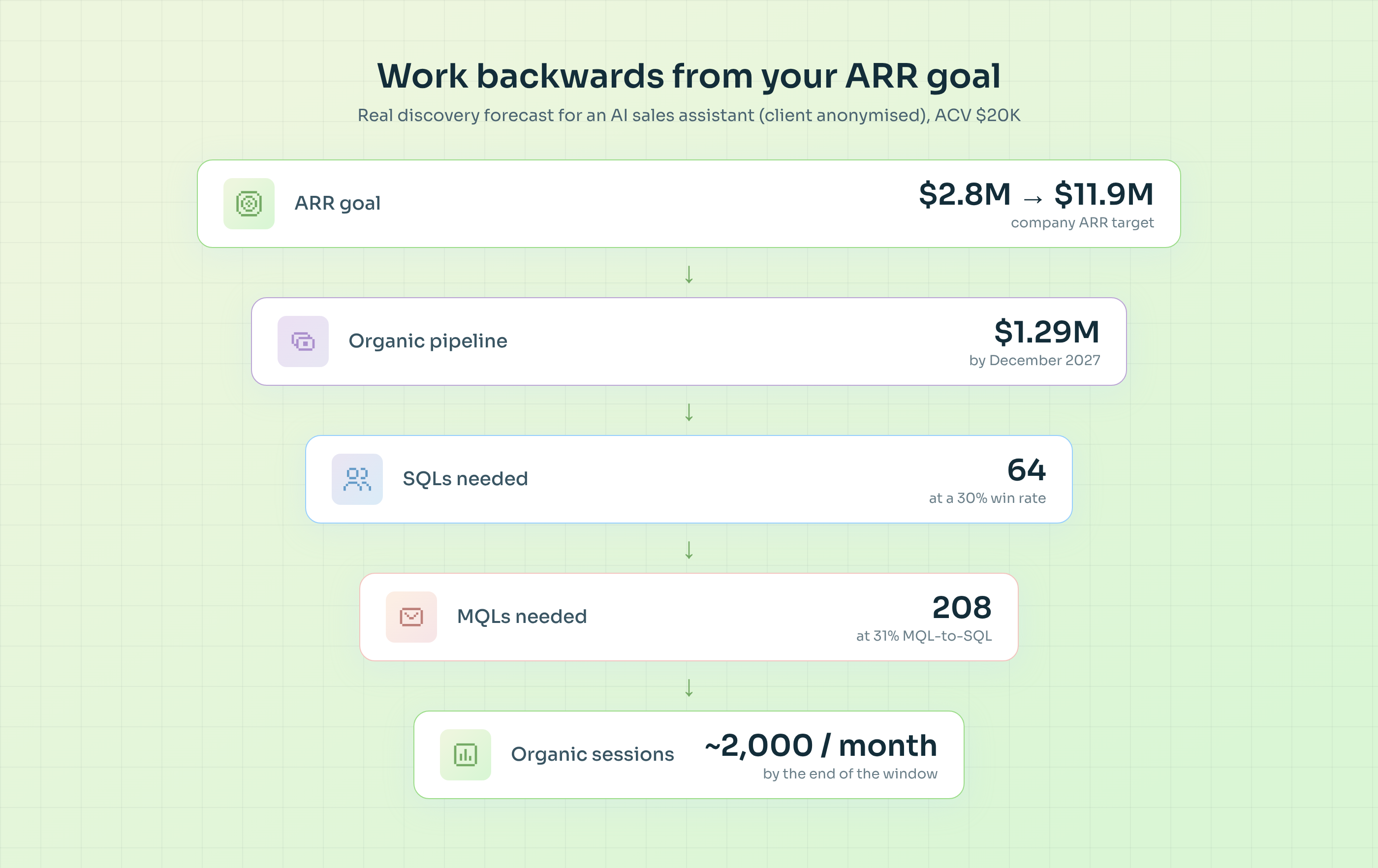
We do it the other way round. In every SEO discovery phase, we start with the client’s ARR goal and work backwards through their own funnel to the traffic, MQLs and SQLs that organic search needs to deliver. It’s the same reverse-funnel model behind our free organic revenue goals calculator.
The reverse funnel, step by step
The model has five steps, and each one uses a number from your own business:
- New ARR from organic: take the gap between your current ARR and your goal, and decide what share of it organic and AI search should deliver.
- Customers: divide that new ARR by your average contract value (ACV).
- SQLs and pipeline: divide the number of customers by your win rate to get the SQLs – and the pipeline – sales needs to work.
- MQLs: divide SQLs by your MQL-to-SQL conversion rate.
- Organic traffic: divide MQLs by your traffic-to-MQL conversion rate to get the monthly organic traffic you need.
Every number comes from your analytics and CRM, ideally averaged over the last six to twelve months so one unusual month doesn’t skew the plan. If you don’t have reliable conversion rates yet, use conservative benchmarks: across our clients, traffic-to-MQL rates usually sit around 1–2%, MQL-to-SQL around 20–35% and SQL-to-won around 20–30%.
A real example: an AI sales assistant for field sales teams
Here’s what that looks like in a forecast we built for a recent client, an AI sales assistant for enterprise field sales teams (client name blurred). They were at $2.8M ARR with an ACV of $20,000, a 31% MQL-to-SQL rate and a 30% win rate, converting 1.78% of website sessions into MQLs.
Working backwards from an organic pipeline target of $1.29M by December 2027, the forecast showed that organic search needed to deliver:
- 208 MQLs and 64 SQLs over 14 months, ramping from almost zero to about 35 MQLs a month
- around 2,000 organic sessions a month by the end of the window
- roughly 11 won deals and $211,500 in new ARR from organic by December 2027

Two things make this kind of forecast useful. First, the ramp is deliberately back-loaded: content needs time to rank and deals need time to close, so the model expects slow early months and faster growth later, instead of a straight line that sets everyone up for disappointment. Second, the sheet has an “actuals” section under the forecast that we fill in during every monthly review, so the client always sees plan versus reality.
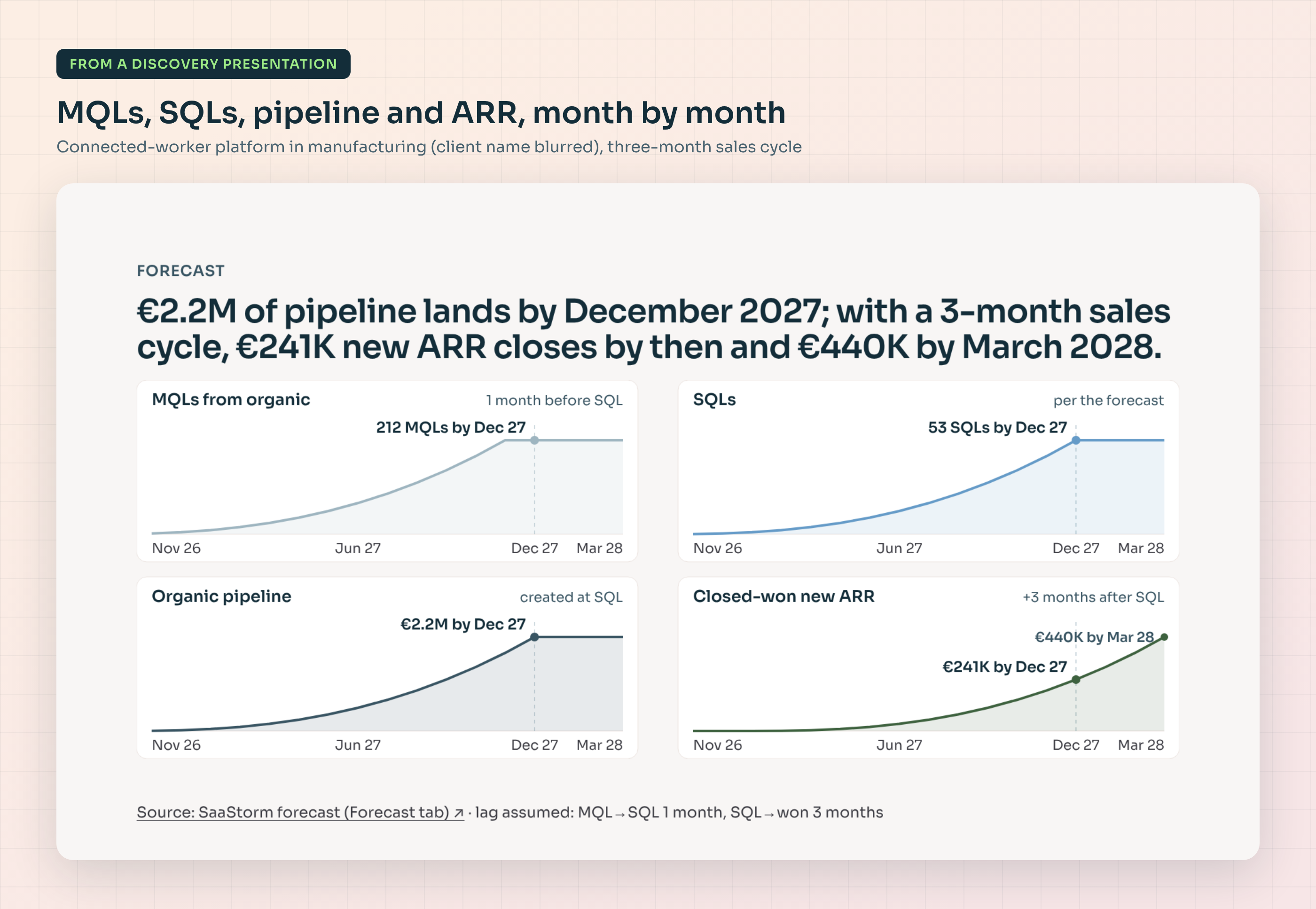
Here’s how the same logic looks in a client presentation, from a discovery for a connected-worker platform in manufacturing: organic MQLs, SQLs, pipeline and closed-won ARR month by month, built from the client’s own conversion rates and a three-month sales cycle.
Calculate your potential ROI with an SEO ROI calculator
You can run the same reverse-funnel maths for your company in our free organic revenue goals calculator. Enter your current and target ARR, the share you expect from organic and AI search, your ACV and your funnel rates, and it shows the pipeline, SQLs, MQLs and organic visits you need, month by month.
A forecast tells you what SEO needs to deliver. To know whether it’s actually delivering, you need to calculate ROI as you go.
How to calculate SEO ROI step by step
Once the work is running, calculating SEO ROI is a monthly habit, not a one-off exercise. Here’s the process we use with clients, in four steps.
1. Add up all your SEO costs
Start with your full SEO budget, not just the SEO agency invoice. SEO costs for a B2B SaaS company usually include:
- agency retainer or in-house team salaries
- content production: writers, editors, design
- link building and third-party placements
- SEO tools such as Semrush, Surfer or AI visibility trackers
- developer time for technical improvements and new pages
- one-off costs such as a discovery phase or website migration
Leaving costs out makes ROI look better on paper but destroys trust the moment someone in finance checks the numbers.
2. Track conversions from organic and AI search
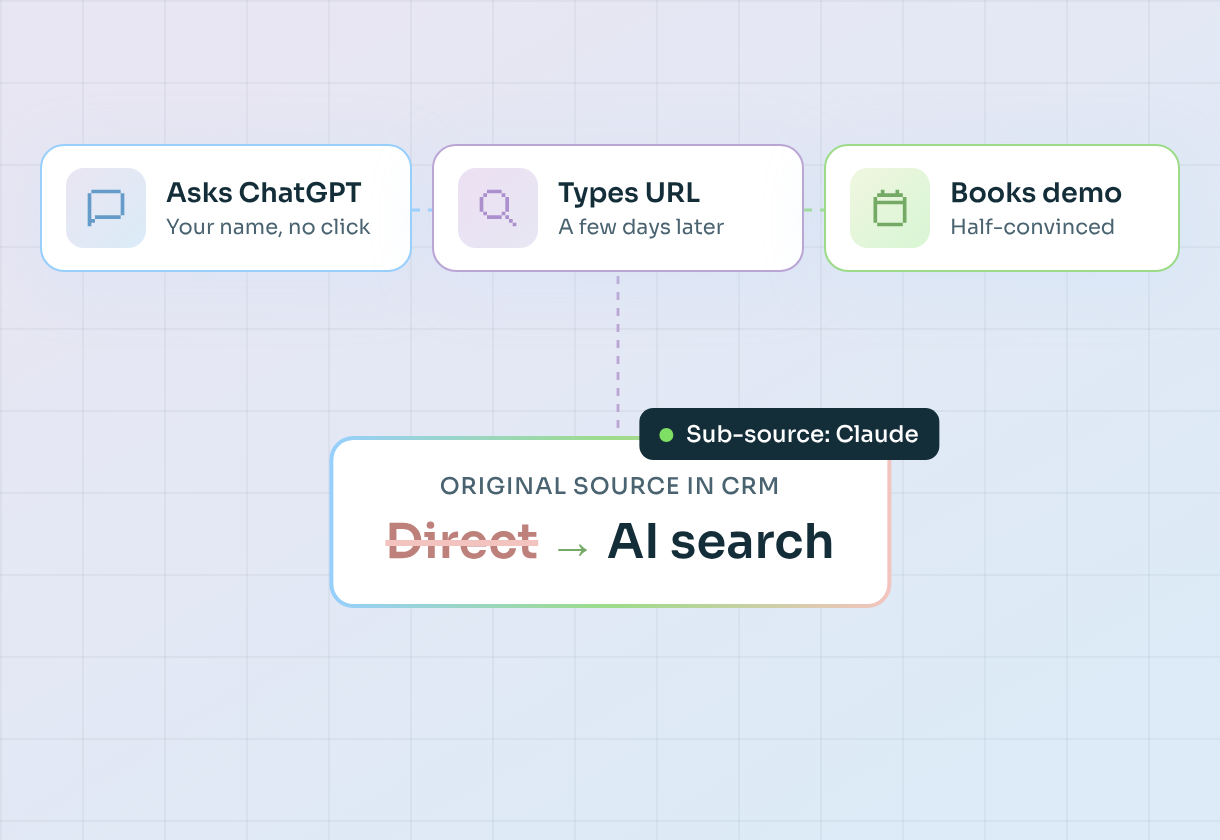
Next, you need to know which leads and deals came from search engines. These organic traffic conversions and sales conversions are the key performance indicators that connect SEO to revenue. At a minimum, that means conversion tracking in Google Analytics for demo requests, trials and form submissions, and a CRM such as HubSpot that records the original source of every contact and deal. We recommend adding “AI search” as its own source alongside “organic search”, because AI assistants are becoming a major channel in their own right. Add a “how did you hear about us?” field to your demo form too: many buyers who discover you in ChatGPT or Google’s AI Overviews arrive by typing your URL directly, and would otherwise show up as direct traffic.
3. Put a value on pipeline and revenue
To track revenue properly, record the pipeline value at SQL stage for each deal sourced by organic and AI search, and the ARR when it turns into paying customers. Pull this revenue data from your CRM rather than estimating it, and compare it with your other customer acquisition costs. If you want lifetime ROI, multiply ARR by your average customer lifetime (adjusted for churn). This is where SaaS SEO usually looks much better than people expect: one enterprise customer can pay for a year of content, and the sales revenue it brings keeps renewing.
4. Calculate ROI over the right timeframe
Finally, run the formula – but over a timeframe that matches how SEO works. A 12-month view almost always understates the return, because the content you published in months 9 to 12 hasn’t had time to rank, and the deals it started haven’t closed yet. We look at ROI on a rolling basis and judge it properly over 24 to 36 months.
Here’s a simple worked example. A company invests €4,000 in a discovery phase and €6,500 a month in SEO for two years: €160,000 in total. Organic and AI search bring in 12 new customers at an ACV of €25,000, or €300,000 in new ARR. ARR ROI over the two years is (300,000 − 160,000) ÷ 160,000 × 100 = 88%. And because those customers keep paying, the return keeps climbing in year three without any extra content spend.
The maths is simple. The timing is what catches most teams out.
When SEO pays back: the payback curve
The single most common reason companies give up on SEO too early is that they expect it to behave like paid ads. With paid search, you spend €10,000 and see the return the same month. With SEO, the cost line rises in a straight line from day one, while the revenue line starts slowly and then compounds as your pages climb the organic search results.

There are two delays built into every SEO investment, and both explain why SEO results look slow in the first months. The first is ranking time: a new article usually takes several months to reach its full traffic and its final position in the search engine results. The second is your sales cycle: an MQL from month four might close in month seven or eight. Put the two together and it’s normal for cumulative revenue to pass cumulative spend somewhere in the second year, after which every new month adds return on content you’ve already paid for.
The chart above shows an illustrative model built with the same logic as our calculator: €6,500 a month plus a €4,000 discovery phase, six new articles a month that each reach 120 visits after six months, a 1.5% visit-to-MQL rate, 30% MQL-to-SQL, a 20% win rate, a €20,000 ACV, a three-month sales cycle and 10% annual churn. The content pays for itself in month 23, and by month 36 it has returned about 3.4 times what it cost.
That compounding is SEO’s biggest advantage over paid advertising, and the reason SEO deserves a long-term place in your marketing budget. When you stop paying for ads, the leads stop. When you stop publishing, the articles you’ve built keep ranking, getting cited in AI answers and bringing in buyers for months or years. Our guide to how long SEO takes explains the timeline in more detail.
You can model your own payback point with our free content ROI calculator. Enter your monthly budget, articles per month, traffic per article, time to rank and funnel numbers, and it shows the month your content pays for itself and your ROI over up to four years.
So what does a good return actually look like in practice?
What SEO ROI looks like in practice
Forecasts and calculators are useful, but CMOs rightly want to see real numbers. Here’s one client who has shared their results publicly, and our honest view of what to expect.
Introw: 20x pipeline and 4x ARR in 19 months
One of our clients is Introw, an AI-native partner relationship management platform. We built their content plan from a discovery phase and have since shipped more than 160 assets for them: blog articles, 12 industry pages, 27+ product and integration pages and 15+ off-site placements in “best tools” listicles. Crucially, they measure SEO performance exactly the way this article recommends: on pipeline and revenue, not on traffic growth.
“We measure SaaStorm’s work based on the pipeline and revenue, and the results speak for themselves. In 19 months, organic and AI search became our #1 source of deals. It generated more than 20x our investment in the sales qualified lead (SQL) pipeline and a 4x+ return in closed won annual recurring revenue (ARR), which keeps compounding.” – Stijn Provoost, Marketing Strategy & GTM Lead at Introw (Clutch review)

The numbers behind that quote show the compounding effect in action. Introw’s closed-won ARR from search more than doubled from the second half of 2025 to the first half of 2026, Q3 2026 was their best quarter yet, and their search-sourced deals have grown every half year.
“AI search has been the biggest shift. AI assistants went from zero to the main driver within search, accounting for 71% of our search-sourced deals and 76% of our search-sourced demos in the third quarter of 2026.” – Stijn Provoost, Marketing Strategy & GTM Lead at Introw
That last point matters for every ROI calculation now, because it shows how much SEO contributes beyond Google. If Introw had measured only Google organic traffic, it would have missed most of the return. Because their CRM tracks AI search as a separate deal source, they can see that the same content and off-site work drives pipeline in both channels.
Our rule of thumb for a good SEO ROI
Not every engagement is a 20x story, and not every client pays back in year one. Smaller ACVs, very new domains and narrow markets all stretch the timeline. Jimo, a digital adoption platform, is a good example of what an earlier-stage funnel looks like when it’s tracked properly:
“Over eight months, SaaStorm’s organic content brought in 43 qualified leads, 19 demos, 13 trials and 3 new customers. Two of those customers found us through AI assistants, which confirmed the bet on AI search.” – Thomas Moussafer, Co-founder at Jimo (Clutch review)
With every stage of the funnel visible – leads, demos, trials and customers – you can see exactly where the return is coming from and how long payback will take at your ACV. That’s why we build the forecast before anyone signs. Our own benchmark is simple:
“If you invest €60K in us, I want to bring you at least €60K back – that’s the worst case. But I want us to be ROI positive two, three or four times over.” – Romana Kuts, Founder at SaaStorm
In practice, that means agreeing the target up front, tracking it monthly against the forecast, and changing the plan when the numbers say so. Which brings us to the set-up that makes all of this possible.
How to set up tracking to measure ROI from SEO
You can’t calculate the ROI of SEO without the data behind it. Most “SEO doesn’t work for us” conversations we have turn out to be “we can’t see what SEO is doing” conversations. Here’s the minimum set-up we put in place with every client, so the key metrics are visible from month one.
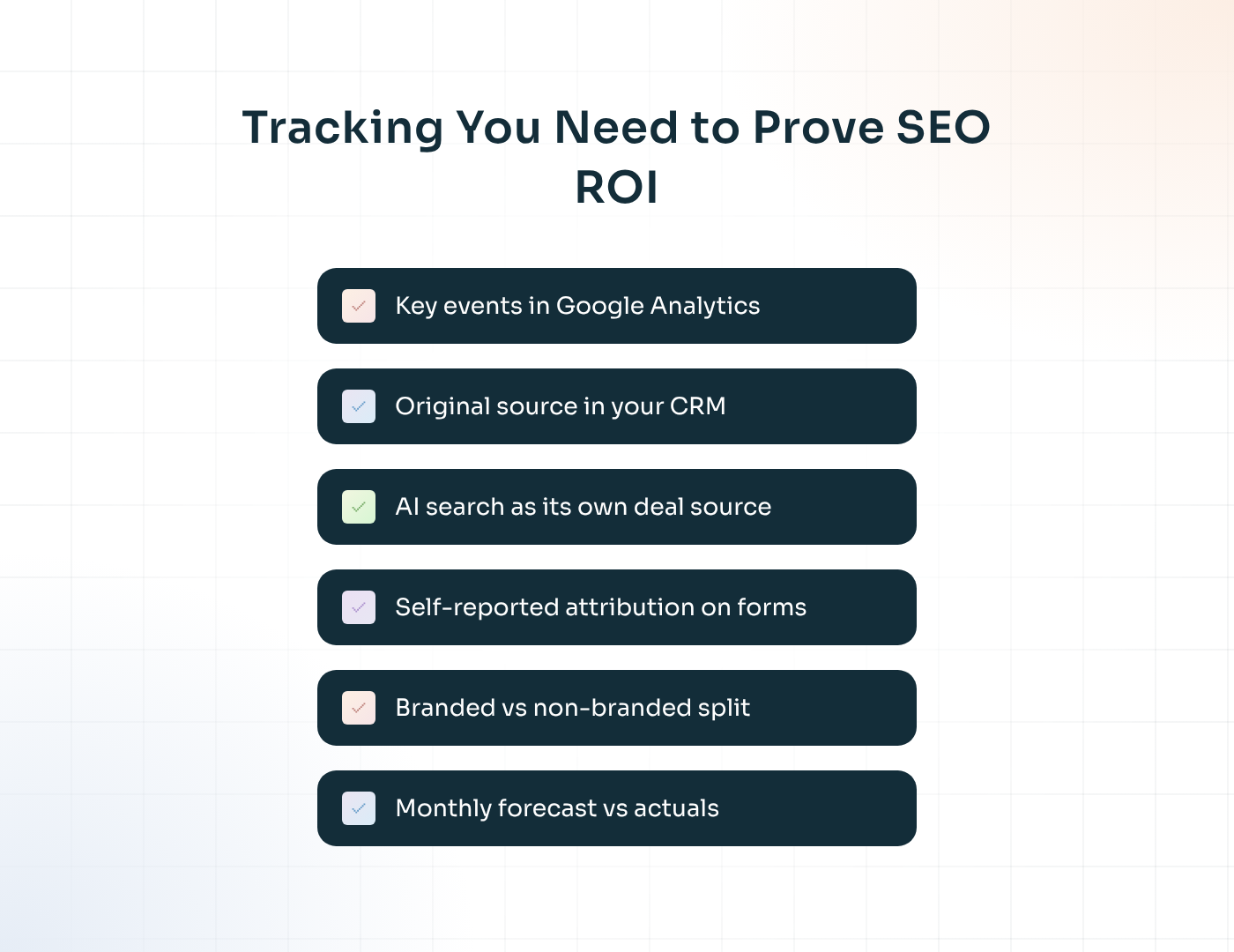
- Conversion tracking in Google Analytics: demo requests, trials, sign-ups and key form submissions set up as key events, so you can see organic and AI referral conversions by landing page.
- Original source in your CRM: every contact and deal tagged with its original source, with “AI search” as its own value next to “organic search”.
- Self-reported attribution: a “how did you hear about us?” field on demo forms, because AI-influenced buyers often arrive as direct traffic.
- Funnel rates and ACV: MQL-to-SQL, SQL-to-won and ACV reviewed every quarter, so the forecast stays realistic.
- Branded and non-branded split: separate branded searches from non-branded ones, so you can see what SEO earned rather than what your brand already had.
- Forecast vs actuals: a monthly review where actual sessions, MQLs, SQLs, pipeline and won deals sit next to the forecast.
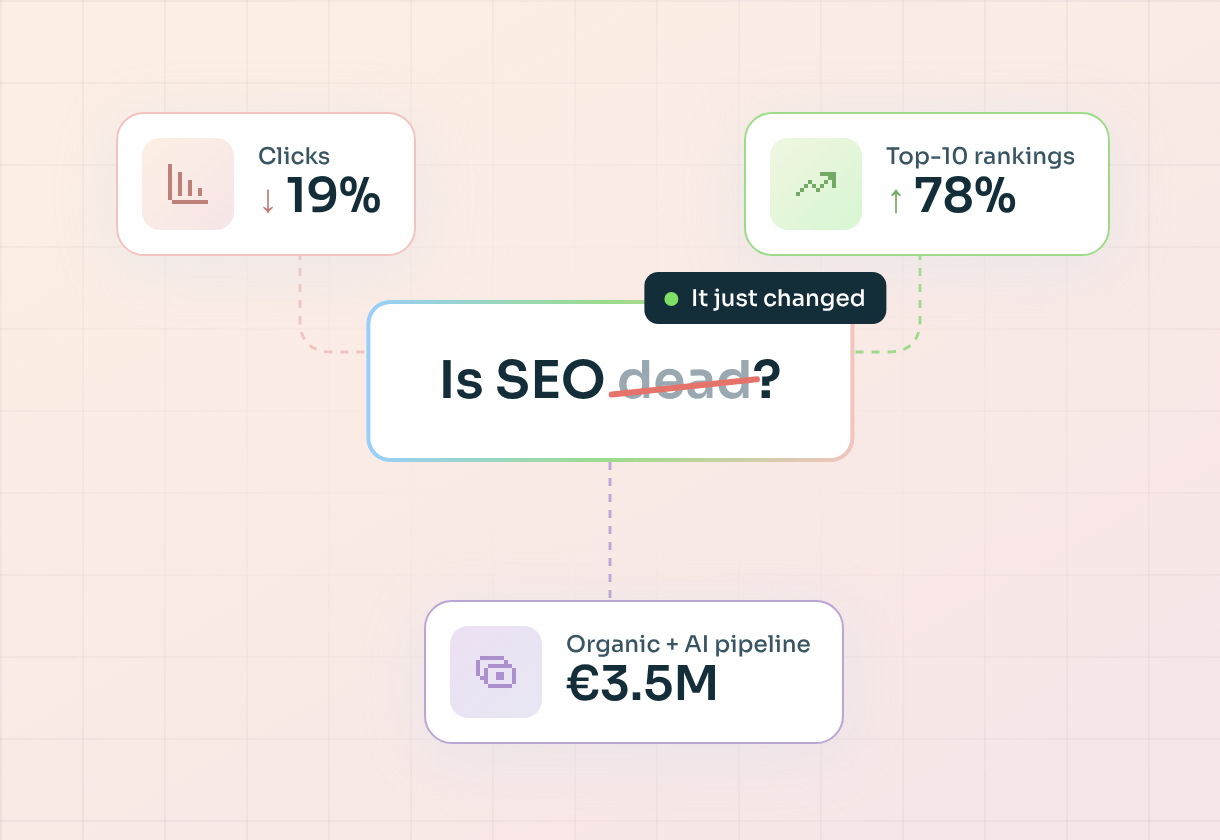
Our guide to SEO for lead generation goes deeper into the reporting set-up, and our article on whether SEO is dead explains why clicks alone are no longer a reliable measure of success.
With tracking in place, the last question is how to make the number go up.
How to improve the ROI of your SEO efforts
The fastest way to improve SEO ROI is to spend the same budget on SEO initiatives that sit closer to revenue. More website traffic is only useful if it’s targeted traffic with the right search intent. Across our client accounts, these are the levers that move ROI most.
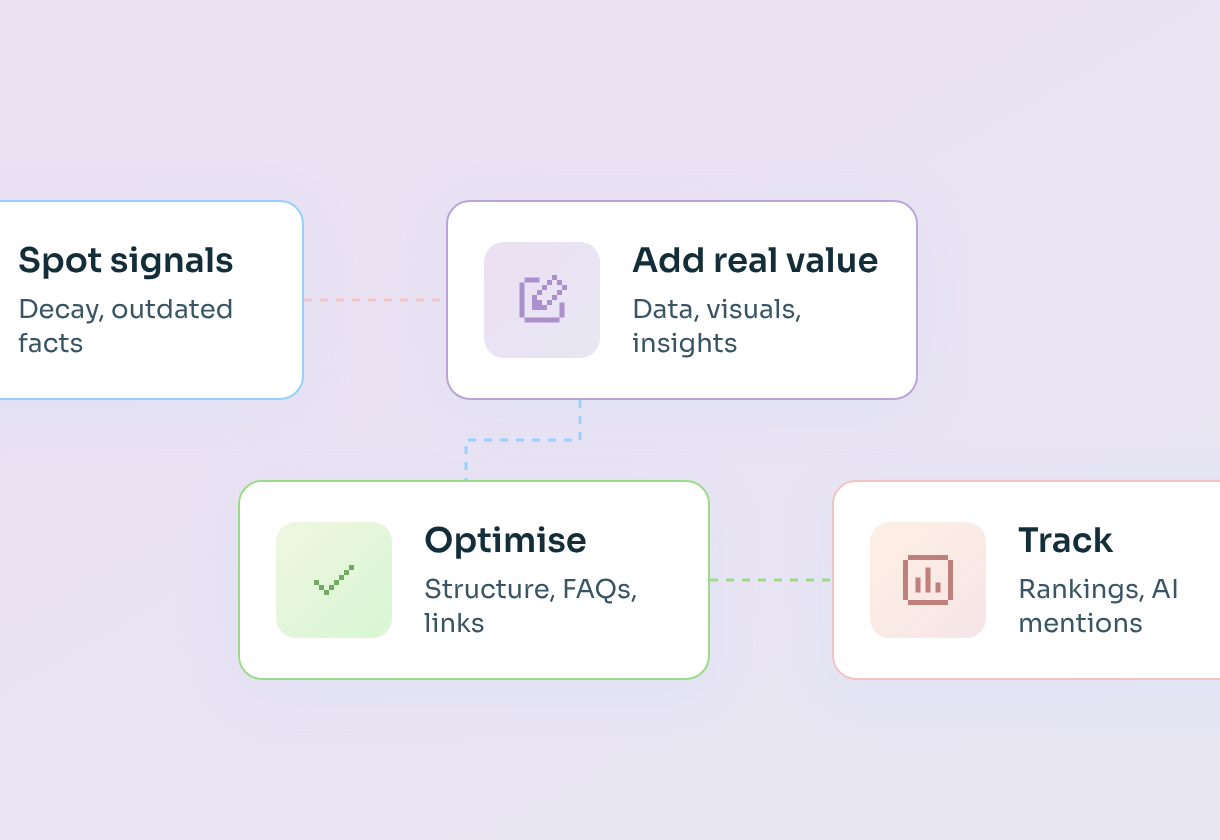
Start with bottom-of-funnel content: comparison pages, alternatives pages, “best X for Y” articles and use-case and integration pages. They target buyers who are already shortlisting, so their organic visitors convert at much higher rates than readers of educational content – even when their search volume is tiny, as we explain in our guide to low search volume keywords. Then protect what you already have: refreshing pages that drive pipeline is usually cheaper than writing new ones, and pruning pages that bring no clicks or leads stops wasting crawl budget and editorial time.
Finally, invest in visibility beyond your own website. Domain authority still matters for search engine rankings, but in a modern SEO strategy and wider digital marketing mix, mentions count as much as links. Third-party listicles, review sites and community mentions feed the AI answers that now drive a growing share of B2B SaaS pipeline – and they’re a big part of why Introw now sees most of its search-sourced deals coming from AI assistants.
The bottom line
SEO ROI in B2B SaaS isn’t a mystery. It’s a funnel: ARR goal, customers, pipeline, SQLs, MQLs and traffic, each with a number you can track. Start from the revenue you need, build a forecast with your own conversion rates, track every deal’s source in your CRM and judge the result over two to three years rather than one.
Do that, and the question “what are we getting back for this?” gets a clear answer – how much value SEO creates, in euros, not in clicks.

00:00
/
00:00
Want a forecast built from your own ARR goals? Book a call with us and we’ll show you what organic and AI search would need to deliver for your business – and what it would take.
FAQs
How do you calculate SEO ROI?

Use the formula (revenue from SEO − SEO costs) ÷ SEO costs × 100. In B2B SaaS, count revenue as closed-won ARR or customer lifetime value from deals sourced by organic and AI search, and include all costs: agency or team, content, links, tools and development.
What is a good ROI for SEO?
For B2B SaaS, a return of at least 1x over the first two years is a sensible minimum, and 2–4x is a strong result. Because SEO compounds, ROI usually keeps improving in years two and three as content keeps ranking without new spend.
How long does it take to see ROI from SEO?
Early signals such as rankings and the first MQLs usually appear within one to three months of publishing, but full payback typically takes 12 to 24 months, depending on your sales cycle, ACV and how competitive your market is.
Is there an SEO ROI calculator?
Yes. Our free organic revenue goals calculator works backwards from your ARR target to the traffic, MQLs and SQLs you need, and our content ROI calculator shows when your content investment pays back.
Why is SEO ROI hard to measure?
Mostly because of tracking gaps: long sales cycles, multiple touchpoints, AI search visits that show up as direct traffic and CRMs that don’t record the original source of deals. With proper conversion tracking, source attribution and self-reported attribution, it becomes measurable.
Is SEO better ROI than paid search?
Over the long term, usually yes. Paid search and paid ads deliver results immediately but stop when you stop paying, while SEO builds an asset that keeps bringing in buyers and continues to generate revenue. Most B2B SaaS companies get the best result from using both, with paid search covering demand while SEO compounds.



“SaaStorm became a key part of our inbound motion. Their SEO and content support helped us scale a consistent flow of high-intent traffic and build a content engine that supported £250K+ in inbound revenue. They plugged into our system and delivered every step of the way.”
Jonny Butler, Head of Marketing at OneUp
Related posts