Back to blog
Claude SEO Guide: How to Rank in Claude in 2027


- You don’t “rank” in Claude the way you rank on Google. There’s no position one. When Claude decides it needs fresh information, it writes its own search queries, pulls back a set of web pages, reads them and cites the specific passages it used. Claude SEO is the work of being found, read, trusted and quoted in that process.
- Claude’s web search has been reported to run on Brave’s index, not Google’s. TechCrunch reported it in March 2025, and Anthropic’s own Claude for Government help page says its web search connector calls the Brave Search API. So a page that ranks well on Google can still be invisible to Claude. Start with our Brave SEO guide if you haven’t checked Brave yet.
- Anthropic runs three crawlers with three different jobs. ClaudeBot collects training data, Claude-SearchBot improves search results, and Claude-User fetches pages when someone asks Claude to read a URL. Blocking Claude-SearchBot or Claude-User while expecting citations is the most common own goal I see.
- Claude quotes passages, not websites. A web search citation in Claude’s API includes the URL, the page title and up to 150 characters of cited text. Your key claims need to be short, specific, self-contained sentences that still make sense when lifted out of the page.
- How you measure Claude changes the answer completely. For one of our sales-tech SaaS clients, a tool that runs Claude without web search showed the brand in 4.4% of answers. A tool that runs Claude with web search showed it in 37.2% of answers, with the client’s own website as the most retrieved domain in Claude.
- Claude traffic is small but it converts. For an HR tech SaaS client, claude.ai sent 132 sessions in 12 months, with a key event rate of 5.3%, almost four times the site average.
- What to do: let Claude-SearchBot and Claude-User in, make sure Brave has your key pages, put the answer in the first 100 words, write quotable facts, keep your entity information consistent, earn mentions on the third-party sites Claude reads, and track Claude visibility with web search switched on.
If you’re a CMO, Head of Marketing or SEO lead at a B2B SaaS company, this guide is for you. A year ago, almost nobody asked me about Claude. Now it comes up in nearly every client call. CMOs tell me their own teams live in Claude, their sales reps see demo requests where the prospect “found us in Claude”, and they want to know why their brand shows up for some questions and not for others.
I said it on a client call in November, and I still think it’s the simplest way to put it:
“Claude became a key LLM for everyone.” – Romana Kuts, Founder at SaaStorm, on a client call in November 2026
It’s written for marketing leaders who already have a solid Google foundation and want to know what it takes to get cited in Claude. It matters because Claude finds sources through a different search index from Google, so your Google rankings don’t automatically carry over. By the end, you’ll know how Claude chooses sources, what to fix on your site this week, and how to measure Claude visibility without fooling yourself.
I’ll walk you through how Claude web search works, which Anthropic crawlers to allow, why Brave matters so much, how to write pages Claude can quote, and how we measure Claude for our clients. I’ll share anonymised data from three of our B2B SaaS clients, including one where the “Claude score” jumped from 4% to 37% just by measuring it properly.
What is Claude SEO?
Let me start with a definition, because “Claude SEO” sounds like a made-up term, and partly it is.
Claude SEO is the work of making your website and brand discoverable, retrievable and citable by Claude, Anthropic’s AI assistant. That includes two things:
- Being mentioned when Claude answers from what it already knows (its training data).
- Being cited when Claude searches the web and links to sources in its answer.
One quick note, because you’ll see it if you search the term: “Claude SEO” also gets used for something else, which is using Claude AI as a tool to do SEO work. That’s a real and useful thing (and I’ll cover how we use it near the end of this guide), but this article is mainly about the first meaning: getting your brand cited in Claude’s answers.
The second part, being cited, is where most of the opportunity sits for B2B SaaS. When a buyer asks Claude “what are the best tools for X” or “how do I solve Y”, Claude often runs a web search, reads a handful of pages and builds the answer from them. If your page is one of them, you get named, linked and sometimes clicked.

How does Claude search the web?
Before you optimise anything, it helps to see what Claude actually does when it searches. It’s quite different from a person typing a query into Google.

Claude decides whether to search at all
Claude doesn’t search for every question. If it can answer from training data, it often will. If the question needs current information (prices, recent news, “best tools in 2026”, a specific company’s details), or the user asks it to look something up, Claude runs a web search. Users can also switch web search on or off in their settings, and Claude can also fetch a specific URL or browse pages when a user pastes a link.
That’s why the same brand can be invisible in one Claude answer and cited in the next. Different question, different mode.
Claude writes its own queries
Here’s the part most marketers miss, and it’s basically the key to the whole subject. The buyer’s prompt is not the search query. Claude turns a long, conversational question into one or more short search queries, often several in a row, refining them as it reads results. A prompt like “we’re a 200-person SaaS company moving into EMEA, what should we look at for hiring in Germany?” might become three or four separate searches.
So you’re not optimising for the prompt. You’re optimising for the many smaller queries Claude generates from it, which look a lot like classic long-tail search queries.
Claude reads the pages and cites passages
After searching, Claude fetches the most promising pages, reads them and writes its answer. Anthropic’s documentation says citations are always enabled for web search, and each citation points to specific source material. In the API, a web search citation includes the URL, the title and up to 150 characters of cited text.
So the target is not a SERP position. It’s a chain of five steps:
- Be discovered by Claude’s search systems.
- Be retrievable when Claude fetches the page.
- Be selected as a credible source for the query.
- Be quoted for a specific claim.
- Be linked in Claude’s citations.
Every section below maps to one of those steps.
Claude, Brave and why your Google rankings aren’t enough
This is the section I’d ask every CMO to read twice, because it explains most of the “but we rank number one on Google” frustration.
When Anthropic launched web search for Claude in March 2025, TechCrunch reported strong evidence that it runs on Brave Search. Anthropic had added Brave Search to its list of data subprocessors, and developer Simon Willison found that Claude’s citations matched Brave’s results for the same queries. Anthropic’s own help page for Claude for Government states that its web search connector calls the Brave Search API. For the commercial Claude apps, Anthropic doesn’t name the provider publicly, so I’d treat Brave as “very likely, not officially confirmed”.
Why does that matter? Because Brave runs its own independent index of more than 40 billion pages. It doesn’t copy Google’s results. A page can rank first on Google and not be in Brave at all, or rank on page three there.
I wrote a full Brave SEO guide on exactly this, so I won’t repeat it all here. The short version for Claude:
- Check Brave first. Search site:yourdomain.com on search.brave.com, then check your ten most important URLs one by one.
- Keep Googlebot happy. Brave says its crawler follows the same crawl limits as Googlebot, so if Googlebot can’t crawl a page, Brave won’t either.
- Use noindex, not robots.txt, to keep pages out. Brave can still index URLs that are blocked in robots.txt.
- Ask Brave to re-fetch updated pages through its submit page at search.brave.com/submit-url.
And don’t drop Bing. Microsoft Copilot and many other AI tools still sit on Bing’s index, and Bing Webmaster Tools now shows AI citation data. Our Bing SEO guide covers that side.
Which Anthropic crawlers should you allow?
Now that you know where Claude looks, the next question is whether Claude is allowed in. This is the quickest win in this whole guide, and I still find it broken on more sites than you’d expect.
Anthropic uses three separate crawlers, and they do very different jobs:

Anthropic says all three respect robots.txt, and a rule that names a specific bot takes priority over a general one.
A robots.txt setup for most B2B SaaS sites
If you want to be cited in Claude but you’re unsure about training, here’s a sensible starting point:
Personally, for most B2B SaaS companies I’d allow ClaudeBot too. Being part of what Claude “knows” helps you get named even when Claude doesn’t search, and your marketing pages aren’t a trade secret. But that’s a business decision for you and your legal team, not an SEO default. What I would never do is block Claude-SearchBot or Claude-User and then wonder why Claude doesn’t cite you.
Check your firewall, not just robots.txt
Robots.txt is only half of it. A lot of sites block AI crawlers at the CDN or firewall level without anyone in marketing knowing. Cloudflare, for example, has offered settings to block AI bots with one click, and some security tools do it by default.
- Do we block any AI crawlers in our CDN, WAF or bot protection settings?
- Do our server logs show requests from ClaudeBot, Claude-SearchBot and Claude-User?
- Do those requests get a 200 response, or a 403, a challenge page or a timeout?
If you can’t answer those, you don’t actually know whether Claude can read your site.
The technical checklist: make every key page readable
Once the doors are open, Claude still needs to read what’s behind them. Claude can’t cite what it can’t fetch or parse, and AI crawlers are often less patient than Googlebot with heavy JavaScript.
Here’s the checklist we run for clients on their priority pages:
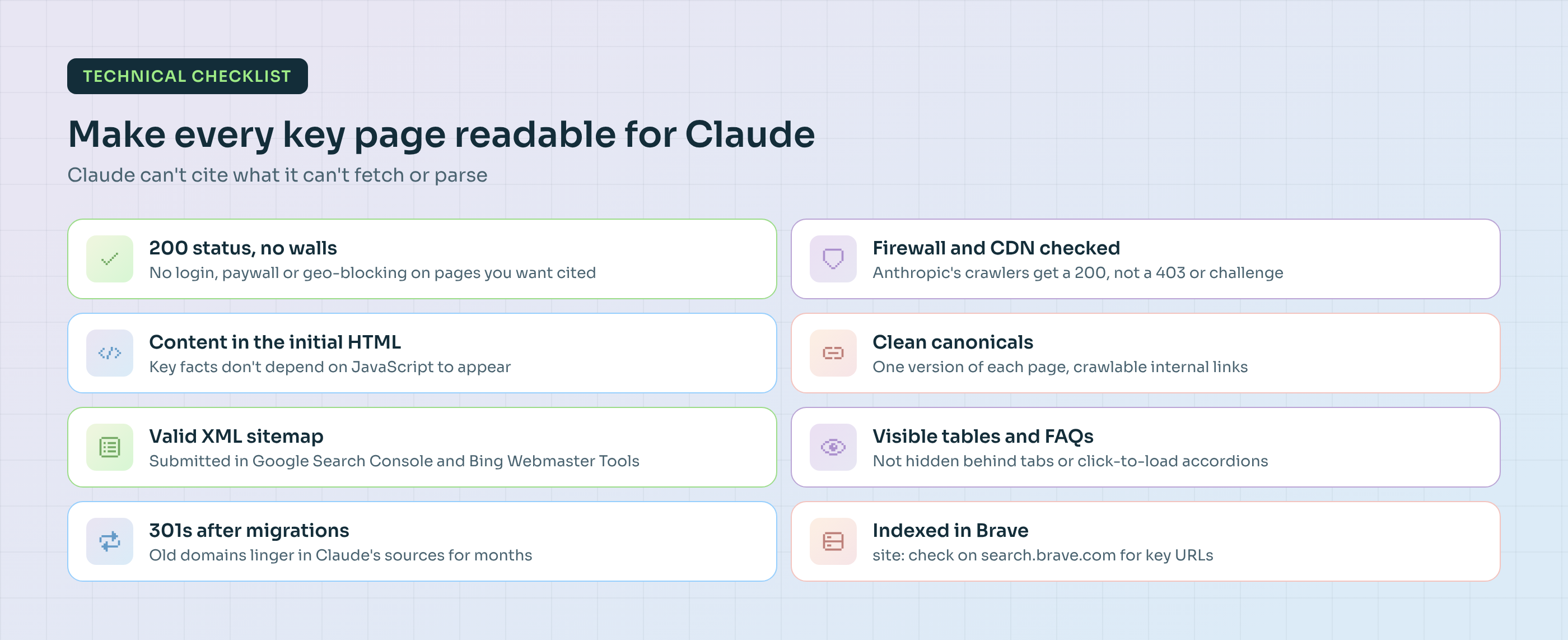
- Return a 200 status on every page you want cited, with no login wall, paywall or geo-blocking.
- Put the important content in the initial HTML. If your pricing table, comparison data or FAQ only appears after JavaScript runs, assume Claude may not see it.
- Use clean canonical URLs and avoid several versions of the same page.
- Keep a valid XML sitemap and submit it in Google Search Console and Bing Webmaster Tools.
- Use crawlable internal links with descriptive anchor text.
- Keep HTTPS working and fix broken resources.
- Make tables, FAQs and key facts visible by default, not hidden behind tabs, accordions that load on click, or “read more” buttons.
- Don’t let key pages get deleted or 404 quietly. A deleted page can’t be cited, and Claude may keep sending people to a dead URL from an old answer.
- Redirect properly after migrations. More on this one in the data section below, because we saw it happen in real life.
None of this is new SEO. It’s the same technical foundation that helps you on Google. The difference is that AI crawlers forgive less.
How to write pages Claude can cite
Technical access gets you into the room. Writing is what gets you quoted. And because Claude cites passages rather than whole websites, the way you write a page matters more than ever.
Write short, self-contained, verifiable statements
Remember the 150 characters of cited text? That’s roughly one or two sentences. Each important claim on your page should work as a standalone quote.
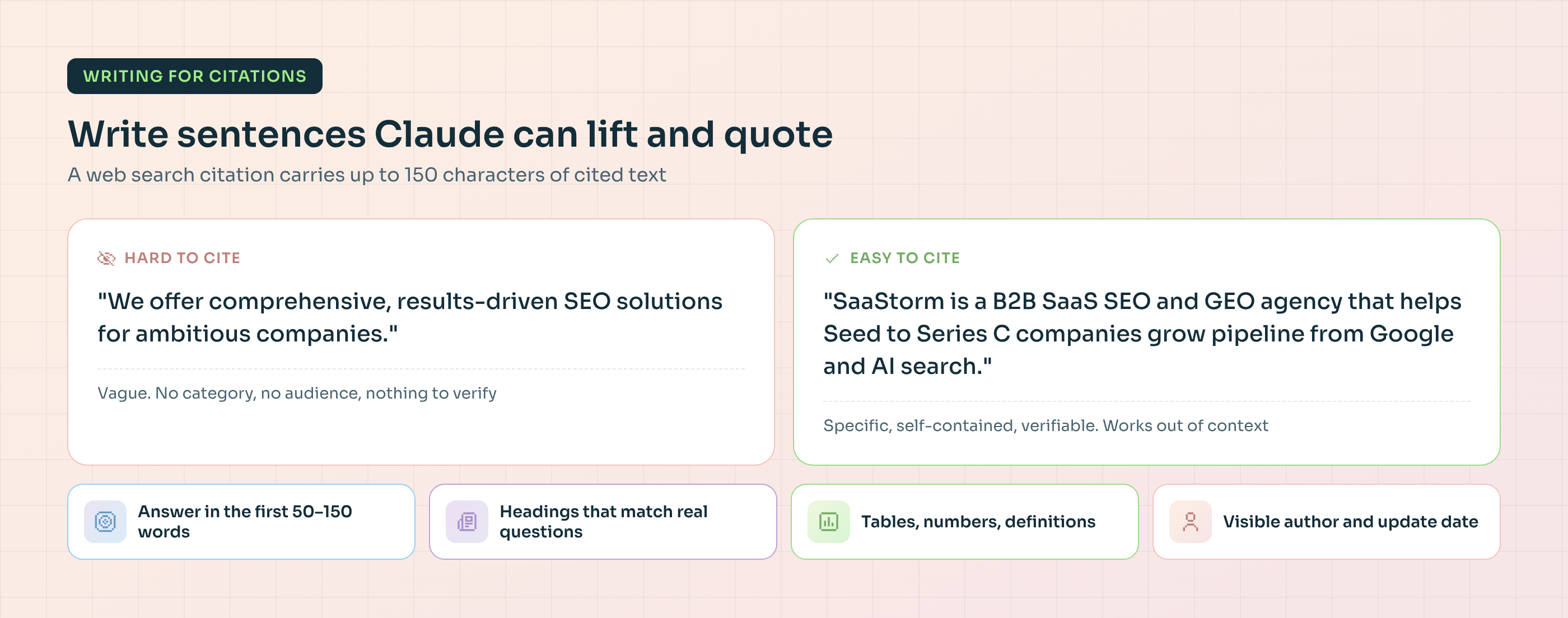
Here’s the difference, using our own service pages as an example.
Instead of:
“We offer comprehensive, results-driven SEO solutions for ambitious companies.”
Write:
“SaaStorm is a B2B SaaS SEO and GEO agency that helps Seed to Series C companies grow pipeline from Google and AI search.”
Or, for an informational page:
“A technical SEO audit should check crawlability, indexation, canonical tags, internal links, page speed, structured data and mobile usability.”
The first version says nothing Claude could use. The second and third are specific, factual and quotable. Claude can lift them straight into an answer and link to you. Think of every key line on the page as raw material for someone else’s answer.
Put the answer in the first 50 to 150 words
Claude reads a lot of pages quickly. If your intro is three paragraphs of “in today’s fast-moving digital landscape”, the useful bit may never get picked up. Answer the main question right at the top, then go into detail.
Structure the page around real questions
For every priority page, we use this structure:
- A direct answer in the first 50 to 150 words.
- Descriptive H2 and H3 headings that match real questions buyers ask.
- A short key takeaway or definition block.
- Comparison tables for alternatives, pricing, features or criteria.
- Step-by-step instructions for how-to topics.
- Original examples, screenshots, research or first-hand experience.
- Links to primary sources and official documentation.
- A visible author and a real “last updated” date.
- Structured data where it fits (Organisation, Article, FAQ, Product).
Use structured data, but keep key facts in plain text
Structured data is not a magic switch for Claude citations, by the way. It helps with clarity, but there’s no evidence that schema alone gets you cited. Treat it as hygiene, not strategy. The facts that matter most should always sit in plain text in the HTML, where any crawler or browser can read them without running code.
Build content around prompts, not just keywords
Claude responds to prompts, so your content plan should include the specific questions your buyers actually ask, not just the keywords they type into Google. For a B2B SaaS company, that usually means:
- “What’s the best [category] tool for [company type]?”
- “[Your brand] vs [competitor]: which is better for [use case]?”
- “How much does [category] software cost?”
- “How do I [solve the problem your product solves]?”
- “What should I look for when choosing a [category] vendor?”
Give each page one clear job. A cluster of focused pages usually beats one giant page trying to answer everything. That’s the same topic-cluster logic we use for Google, and it carries over well.
What our client data shows about Claude
Theory is nice, but I wanted to see what Claude actually does with real B2B SaaS brands. So I pulled data from our AI visibility tools and GA4 for three clients. They’re anonymised, but the numbers are real.
Lesson 1: Measure Claude with web search on, or you’ll get the wrong answer
This was the biggest surprise for me this year. We track AI visibility for clients with two tools: Scrunch and, more recently, Peec AI. In Scrunch, Claude runs without web search. In Peec AI, Claude runs with web search, so you see what sources it actually retrieves and cites.
For one sales-tech SaaS client, look at the difference:
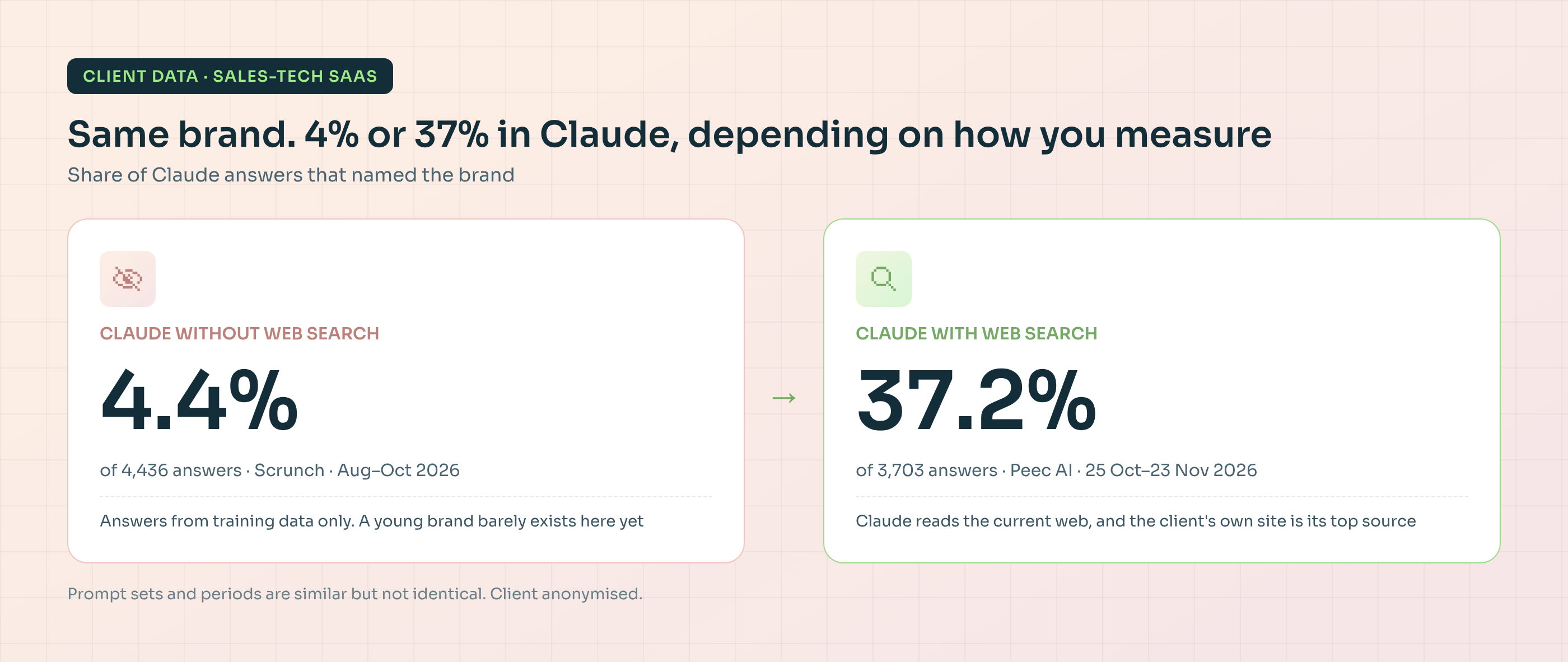
Same brand, similar prompt set, completely different story. The prompts and periods aren’t identical, so it’s not a perfect lab test, but the gap is far too big to be noise. Without web search, Claude answers from training data, and a young brand simply isn’t there yet. With web search, Claude reads the current web, and this client’s content is strong.
That’s exactly why I told another client on a call:
“I removed Claude on purpose because I told you that Scrunch really didn’t do a good job with Claude and it shows 0.0, but it’s not true.” – Romana Kuts, Founder at SaaStorm, on a client call in November 2026
And it’s why we’ve been moving our AI visibility tracking to Peec AI.
Lesson 2: With web search on, Claude can be just as strong as ChatGPT
For the same sales-tech SaaS client, here’s how often the brand was named across AI platforms in Peec AI over the same 30 days (25 Oct–23 Nov 2026):
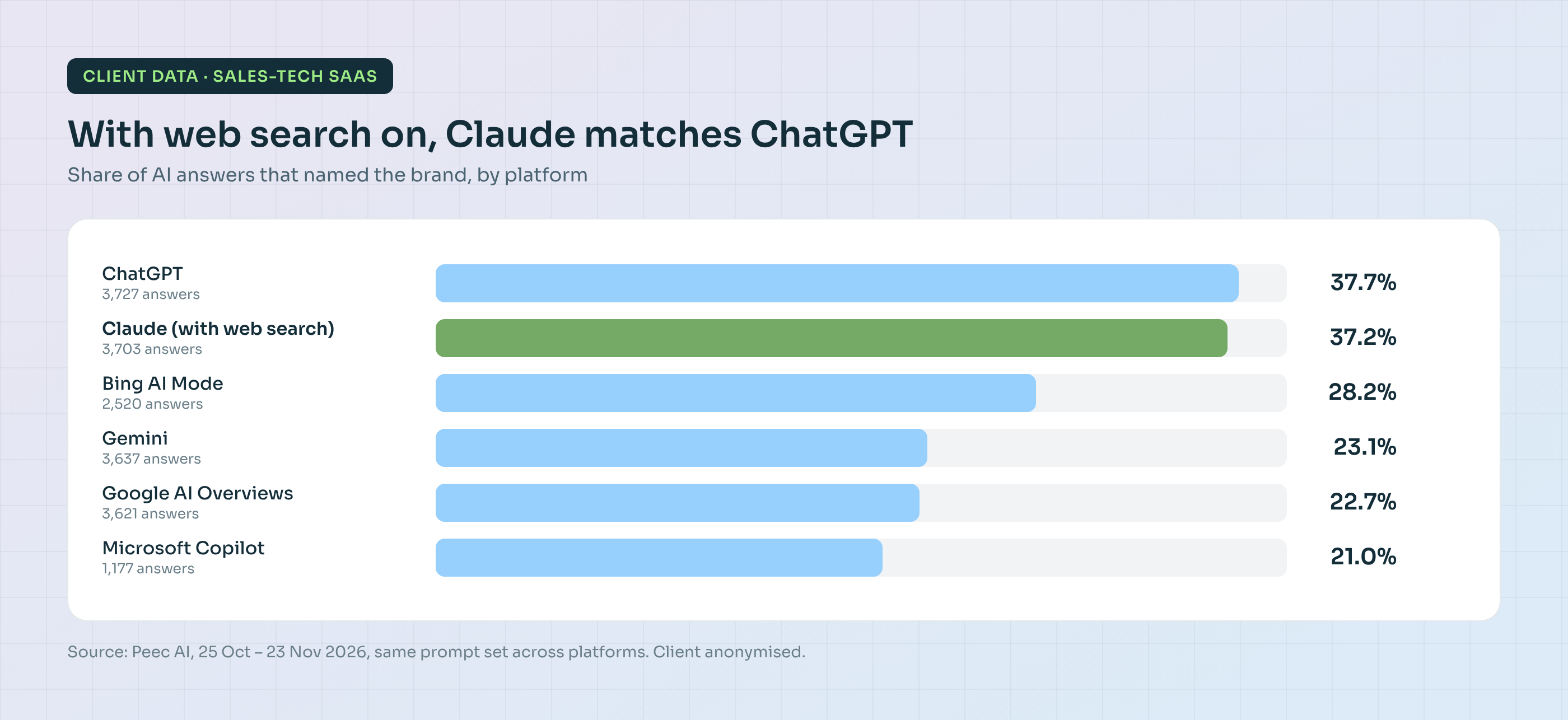
Claude sits right next to ChatGPT, ahead of Gemini and Google’s AI Overviews. When the brand was named in Claude, it was the first brand mentioned in about 17% of all Claude answers. That’s not a “nice to have” channel anymore.
Lesson 3: Your own website can be Claude’s number one source
The second thing Peec AI shows is which domains Claude retrieves and cites. Across 3,703 Claude answers in 30 days, Claude pulled pages from 1,192 different domains. The client’s own website was the most retrieved domain of all:

A few things jump out:
- Owned content works in Claude. When the page answers the question clearly, Claude retrieves it and cites it. On average, Claude cited the client’s site about three times in each answer that retrieved it.
- Old domains linger. This client moved to a new domain, and Claude was still retrieving the old one in 23% of answers a few months later. That’s a strong case for clean 301 redirects and for asking Brave to re-fetch your key URLs after a migration.
- Retrieved is not the same as cited. Wikipedia was retrieved in 6.8% of Claude answers but cited in only 1.6%. Claude reads more than it quotes, and it quotes the pages with clear, specific claims.
- Competitors and vendor blogs win with listicles and comparisons. The other top domains are mostly pages that list and compare tools. If you’re not on those pages, someone else is shaping how Claude describes your category.
Lesson 4: Training data still matters
For questions where Claude doesn’t search, it answers from what it already knows. And here the picture between clients is very different.

In Scrunch, where Claude runs without web search, our climate data SaaS client was named in 49.6% of 1,303 non-branded Claude answers between August and October 2026. That’s higher than in ChatGPT for the same client (37.3%). Our HR tech SaaS client was named in 0 of 1,616.
The difference? The climate data client has been publishing data-led content and earning mentions in industry media for years, so it’s well established in what models learned. The HR tech client is in a crowded category where a handful of big brands dominate the conversation. You can’t fix training data overnight. But the content and mentions you build today are what the next models learn from.
Lesson 5: Claude traffic is small, but it’s very good traffic
Finally, does any of this turn into visits and leads? For our HR tech SaaS client, GA4 shows claude.ai as a referral source between 24 November 2025 and 23 November 2026:

- 132 sessions from claude.ai in 12 months.
- 60.6% engagement rate, 53% above the site average.
- 13 key events, a key event rate of 5.3%, almost four times the site average.
132 sessions won’t change anyone’s quarter. But a visitor who comes from Claude has usually already read a summary that mentions you, so they arrive warmer. Another of our clients has had demo requests coming in from Claude and other LLMs, which is exactly the kind of pipeline that rarely shows up as a big traffic number.
Build entity clarity so Claude knows who you are
Now let’s move from your pages to your brand. Claude needs to understand who you are, what you do and why you’re credible. The clearer and more consistent that picture is across the web, the easier it is for Claude to describe you correctly.
Keep these consistent everywhere, from your website to LinkedIn, G2, Crunchbase and partner pages:
- Company name and how you describe your category.
- Founder and author names.
- Location and the markets you serve.
- Website URL and social profiles.
- Product and service descriptions.
- Pricing model, if you share it publicly.
On your own site, make sure you have a clear About page, real author pages with experience and credentials, Organisation schema, consistent contact details and dedicated pages for each product or service. If Claude finds three different descriptions of what you do, it’ll pick one, and it may not be the one you want.
Earn corroboration from third-party sources
A page is more credible when other sources say the same thing. That’s true for Google, and it’s even more visible in Claude, where you can literally see which domains it reads next to yours.
Here’s how we build that corroboration for B2B SaaS clients:

- Get into the listicles and comparisons that Claude already retrieves for your category. Check which pages it cites, then pitch the authors with real data or a product demo.
- Publish original research or data. Benchmarks, surveys and data studies get quoted by others, which puts your facts on more domains.
- Show up on review platforms like G2 and Capterra with recent, detailed reviews.
- Do podcasts, interviews and expert commentary in your niche.
- Publish case studies with real numbers and named customers where you can.
- Take part in communities where your buyers ask questions, and add actual value rather than links.
What doesn’t work is low-quality link spam. Claude reads the pages it cites, so a mention on a spammy directory does nothing for you. If you want to know how we approach links that actually move the needle for SEO and AI visibility, our SaaS link building guide explains our process.
How to measure Claude visibility
You’ve done the work, so how do you know if it’s paying off? There’s no Claude Search Console, no official citation report and no impressions data. You have to build your own measurement, and you have to be consistent.
These are the KPIs we track:
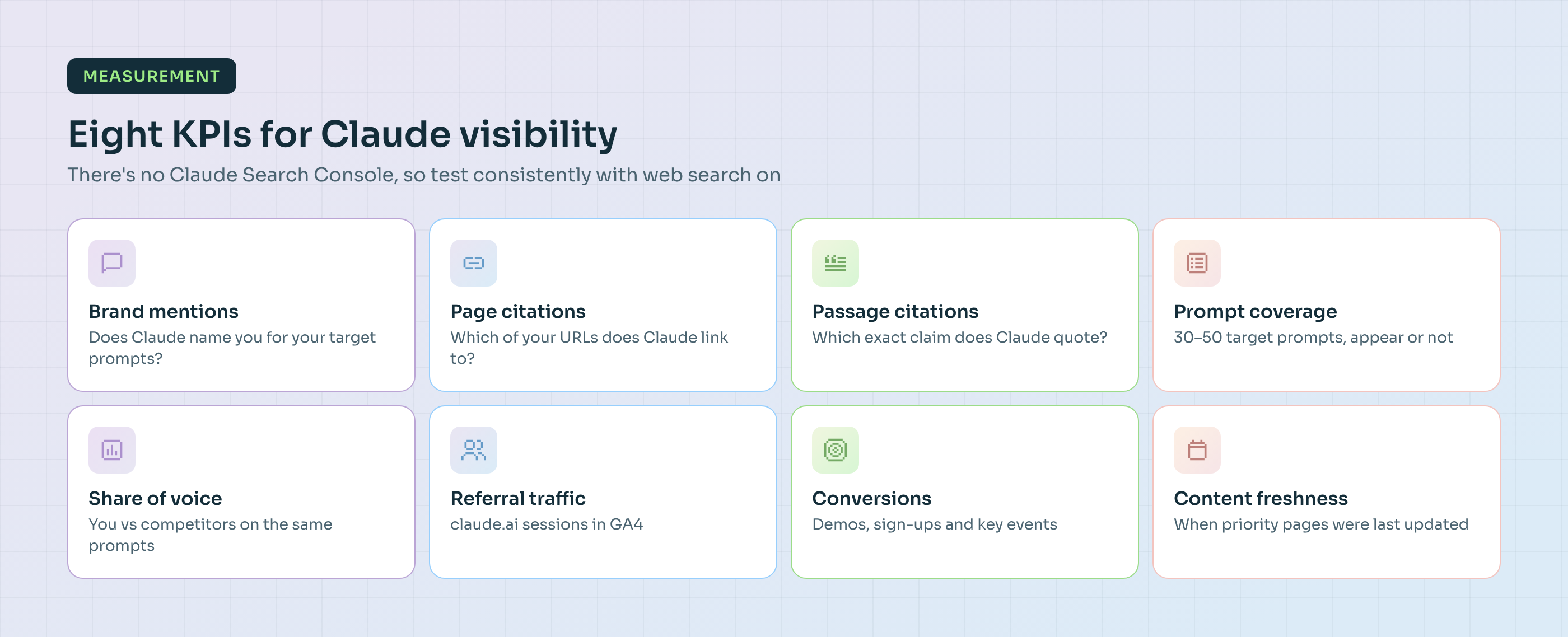
A few practical tips:
- Always test with web search on, in a clean chat, and note the date. Claude’s answers change with wording, user context, available sources and model updates.
- Use an AI visibility tool for scale. Manual checks are great for understanding, but you need hundreds of prompt runs to see a trend. Just check whether the tool runs Claude with web search.
- Track Brave too. Since Claude very likely uses Brave’s index, a page that drops out of Brave is a page Claude can’t find.
- Look at conversions, not just mentions. A brand mention that never turns into a visit or a branded search isn’t worth much.
A 90-day Claude SEO plan
If you want a practical starting point, this is the plan we use with clients. It’s roughly 90 days, and it builds from access to authority.

Days 1–14: Open the doors
- Review robots.txt for ClaudeBot, Claude-SearchBot and Claude-User.
- Decide your policy on training versus search visibility.
- Check CDN, firewall and bot protection settings, and confirm in server logs that Anthropic’s crawlers get a 200.
- Check whether Brave has indexed your top 20 pages.
- Write a list of 30 to 50 prompts your buyers actually ask.
Days 15–45: Make your pages citation-ready
- Rewrite intros so they answer the main question in the first 100 words.
- Add quotable facts, definitions, tables and FAQs.
- Improve headings, internal links and sources.
- Upgrade five to ten priority pages: product, comparison, pricing and your strongest guides.
- Add visible authors and real update dates.
Days 46–75: Build authority
- Earn mentions in the listicles and comparison pages Claude already retrieves for your category.
- Publish one original resource: research, a benchmark, a tool or a detailed guide.
- Make your company information consistent across the web.
- Build topic clusters around your core expertise.
Days 76–90: Test and improve
- Run your target prompts in Claude with web search on.
- Record mentions, citations and the passages Claude quotes.
- Find pages that get cited but don’t convert, and pages that never get cited.
- Add missing evidence, clearer answers and better structure.
- Refresh outdated pages with real updates, not just a new date.
The other Claude SEO: using Claude AI for SEO work
As promised, a short detour into the other meaning of Claude SEO, because most people searching the term want to know whether Claude can help with SEO. It can, and we use it every single day at SaaStorm. But it works best as part of a process, not as a replacement for one.
What Claude is good at in an SEO workflow
- Competitor analysis and content gaps. Give Claude your competitors’ top pages and your own sitemap, and it will point out relevant topics they cover and you don’t.
- Faster technical audits. A technical audit that used to take days can take minutes when Claude reads the crawl files for you. You still need to check what it flags.
- Analysing data at scale. Feed Claude a Google Search Console data export or a crawl file with thousands of URLs and it can find patterns in minutes: queries with high impressions and low clicks, pages with indexing issues, redirect chains, thin pages.
- Clustering keywords by search intent. Give it a raw keyword list from Semrush and ask it to group terms by intent and topic. It’s a fast first pass for a content plan.
- Drafting briefs and outlines from source documents like call transcripts, research PDFs and client reports.
- Technical details and code. Writing structured data, regex for redirects, robots.txt rules or small scripts, and explaining PageSpeed Insights output in plain text for a non-technical stakeholder.
- Internal linking suggestions based on the document content of your existing articles.
- Link building research. Backlinks are still a significant ranking signal in Google’s algorithm, and Claude helps scope a backlink campaign in a fraction of the time by sorting prospects and spotting newsworthy findings in your own data.
- Outreach emails for link building, as long as a human edits them and each one is built around something specific you’ve referenced from the site or posts of the person you’re contacting.
- Summarising product key features from release notes into page copy, comparison tables and FAQs.
How we set it up
Claude on its own has no proprietary database of backlinks or search volumes. The magic happens when you connect it to live data. We connect Claude to tools like Semrush, Surfer, Google Search Console and our AI visibility tracking through connectors (MCP integrations), and we use Skills (the same idea the OpenClaw community and Claude Code users share publicly): reusable instruction sets, usually written as md files, that tell Claude exactly how we run a recurring task, like a keyword cannibalisation check or a monthly report. That gives Claude the right context and keeps the output consistent from one request to the next.
For a marketing team, this kind of workflow automation is where the value is: research and first drafts that used to take days can take hours, and people spend that time on strategy and client work instead. The same goes for outreach: personalised emails that referenced a specific article on the target site tend to beat generic templates, and Claude makes that personalisation affordable at scale.
Where you still need a human
Here’s the catch: Claude is confident, but confidence is not accuracy. Always verify numbers against the source tool, check every claim before you publish, and keep control over strategy and editing. Claude can produce a first draft in an afternoon (and it won’t cost you much money on a paid plan), but the original insight, the client data and the judgement about what’s worth writing have to come from your team. Generic AI content with nothing new in it won’t rank on Google, and it won’t get cited by Claude either.
Common Claude SEO mistakes
Before we wrap up, here are the mistakes I see most often. Most of them are easy to fix once you know about them.
- Blocking Claude-SearchBot or Claude-User and still expecting Claude citations.
- Assuming Google rankings automatically carry over to Claude. Check Brave.
- Measuring Claude without web search and concluding you’re invisible.
- Publishing generic AI-written content with nothing original in it.
- Burying the answer under long introductions.
- Writing vague claims that can’t be quoted accurately.
- Ignoring third-party sources while competitors fill the listicles Claude reads.
- Treating structured data as a guarantee of citations.
- Leaving old domains or URLs without proper redirects after a migration.
- Measuring only traffic instead of mentions, citations and conversions.
The bottom line
Claude is now one of the places your buyers go to research vendors, and it finds sources in a different way from Google. It decides when to search, writes its own queries, very likely uses Brave’s index, reads a handful of pages and quotes specific passages.
The best Claude SEO strategy isn’t a trick. Let Anthropic’s search crawlers in, make sure Brave has your key pages, keep your pages technically clean, write clear and quotable content, keep your brand information consistent and earn mentions on the sites Claude already trusts. Then measure Claude properly, with web search on, and connect it to pipeline.
Want to know how your brand shows up in Claude, ChatGPT, Perplexity and Google’s AI features? Talk to our team and we’ll show you where you’re cited, where you’re missing and what to fix first.
00:00
/
00:00
FAQs
How do I rank in Claude?

You can’t rank in Claude the way you rank on Google, because there’s no fixed results page. To get cited, allow Claude-SearchBot and Claude-User in robots.txt and your firewall, make sure Brave Search has indexed your key pages, put clear answers and quotable facts on your pages, keep your brand information consistent and earn mentions on credible third-party sites.
Does Claude use Google or Brave for web search?
TechCrunch reported in March 2025 that Claude’s web search appears to use Brave Search, based on Anthropic listing Brave as a subprocessor and Claude’s citations matching Brave results. Anthropic’s Claude for Government help page says its web search connector calls the Brave Search API. Anthropic hasn’t publicly named the provider for every Claude product.
What is ClaudeBot?
ClaudeBot is Anthropic’s crawler that collects public web content that may be used to train its AI models. It’s separate from Claude-SearchBot, which helps improve Claude’s search results, and Claude-User, which fetches pages when a user asks Claude to read a URL. You can block ClaudeBot without blocking the other two.
Should I block ClaudeBot?
It depends on your business. Blocking ClaudeBot keeps your content out of future training data but doesn’t stop Claude from citing you through search, as long as Claude-SearchBot and Claude-User are allowed. For most B2B SaaS marketing sites, I’d allow all three, because being known to the model helps you get mentioned even when Claude doesn’t search.
How does Claude choose which sources to cite?
Anthropic hasn’t published a ranking algorithm. Claude decides whether to search, generates its own search queries, retrieves pages and cites the specific passages it used. In practice, pages that are indexed, accessible, clearly structured and full of specific, verifiable statements get cited more often.
How can I track Claude citations?
There’s no official Claude Search Console. Run your target prompts in Claude with web search on and record mentions and citations, use an AI visibility tool that runs Claude with web search, and track claude.ai referral sessions and conversions in GA4.
Can Claude do SEO?
Claude can help with a lot of SEO tasks: analysing Google Search Console data, clustering keywords by intent, writing briefs, structured data and outreach emails. It works best connected to live SEO tools, with a human who verifies the output and owns the strategy.
Is Claude SEO different from ChatGPT SEO?
The fundamentals are the same: be crawlable, clear, credible and well cited elsewhere. The biggest difference is the index. ChatGPT search has historically leaned on Bing and its own crawling, while Claude’s web search very likely uses Brave. So for Claude, checking your visibility in Brave Search matters more.


“SaaStorm became a key part of our inbound motion. Their SEO and content support helped us scale a consistent flow of high-intent traffic and build a content engine that supported £250K+ in inbound revenue. They plugged into our system and delivered every step of the way.”
Jonny Butler, Head of Marketing at OneUp
Related posts