Back to blog
How to Rank in Perplexity: A Perplexity SEO Guide for B2B SaaS

- You don’t “rank” in Perplexity the way you rank in Google. Perplexity searches the web in real time, picks a handful of sources, writes an answer and attaches numbered citations. Perplexity SEO is the work of becoming one of those cited sources, and of getting your brand named in the answer itself.
- Perplexity is the most generous AI engine for B2B SaaS sites. Across four of our clients (sales-tech, HR tech, climate data and retail tech SaaS), Perplexity had the highest citation rate of any AI platform we track for three of them, and the second highest for the fourth. For our climate data SaaS client, 49% of non-branded Perplexity answers cited their site between August and November 2026.
- Step one is technical: let PerplexityBot in. If you block PerplexityBot in robots.txt, your CDN or your firewall, Perplexity says it won’t index the full text of your pages. Then check that your key answers live in the initial HTML, not behind JavaScript, tabs or logins.
- Perplexity reads your site more than other AI tools do. For our sales-tech SaaS client, Perplexity pulled at least one page from the client’s domain in 57% of tracked chats, roughly double ChatGPT (28%) and more than three times Google’s AI Overviews (16%).
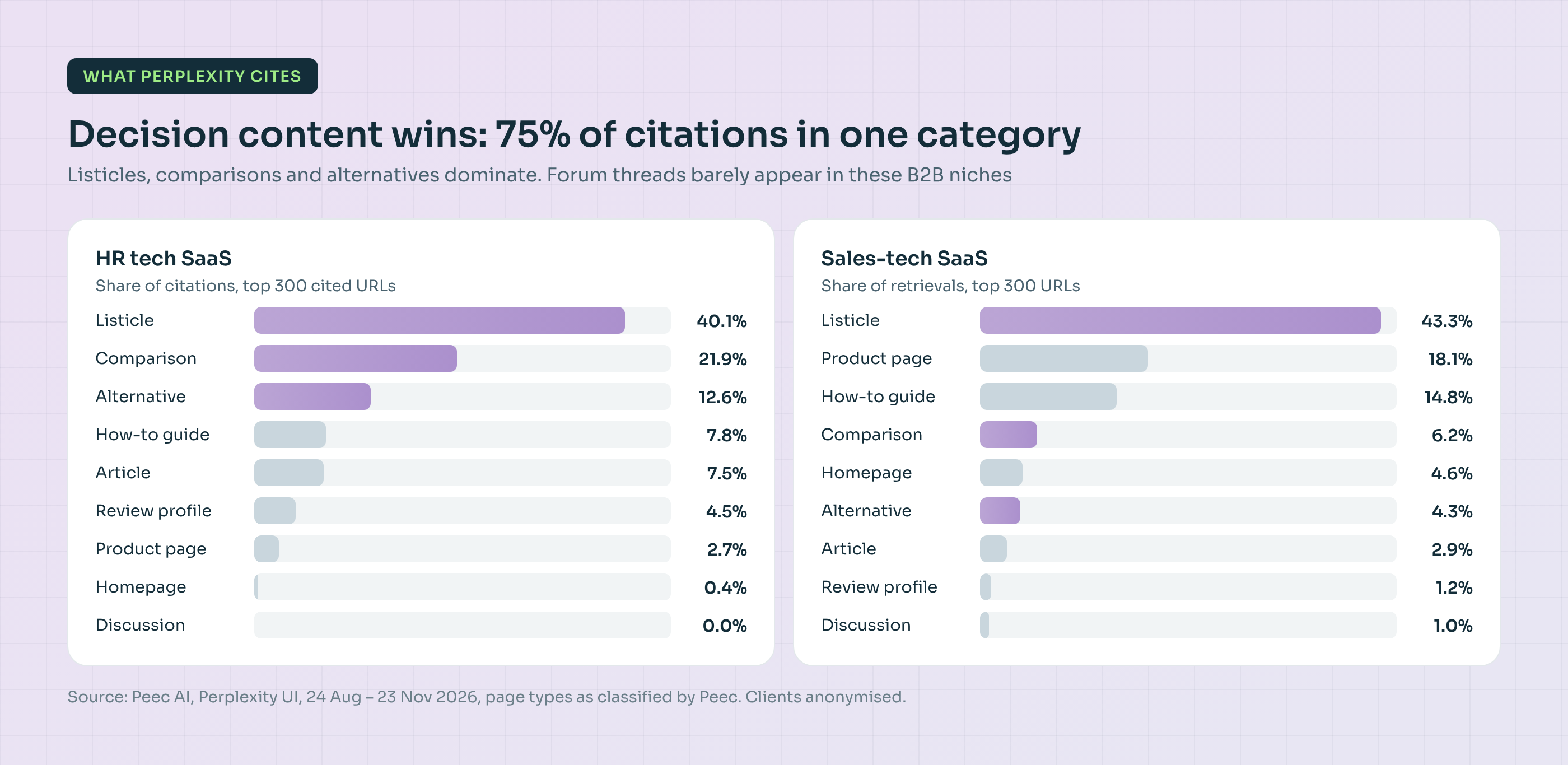
- Decision content wins citations. In our HR tech SaaS client’s category, listicles, comparisons and “alternatives” pages made up 75% of all citations across the 300 URLs Perplexity cited most. Reddit and forum threads barely showed up in that niche.
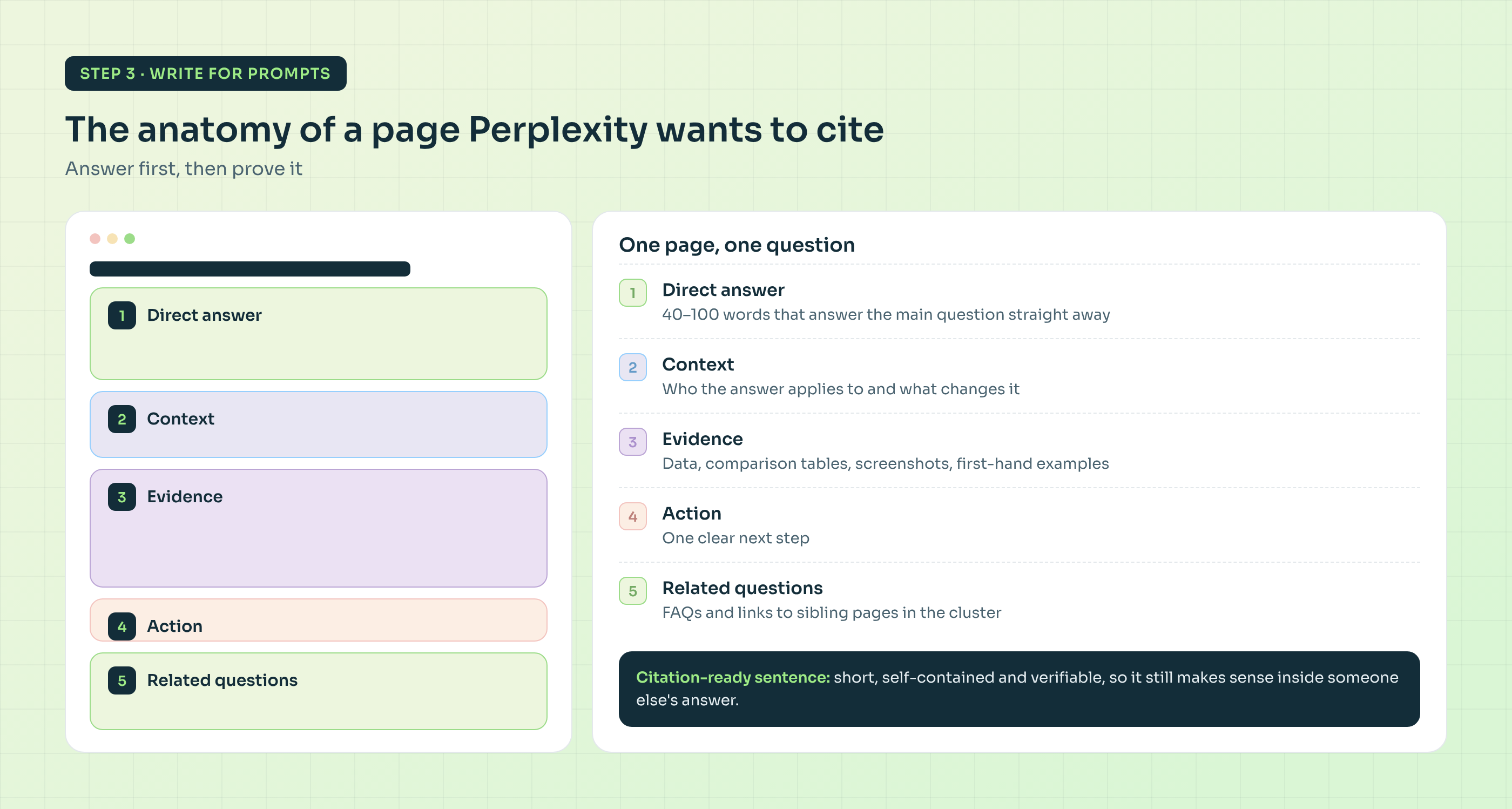
- Write for questions, not keywords. Put a direct 40 to 100 word answer at the top of each page, back it with data and examples, and add comparison tables and FAQs. Self-contained, verifiable sentences are easy for Perplexity to quote.
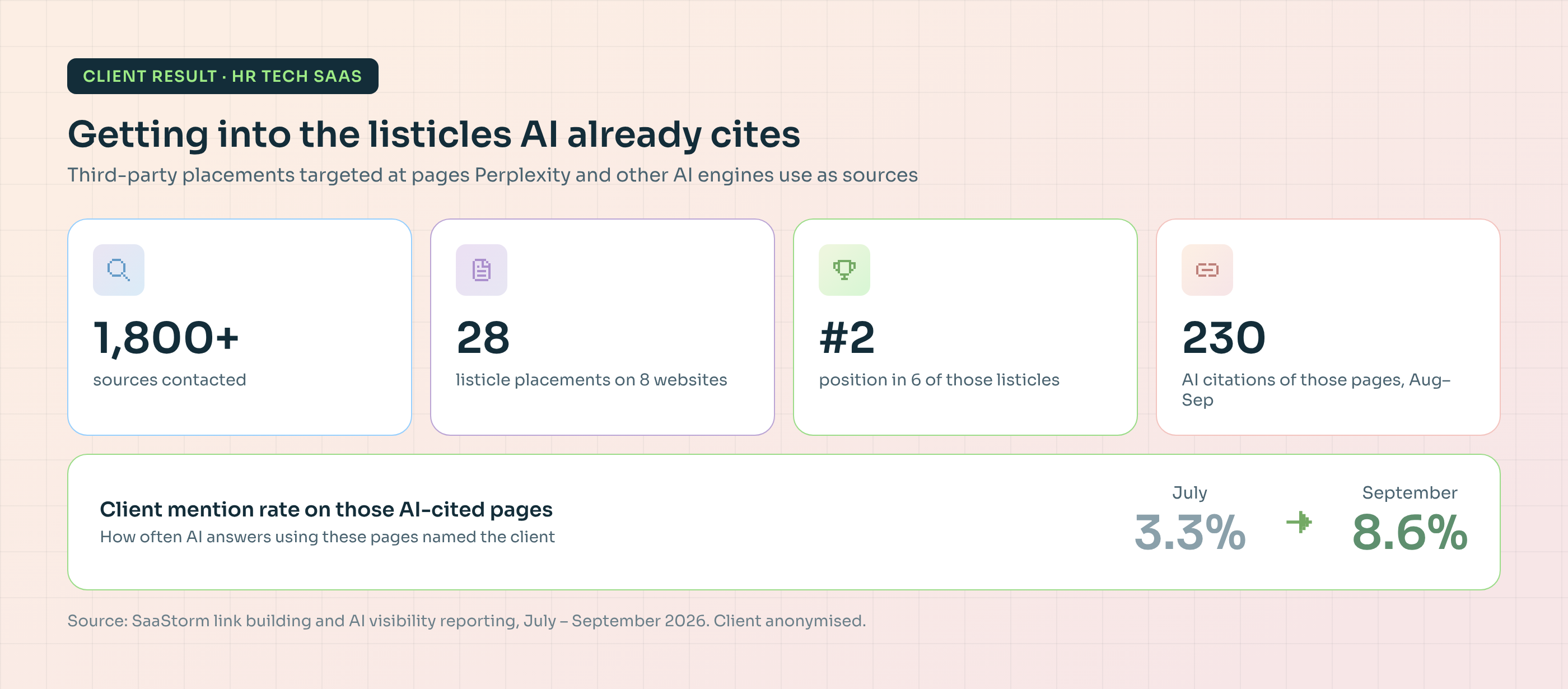
- Off-site mentions move the needle. When we got our HR tech SaaS client into 28 listicles on eight websites that AI tools already cite, the client’s mention rate on those pages went from 3.3% in July to 8.6% in September.
- Visibility and traffic are not the same thing. One client’s Perplexity presence more than doubled in Q3 while Perplexity sessions in GA4 fell. Track mentions, citations and referral traffic separately, and judge Perplexity by the quality of visits, not volume alone.
Perplexity is the AI tool I end up talking about most on client calls, and it’s not because it’s the biggest. ChatGPT has far more users. It’s because Perplexity is the one that shows its work. Every answer comes with numbered sources, so you can see exactly which pages it trusted, and that makes it the easiest AI engine to learn from and to influence.
“Perplexity, for example, can cite you, even give you like three or four sources.” – Romana Kuts, Founder at SaaStorm, on a quarterly report call with a climate data SaaS client
This guide is for CMOs, Heads of Marketing and SEO leads at B2B SaaS companies who already invest in SEO and want to know what it takes to get cited in Perplexity. It matters because Perplexity is where your buyers go when they want a researched answer with sources, often right before they build a shortlist, and in our client data it cites vendor websites more often than most AI engines. If you’re not in its sources, you’re not in that shortlist. By the end, you’ll know how Perplexity picks sources, what to fix first and how to measure progress.
I’ll walk you through how Perplexity works, the technical setup, how to write pages Perplexity wants to cite, what our client data shows about which pages get picked, and a 90-day plan. All client data is anonymised and comes from our AI visibility tracking in Scrunch and Peec AI, plus client analytics.
What is Perplexity AI SEO?
Perplexity SEO (sometimes called Perplexity optimization or Perplexity AI SEO) is the work of getting your pages retrieved and cited in Perplexity AI’s answers, and getting your brand mentioned when buyers ask about your category. It sits under the wider umbrella of AI search optimization and generative engine optimisation (GEO), but Perplexity has its own crawler, its own index and its own habits, so it’s worth treating as a channel in its own right.
Unlike traditional search engines, Perplexity doesn’t hand the user ten blue links. It’s an answer engine: it reads multiple sources, writes AI generated responses and shows the sources underneath. So instead of competing for a position, you compete for a place in the source list.
In short, AI search optimization is about earning citations, not keyword rankings. Two outcomes matter, and they’re not the same:

How Perplexity AI works (and why “ranking” is the wrong word)
Before we get into tactics, it helps to understand what happens when someone types a question into Perplexity, because the whole strategy follows from it.
From question to cited answer
Perplexity’s help centre describes the process simply: it interprets the question, searches the web, gathers information from sources such as articles, websites and journals, and compiles the most relevant points into an answer with numbered citations that link back to the original sources.
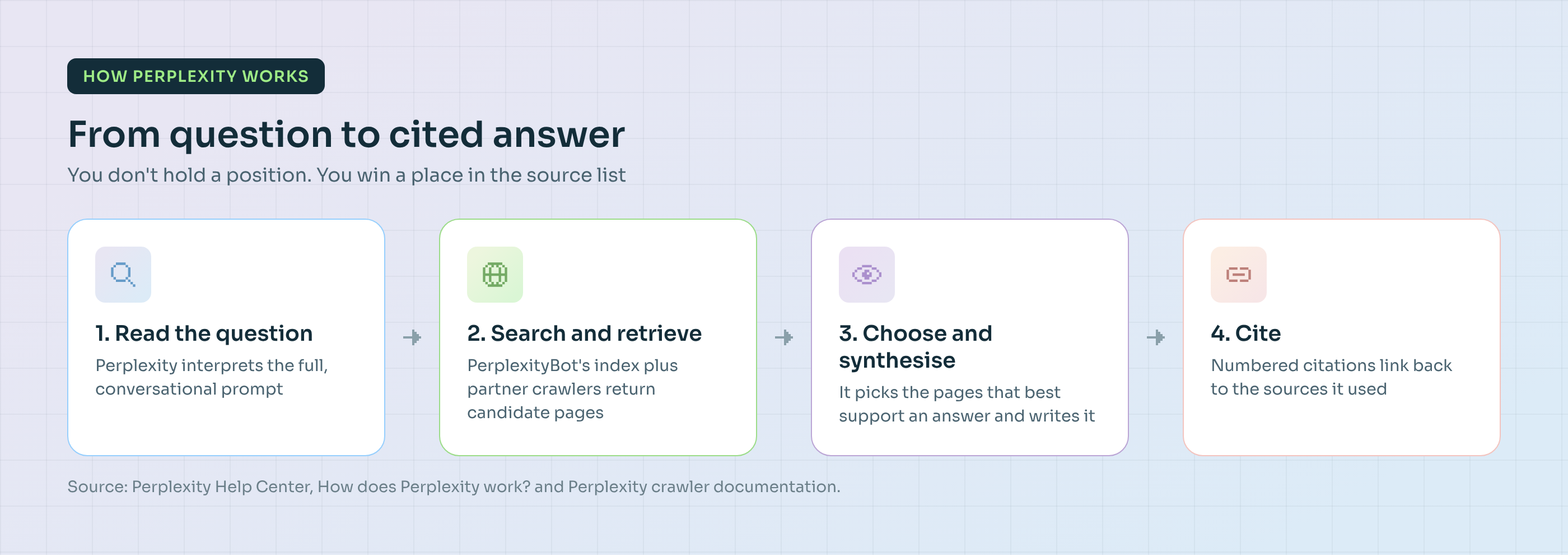
So the sequence is: retrieve candidate pages, choose a few, synthesise, cite. Your job is to be in the candidate pool, then be the most useful page in it. Perplexity uses natural language processing to understand the full question, so semantic relevance and contextual relevance matter more than exact-match keywords. Unlike Google, it isn’t trying to rank one page for a keyword; it’s trying to assemble the best evidence for one answer from multiple sources.
What Perplexity has (and hasn’t) said about ranking
Perplexity has not published a full source-ranking formula, and nobody can guarantee a citation. What it has said is useful, though:
- It runs its own crawler, PerplexityBot, which is designed to surface and link websites in Perplexity’s search results.
- It also partners with third-party crawlers to help build its index, so pages that are strong in Google, Bing and Brave are more likely to be discovered.
- It reviews whole websites when assigning source labels, looking at things like whether a site identifies its authors, corrects mistakes and separates news from advertising and opinion.
That’s a very traditional set of signals. Crawlability, a strong presence in traditional search, domain authority and credibility. Which is why I tell clients that good traditional SEO is still the foundation of good Perplexity visibility and AI search visibility in general. Traditional SEO tactics alone won’t get you cited, but relying solely on AI-specific tricks won’t either.
Why Perplexity matters for B2B SaaS AI search
Perplexity doesn’t have ChatGPT’s reach. But in our client data, it’s the AI engine that gives B2B SaaS websites the most credit among the AI platforms we track. Here’s the share of non-branded answers that cited each client’s own website, by platform, between 1 August and 23 November 2026 (Scrunch).
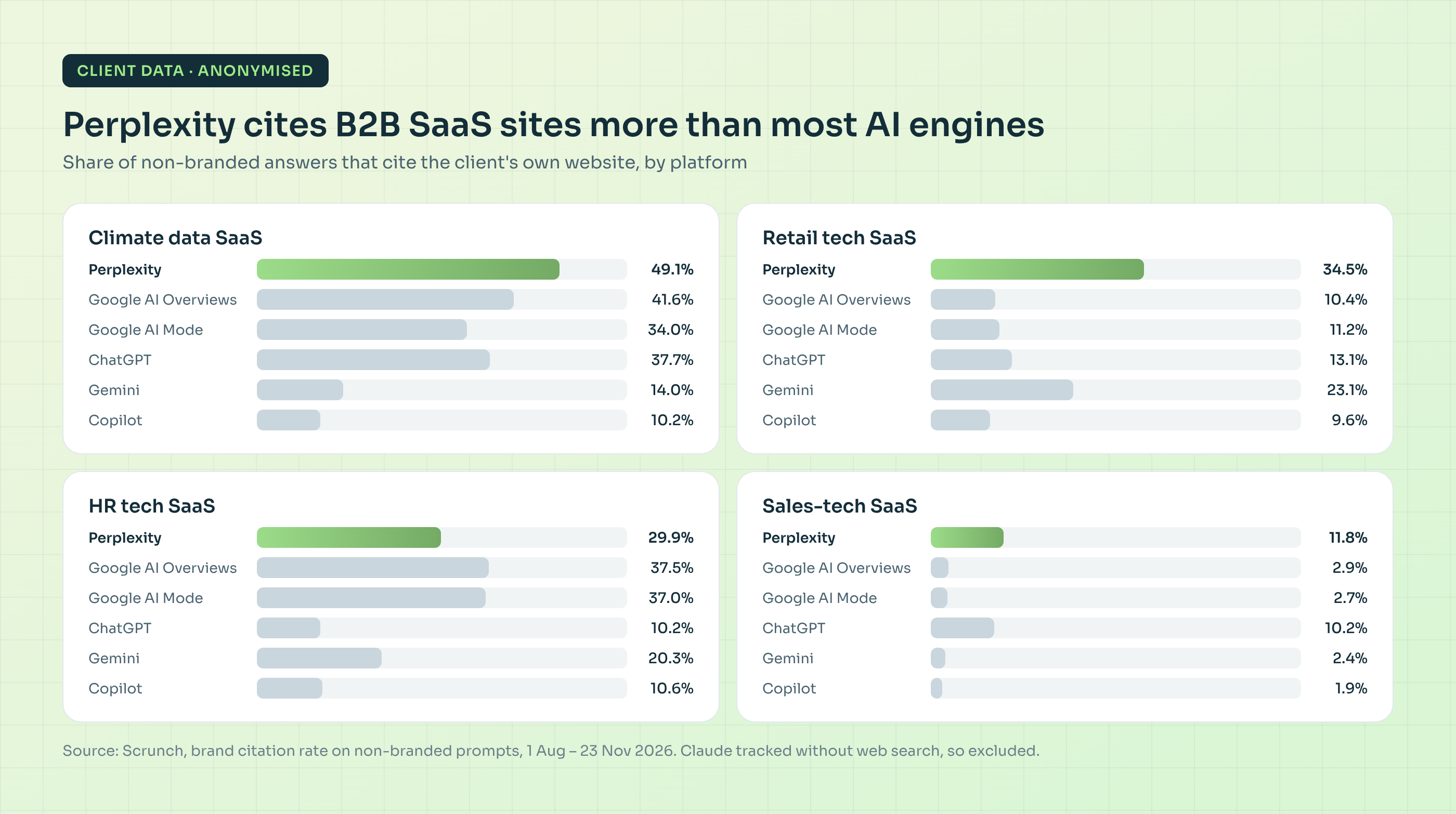
Perplexity had the highest citation rate for three of the four clients:
Claude cited none of them in this tracking, because Scrunch runs Claude without web search. If you’re curious how Claude finds sources when search is on, read our Brave SEO guide, since Claude’s web search has been reported to use Brave’s index.
So if you want to see quickly whether your content is AI-ready, Perplexity is the best place to look. Which brings us to step one.
Step 1: Let PerplexityBot crawl your site
Everything else in this guide is useless if Perplexity can’t read your pages. This is the boring part, and it’s where I find the most surprises in audits.
Allow PerplexityBot in robots.txt
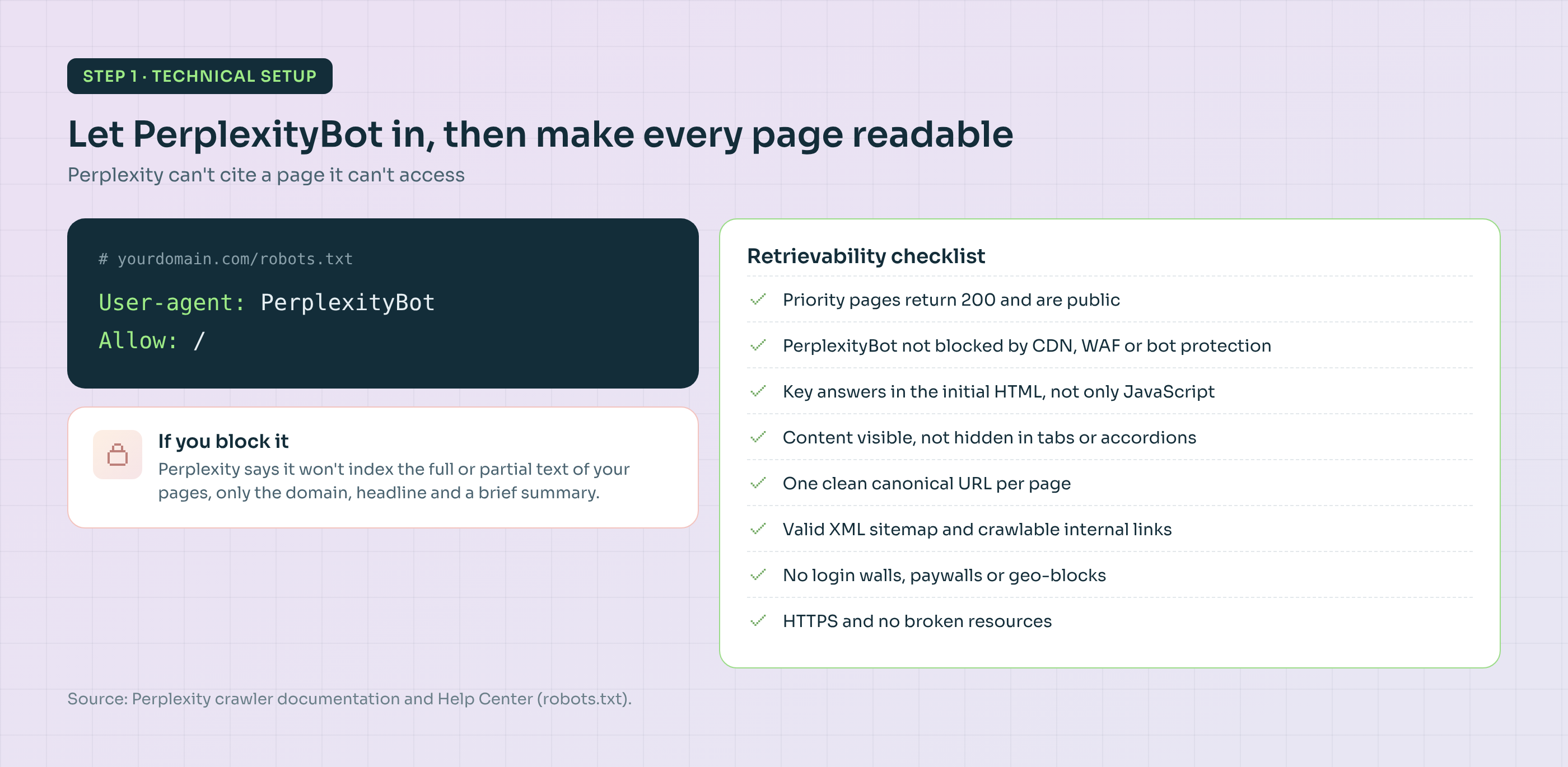
Perplexity’s documentation recommends allowing PerplexityBot in robots.txt and permitting requests from its published IP ranges. The simplest rule:
If you block PerplexityBot, Perplexity says it won’t index the full or partial text of your site. It may still show your domain, headline and a short factual summary, but that’s not enough to get cited for detailed questions.
Two things worth knowing:
- PerplexityBot is for search, not model training. Perplexity says it’s used to surface and link websites, not to train foundation models. So blocking it to “protect your content from AI training” mostly just removes you from Perplexity’s answers.
- There is a second user agent, Perplexity-User. It fetches a page when a user requested it, for example by asking Perplexity about a specific URL. It’s triggered by a person, not a crawl, so it doesn’t behave like a normal crawler. Don’t rely on it for discovery. You can spot both in your logs by their user agent string.
Check your CDN, WAF and bot protection
Many B2B SaaS sites sit behind Cloudflare or a similar web application firewall. Some “block AI crawlers” toggles quietly block PerplexityBot across the entire site even when your robots.txt allows it. Check your firewall rules against Perplexity’s published IP ranges, and look in your server logs for PerplexityBot requests that return 403 or 429 errors.
Make your pages readable on the first request
Perplexity can’t cite what it can’t read. Technical SEO comes first here. My technical optimization checklist for every priority page:
- The page returns a 200 status and is publicly accessible, with no login wall, paywall or geo-block.
- Key facts and answers are in the initial HTML, not only rendered by JavaScript.
- Important content is visible, not hidden behind tabs, accordions or “read more” interactions.
- One clean canonical URL, with no duplicate versions competing.
- A valid XML sitemap that updates automatically when you publish, so AI crawlers discover new content quickly, plus crawlable internal links with descriptive anchor text.
- Fast pages. Aim for load times under three seconds on your key templates.
- HTTPS everywhere, no broken resources and no broken internal links.
Don’t ignore Google, Bing and Brave
Because Perplexity uses partner crawlers as well as its own, your search visibility in Google Search, Bing and Brave helps content discovery in Perplexity too. If you haven’t set up Bing Webmaster Tools yet, our Bing SEO guide covers it, and the Brave guide covers checking Brave’s independent index. In practice, the sites that do well in Perplexity for our clients are the same ones with a healthy organic foundation.
Once Perplexity can read you, the question becomes: does it want to?
Step 2: Understand which AI search results Perplexity actually cites
This is where client data beats generic advice. We track thousands of buyer-style prompts for our clients, and the pattern in what Perplexity retrieves and cites is very consistent.
Perplexity reads your site more than other AI engines do
For our sales-tech SaaS client, we looked at how often each AI engine pulled at least one page from the client’s own domain (Peec AI, 24 August to 23 November 2026):
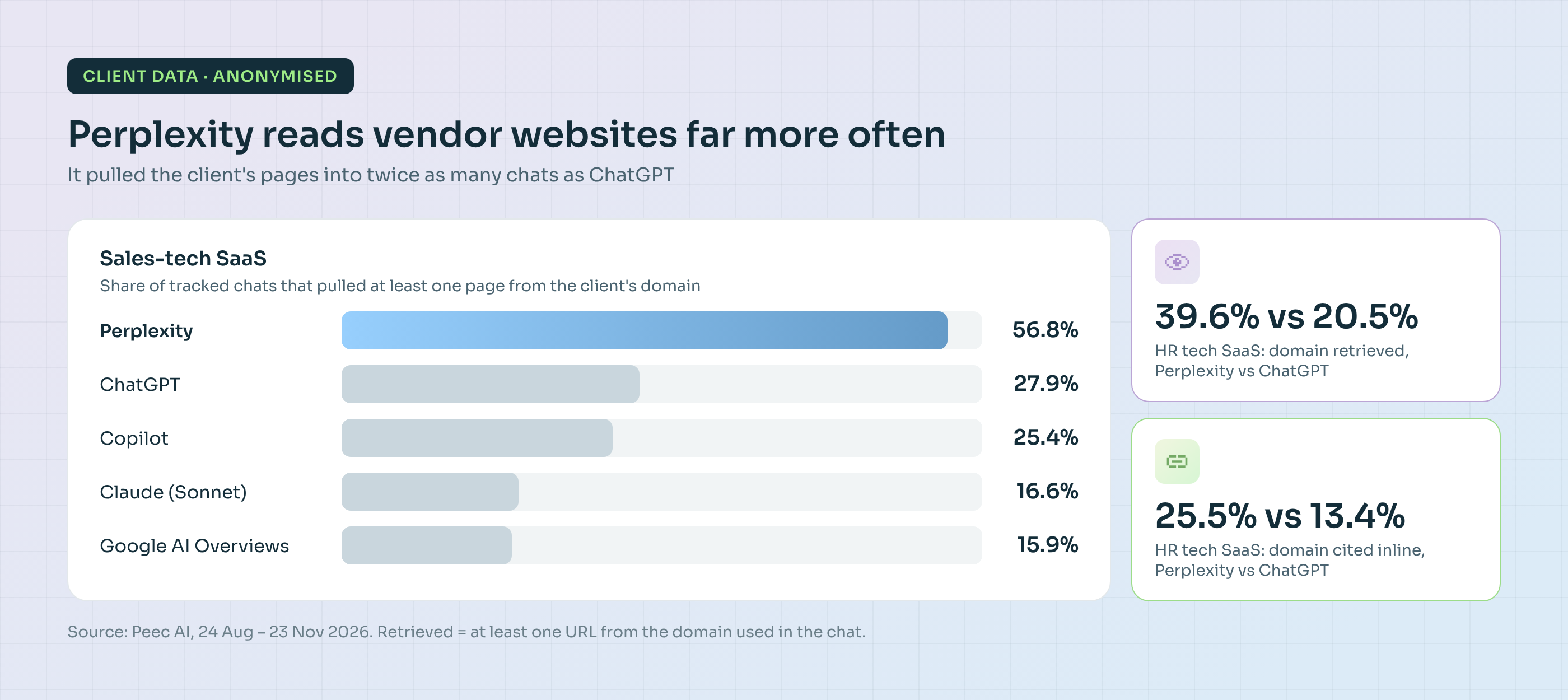
For our HR tech SaaS client, Perplexity retrieved the client’s domain in 39.6% of chats and cited it inline in 25.5%. ChatGPT retrieved it in 20.5% and cited it in 13.4%. Perplexity also named the client first in 12.1% of answers, compared with 8.5% in ChatGPT.
In other words, of all the AI search engines we track, Perplexity is the one most actively reading vendor sites. The opportunity is real, but so is the competition: your competitors’ sites are in that pool too.
Listicles, comparisons and alternatives dominate
When we grouped the 300 URLs Perplexity cited most for our HR tech SaaS client’s prompts by page type, the result was striking:
That’s 74.6% of citations going to decision-stage content. For our sales-tech SaaS client, listicles were again the biggest group, at 43.3% of retrievals among the top 300 URLs, followed by product pages (18.1%) and how-to guides (14.8%).
I said it bluntly on a call with that sales-tech client:
“It’s literally listicles. Best tools, best alternatives, competitors, etc. So once again, you can see that LLMs are really loving this type of content.” – Romana Kuts, Founder at SaaStorm, on a monthly report call with a sales-tech SaaS client
Reddit matters less than you’d think (in B2B niches)
You’ll read a lot of advice saying Perplexity loves Reddit. In consumer topics, that’s often true. In our two B2B niches, discussion threads made up 1% of retrievals for the sales-tech client and didn’t appear at all among the HR tech client’s 300 most-cited URLs. Editorial sites, niche review sites and vendor blogs did the heavy lifting.
Your own pages can win, too
The HR tech client’s own site had some of the most-cited pages in the whole category. Their best performers on Perplexity were:
- a “best providers in Europe” comparison page (984 citations in three months),
- a “best global providers” listicle (963 citations),
- a three-way comparison of the client against two competitors, which earned almost two citations every time Perplexity retrieved it,
- and their pricing page, which, when cited, was usually the first source in the answer.
Notice what these have in common: clear decision content, specific facts, and a page that answers one question well. Which leads to how to write for Perplexity.
Step 3: A content strategy for pages Perplexity wants to cite
Perplexity users ask full questions, and user queries in AI search are longer and more specific than in Google: “What’s the best partner portal for a mid-sized SaaS?” or “How much does an employer of record cost in Germany?” Your pages need to give direct answers to those user questions, then prove it. This is how you create content AI systems want to quote.
Use an answer-first structure
The way I structure content for every page we want cited:
- Direct answer. Answer the main question in the first 40 to 100 words.
- Context. Say who the answer applies to and what conditions change it.
- Evidence. Add data, examples, comparisons, screenshots or first-hand experience.
- Action. Give a clear next step.
- Related questions. Cover the natural follow-ups in the same cluster.
Make passages citation-ready
Perplexity cites sentences that support its answer. The easiest sentences to cite are concise answers that are short, self-contained and verifiable. Vague statements give AI systems nothing to quote, and factual accuracy matters: a wrong number on your page can end up in someone’s answer.
Instead of: “We provide excellent compliance software.”
Write: “[Product] syncs invoices from Stripe to Xero every 15 minutes and flags failed payments in Slack.”
Or: “A technical SEO audit should review crawlability, indexation, canonical tags, internal links, page speed, structured data and mobile usability.”
The second and third versions can stand on their own inside someone else’s answer. The first can’t.
Give each page one job
A focused page is easier to retrieve and cite than a broad page that tries to answer everything. Rather than one “Solutions” page, create pages that each answer one buyer question: pricing, comparisons against named competitors, alternatives, use cases by industry, and how-to guides for the problems your product solves.
Add the structural signals that help
These are the on-page elements we add to every priority page:
- Descriptive H2 and H3 headings that read like questions or clear statements.
- A short “key takeaways” or definition paragraph near the top. A clear definition is one of the easiest passages for Perplexity to lift.
- Clear headings and concise paragraphs, so each section is easy for AI to parse on its own.
- Comparison tables for features, pricing and alternatives.
- Step-by-step sections for how-to topics.
- Original screenshots, data, research or case studies.
- A visible author with real expertise, and a “last updated” date only when you’ve meaningfully updated the page.
- Structured data (Article, FAQPage, HowTo, Product, Organization) where it fits.
Build topical authority with clusters, not one-off articles
Topical authority comes from comprehensive topic coverage. Perplexity is more likely to retrieve a page that clearly matches the question’s intent, and a cluster of related pages gives it more chances to find you. For an AI search cluster, for example, a pillar on generative engine optimisation would link to guides on ranking in Perplexity, ChatGPT and Claude, to engine-specific guides like Bing and Brave SEO, and to measurement guides. Link every supporting page to its pillar and to close siblings.
Your own site is only half the picture, though. Perplexity’s answers lean heavily on what other sites say about you.
Step 4: Earn mentions on the pages Perplexity already cites
Remember that 75% of citations in our HR tech client’s category went to listicles, comparisons and alternatives, and most of those pages live on other people’s websites. If your brand isn’t in them, you’re missing from most of the evidence Perplexity reads.
Target the listicles AI already cites
Our process is simple to describe and slow to execute:
- Pull the URLs Perplexity (and other AI engines) cite for your category prompts from your AI visibility tool.
- Filter for third-party listicles, comparisons and alternatives pages where competitors appear and you don’t.
- Reach out to the publishers with a genuine reason to include you: a clear positioning angle, accurate product facts, screenshots and pricing.
- Track whether those pages, and your mention rate on them, change.
For our HR tech SaaS client, we contacted over 1,800 sources. We ended up in 28 listicles on eight websites, with the client placed second in six of them. Those pages drew 230 AI citations in August and September, and the client’s mention rate on them rose from 3.3% in July to 8.6% in September.
It’s tricky work, and you’ll sometimes promote a competitor alongside yourself. That’s fine. Being absent is worse. If you want the full playbook, our guide to SaaS link building covers how we combine classic links with AI-cited placements, and it’s a core part of our AEO work for clients.
Keep your brand facts consistent everywhere
Perplexity pulls from your site, review platforms, industry directories, LinkedIn, media coverage and partner pages, across multiple platforms and digital channels. If your pricing, positioning or feature set differs between them, you make it harder for Perplexity to describe you accurately. Audit your G2 and Capterra profiles, directory listings and partner pages once a quarter.
Publish something worth citing
Original research, benchmarks, calculators and detailed case studies are the kind of authoritative content that attracts brand mentions, links and authoritative citations from other authoritative sources. In our climate data client’s case, data-heavy pages (prices, ratings, market trends) are consistently the ones AI engines quote.
Doing the work is one thing. Knowing whether it’s working is another, especially as Perplexity doesn’t give you a console.
Step 5: Measure your Perplexity visibility and AI visibility
There’s no Perplexity Search Console and no public citation report. You have to measure it yourself, consistently.
The KPIs I track
These are the KPIs we report on for every client:
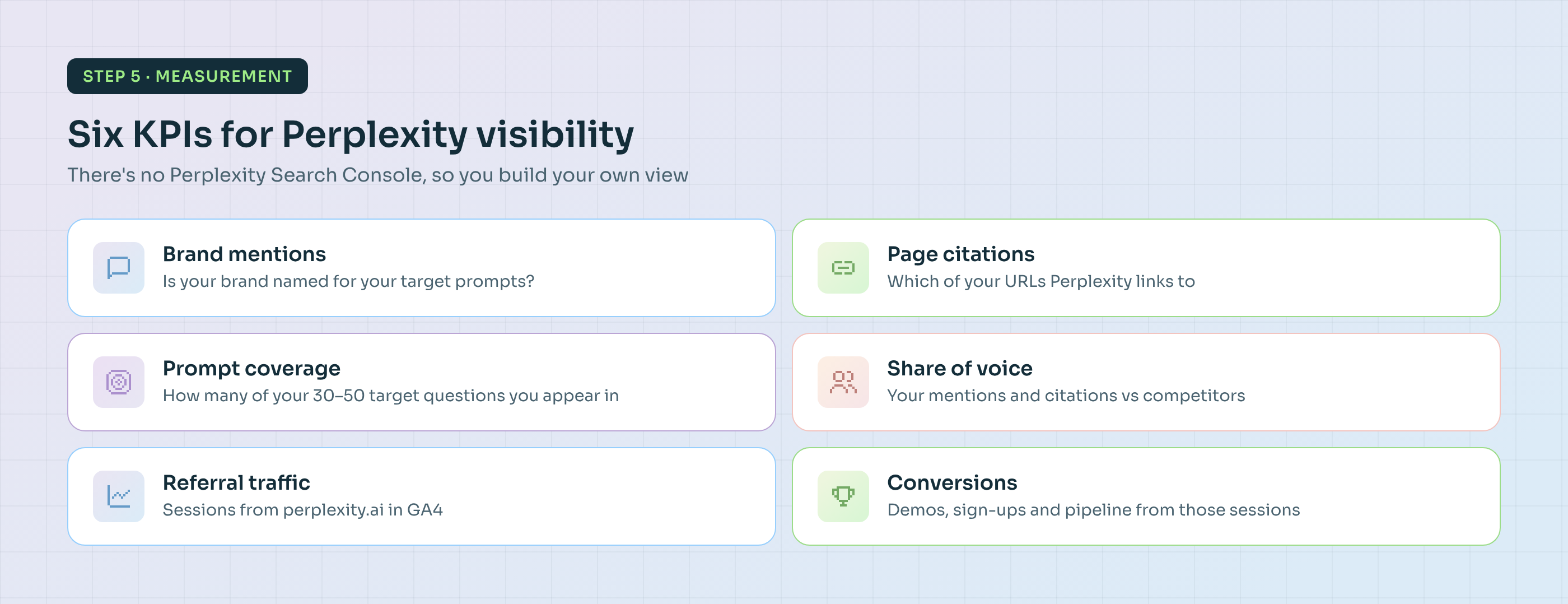
Record a baseline before you change anything, so you can see citation frequency move over time. Most AI visibility tools can also send automated alerts when new mentions appear or a trend shifts.
You can run prompts manually in clean Perplexity chats once a month, but results vary with wording, location and model updates. For anything beyond a handful of prompts, use an AI visibility tracker. We use Scrunch and Peec AI with clients, which run hundreds of prompts daily and break results down by platform.
Expect visibility and clicks to move differently
Here’s our climate data SaaS client’s Perplexity trend in 2026 (Scrunch, non-branded prompts):
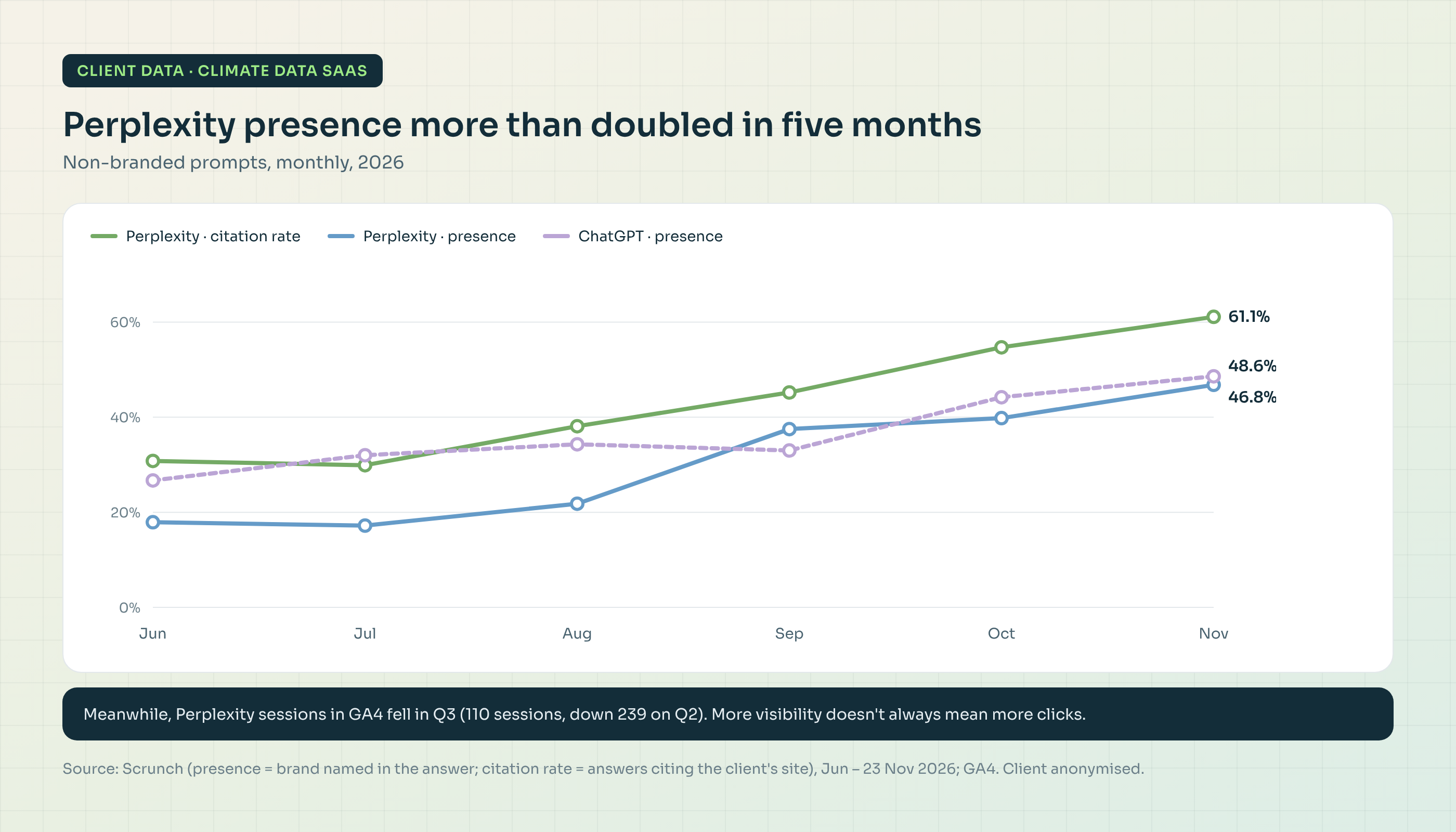
- Presence (brand named in the answer) went from 17.9% in June to 46.8% in November.
- Citation rate (answers citing their site) went from 30.8% to 61.1%.
And yet, in Q3, Perplexity sessions in GA4 fell (110 sessions, down 239 on the previous quarter) while presence was climbing fast. More of the answer was being given inside Perplexity, so fewer people needed to click.
Our guide to SEO attribution explains how we connect organic and AI search to pipeline.
Separate Perplexity traffic in GA4
Perplexity sends referrals from perplexity.ai, and by default GA4 lumps them in with every other referral.
With the measurement in place, here’s how I’d sequence the work.
A 90-day Perplexity SEO plan
This is the order we follow with B2B SaaS clients, from a blocked crawler to tracked citations.
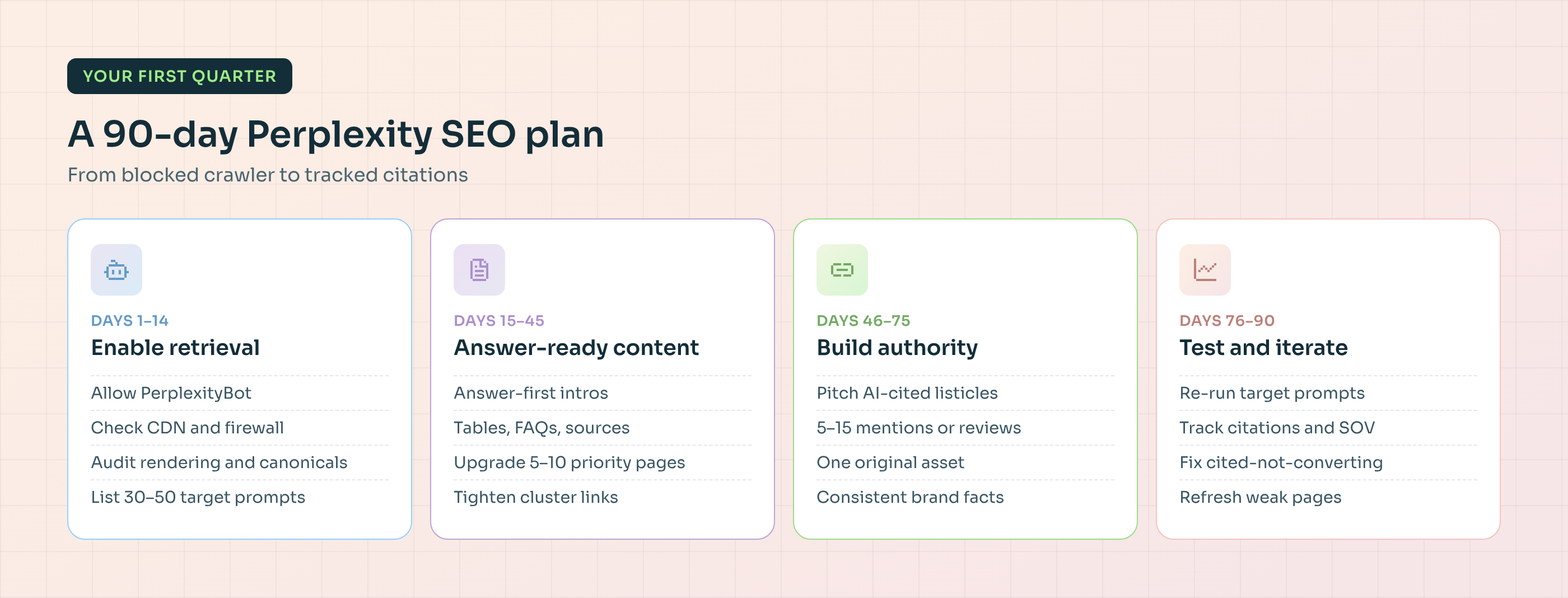
Days 1 to 14: enable retrieval. Allow PerplexityBot in robots.txt. Check your CDN and firewall aren’t blocking Perplexity’s IP ranges. Audit priority pages for status codes, canonicals and JavaScript rendering. Submit your sitemap to Google and Bing. Build a list of 30 to 50 target prompts.
Days 15 to 45: make content answer-ready. Rewrite introductions so each page answers its main question straight away. Add comparison tables, FAQs, definitions and sources. Create or upgrade 5 to 10 priority pages, starting with comparisons, alternatives and pricing. Improve internal linking within each cluster.
Days 46 to 75: build authority. Find the third-party listicles and comparisons Perplexity cites for your category and pitch your inclusion. Aim for 5 to 15 relevant mentions, links or reviews. Publish one original asset. Make your brand facts consistent across your site, review platforms and directories.
Days 76 to 90: test and iterate. Re-run your target prompts. Record mentions, citations and competitor share of voice. Find pages that are cited but don’t convert, and pages that aren’t cited at all. Fill the gaps with clearer answers, better evidence and fresher facts.
Even with a plan, a few mistakes come up again and again.
Common Perplexity AI SEO mistakes
These are the ones I see most often when we audit a B2B SaaS site for Perplexity:
- Blocking PerplexityBot (often by accident, through a CDN “block AI bots” setting) and then wondering why you’re not cited.
- Treating Perplexity like Google and chasing a single keyword position.
- Burying the answer under a long introduction.
- Publishing generic AI generated content with no data, examples, quality control or first-hand experience.
- Ignoring third-party listicles and comparisons, where most citations come from.
- Assuming schema alone will earn citations.
- Building one giant page instead of a focused cluster.
- Measuring traffic only, and missing the mentions and citations that happen without a click.
The bottom line
Perplexity is the most transparent of the AI engines your buyers use, and a good test of your wider online visibility in AI search. It shows you exactly which sources it trusts, and in our client data it gives B2B SaaS websites more credit than almost any other AI platform. That makes it the best place to start your AI search work.
The formula isn’t mysterious: let PerplexityBot in, make your pages readable, answer real buyer questions clearly with evidence, build decision content like comparisons and alternatives, and earn mentions on the third-party pages Perplexity already cites. Then measure mentions, citations and traffic separately, because they won’t always move together.
Want to see how your brand shows up in Perplexity, ChatGPT and Google’s AI answers? Talk to our team and we’ll show you where you’re cited, where competitors are winning and what to fix first.
00:00
/
00:00
FAQs
How do I rank in Perplexity?

You don’t rank in a fixed position. You get cited. Allow PerplexityBot to crawl your site, put clear answers in the initial HTML, structure pages with a direct answer, evidence and FAQs, and earn mentions in the third-party listicles and comparisons Perplexity already cites for your category.
What is PerplexityBot?
PerplexityBot is Perplexity’s search crawler. Perplexity says it’s used to surface and link websites in its search results, not to train AI models. Allow it in robots.txt with User-agent: PerplexityBot and Allow: /, and make sure your firewall doesn’t block its published IP ranges.
How does Perplexity choose its sources?
Perplexity searches the web in real time, retrieves candidate pages from its own index and partner crawlers, and cites the sources that best support its answer. It hasn’t published a full ranking formula, but it says it favours authoritative sources and reviews sites for signals like named authors and clear separation of ads and editorial content.
Does blocking PerplexityBot stop Perplexity from showing my site?
Mostly, yes. Perplexity says that if you block PerplexityBot, it won’t index the full or partial text of your pages, though it may still show your domain, headline and a brief summary. That’s rarely enough to be cited for detailed buyer questions.
Is Perplexity SEO different from regular SEO?
The foundations are the same: crawlability, relevance, authority and useful content. The differences are in emphasis. Perplexity rewards direct answers, self-contained factual sentences and decision content like comparisons and listicles, and a lot of its evidence comes from third-party sites rather than your own.
How do I track traffic from Perplexity?
Look for referrals from perplexity.ai in GA4, ideally in a custom “AI referrals” channel group. For mentions and citations, run your target prompts regularly or use an AI visibility tool like Scrunch or Peec AI that tracks Perplexity alongside other platforms.
Does “perplexity” as an AI writing metric affect SEO?
Different thing, same word. In language models, perplexity is a mathematical metric that measures how predictable a piece of text is: low perplexity means common, predictable phrasing, high perplexity means more unexpected word choices. Search engines don’t automatically penalise low-perplexity text, but overly predictable content often lacks original insight, and that’s what both Google and Perplexity reward.
Does Perplexity use Google results?
Perplexity runs its own crawler and index, and says it also partners with third-party crawlers to build its index. It doesn’t simply show Google results, but strong visibility in Google, Bing and Brave increases the chance Perplexity discovers your pages.



“SaaStorm became a key part of our inbound motion. Their SEO and content support helped us scale a consistent flow of high-intent traffic and build a content engine that supported £250K+ in inbound revenue. They plugged into our system and delivered every step of the way.”
Jonny Butler, Head of Marketing at OneUp
Related posts