Back to blog
Low Search Volume Keywords: Why They Drive B2B SaaS Pipeline

- Low search volume keywords are search terms that keyword tools estimate at roughly 0–50 monthly searches. In B2B SaaS, they're often the most specific, highest-intent searches your buyers make.
- Keyword tools underestimate them. In two niche B2B SaaS accounts we work with, more than half of all Google clicks came from queries so rare that Search Console doesn't even show them.
- Small numbers add up. Across those same accounts, queries with fewer than 200 impressions a month brought in between half and two-thirds of all non-branded clicks.
- AI search makes them more important, not less. Buyers now type long, specific questions into Google and ChatGPT, and almost none of them show up in keyword tools.
- Our approach: start from the bottom of the funnel, find low-volume keywords in sales calls and Search Console as well as in tools, and measure the result in MQLs and pipeline – not traffic.
Every few months, a prospect tells me the same thing on a sales call. They've spoken to another agency, the agency ran some keyword research, and the verdict was that their market is too small: the search volume isn't there, so SEO "won't deliver many results".
It happened again with an early-stage incident response training company. Their marketing lead asked me, a bit nervously, whether a short list of low-volume, low-competition keywords could produce anything at all. My honest answer was that I prefer it that way.
"I would rather have 10 clicks that actually become 10 customers than deliver you 3,000 clicks where nobody converts because we're writing about project management tips." – Romana Kuts, Founder at SaaStorm
In this article, I'll explain why low search volume keywords are usually the best starting point for a B2B SaaS company, why keyword tools make them look smaller than they are, what the data from two very niche clients shows, and how we find and prioritise them. It's written for Heads of Marketing and CMOs who have to defend a niche SEO plan to their CEO, and for founders who've been told their category is "too small for SEO".
What low search volume keywords are (and what "zero search volume" really means)
Before getting into why they work, it helps to be clear about what we mean, because "low volume" is relative and the numbers you see in keyword tools are estimates, not facts.
Low search volume keywords are search terms that keyword research tools such as Semrush, Ahrefs or Google Keyword Planner estimate at a small number of monthly searches – usually anything from 0 to about 50 a month. Zero search volume keywords (or zero volume keywords) are the extreme end: terms where the tool shows 0, a dash or no data at all. Somewhere in between sit the very low volume terms with minimal search volume that most SEO strategy documents quietly drop.
In B2B SaaS, these are rarely obscure or random searches. They tend to be the most specific ones in your market: "best partner portal software for technology distributors", "insetting carbon credits", "scan GitHub repo for vulnerabilities". Long-tail keywords like these are low volume precisely because they're specific – and specific searches are what people type when they know exactly what they need.
Why keyword tools show zero search volume
The first thing to know is that a "0" in a keyword tool doesn't mean nobody searches for that term. It means the tool doesn't have enough data to give it a number.
Search volume data is always an estimate of average monthly searches. Third-party keyword research tools estimate keyword search volume from clickstream panels and Google Ads data, then round and bucket it. Very rare terms either fall below the minimum they report, get grouped into a broader keyword, or never make it into the database at all. Google itself is careful here: in Google Ads, a keyword can carry a "low search volume" status, which means it has very little search traffic history – not that it has none.
And the long tail keeps moving. Google has said for years that around 15% of the searches it sees every day are new, searches it has never seen before. No tool can show you monthly search volume for a query that didn't exist last month.
The only places you see real numbers are your own site's data in Google Search Console and Google Analytics, and only for searches that already reach you. So if your keyword research stops at whatever has a big number next to it, you're planning around the part of the market that tools can see – and missing a lot of the part your buyers actually use. Which raises the obvious question: why would that part be worth more?
Why low search volume keywords drive more pipeline than high-volume keywords
High search volume keywords look attractive in a plan: more traffic, bigger traffic potential, a nicer chart for the board. But high search volumes rarely translate into business value on their own. For a B2B SaaS company, the value of a keyword isn't how many people search for it. It's how many of those people could become customers. And on that measure, low-volume keywords usually win, for three reasons.
Search intent beats search volume
The more specific a search, the clearer the intent behind it. Someone searching "project management tips" could be a student, a freelancer or a Head of Operations killing ten minutes. Someone searching "best incident response tabletop exercise platform" is very likely shortlisting software.
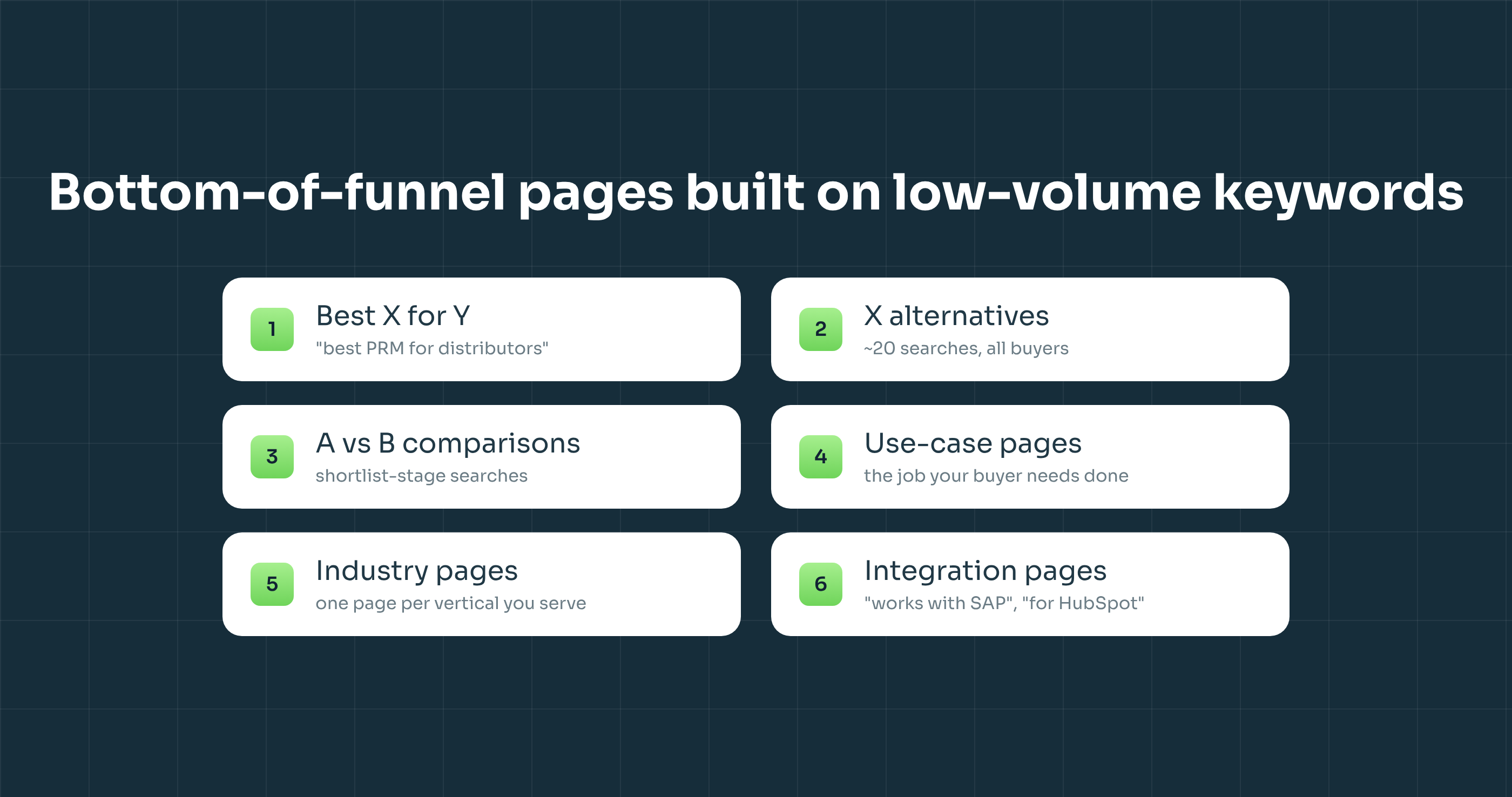
That's why we always start content plans at the bottom of the funnel: "best X for Y" articles, alternatives and comparison pages, use-case and industry pages, pricing and integration pages. Most of these target keywords with tiny volume. An "X alternatives" article for a mid-sized competitor often has around 20 searches a month. But almost everyone behind those 20 searches is in a buying cycle.
"If there's 10 searches a month but it's super, super relevant, it's incredible." – Romana Kuts, Founder at SaaStorm
Small numbers add up
A single keyword with 20 searches a month doesn't look like much. But one topic rarely ranks for just one keyword. A well-written article on a niche topic usually picks up dozens of related keywords and variants – most of them invisible in tools – and a cluster of 15 or 20 of those articles adds up to real, targeted traffic. That's meaningful traffic, even if no single page looks impressive on its own.
This is especially true in narrow markets. When the whole category is 100 to 200 relevant keywords, the goal isn't to find a hidden high-volume term. It's to own those 100 to 200 terms: rank in the top three for all of them, appear in the AI Overview and get named when buyers ask ChatGPT. Ten interested visitors from each of fifty pages is 500 people a month who are actually in your market.
Low competition means faster rankings
Low search volume keywords are also usually low competition keywords. Big SEO budgets chase volume, so a high-volume head term in a crowded category can have a keyword difficulty of 70 or more and take a year to crack. Niche, specific terms often sit at KD 0–20, which means a new or smaller site can start ranking on the first page within weeks rather than months, often without months of link building first.
That matters for early-stage companies in particular. You don't need the domain authority of a category leader to win "best carbon credit due diligence tool for corporate buyers". You need the best page on the internet for that exact question – and it doesn't need a huge word count to get there.
All of this sounds good in theory. So let's look at what happens in practice when we compare what keyword tools say with what Google actually shows.
What the data shows: two niche B2B SaaS examples
To show how much demand hides behind low search volume, we pulled Google Search Console data for two very niche B2B SaaS clients: a cyber security platform for developers and a climate-tech company in the carbon credit market. Both are anonymised, and the period is the same for both: August to October 2026.
Most queries are tiny, and they bring a big share of clicks
The first thing we looked at was how clicks split by query size. We excluded branded keywords and grouped every other search query by its average monthly impressions, from fewer than 10 a month to more than 1,000.
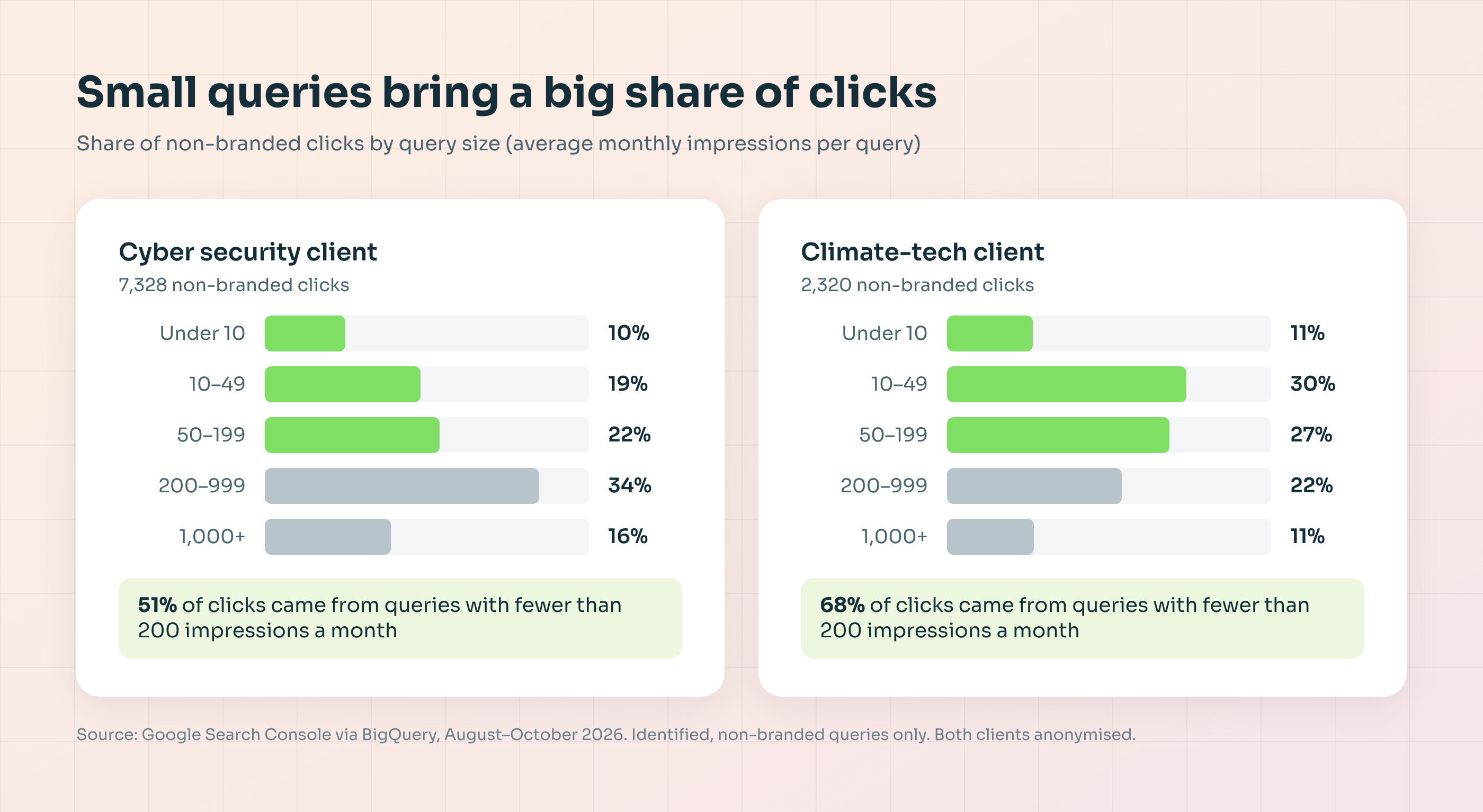
The result is the same pattern we see in almost every account. More than 99% of the queries that brought each site impressions had fewer than 200 impressions a month. And those small queries weren't just noise. For the cyber security client, queries under 200 monthly impressions brought just over half of all non-branded clicks (3,711 of 7,328). For the climate-tech client, it was two-thirds (1,571 of 2,320).
Search Console hides the smallest queries completely
It goes further than that. Google doesn't show every query in Search Console: queries that very few people search for are anonymised for privacy and left out of the query report. You only see them as the gap between total clicks and the clicks you can attribute to a query.
For our two clients, that gap was huge. For the cyber security platform, 52% of all Google clicks came from queries too rare to show. For the climate-tech company, it was 71%.
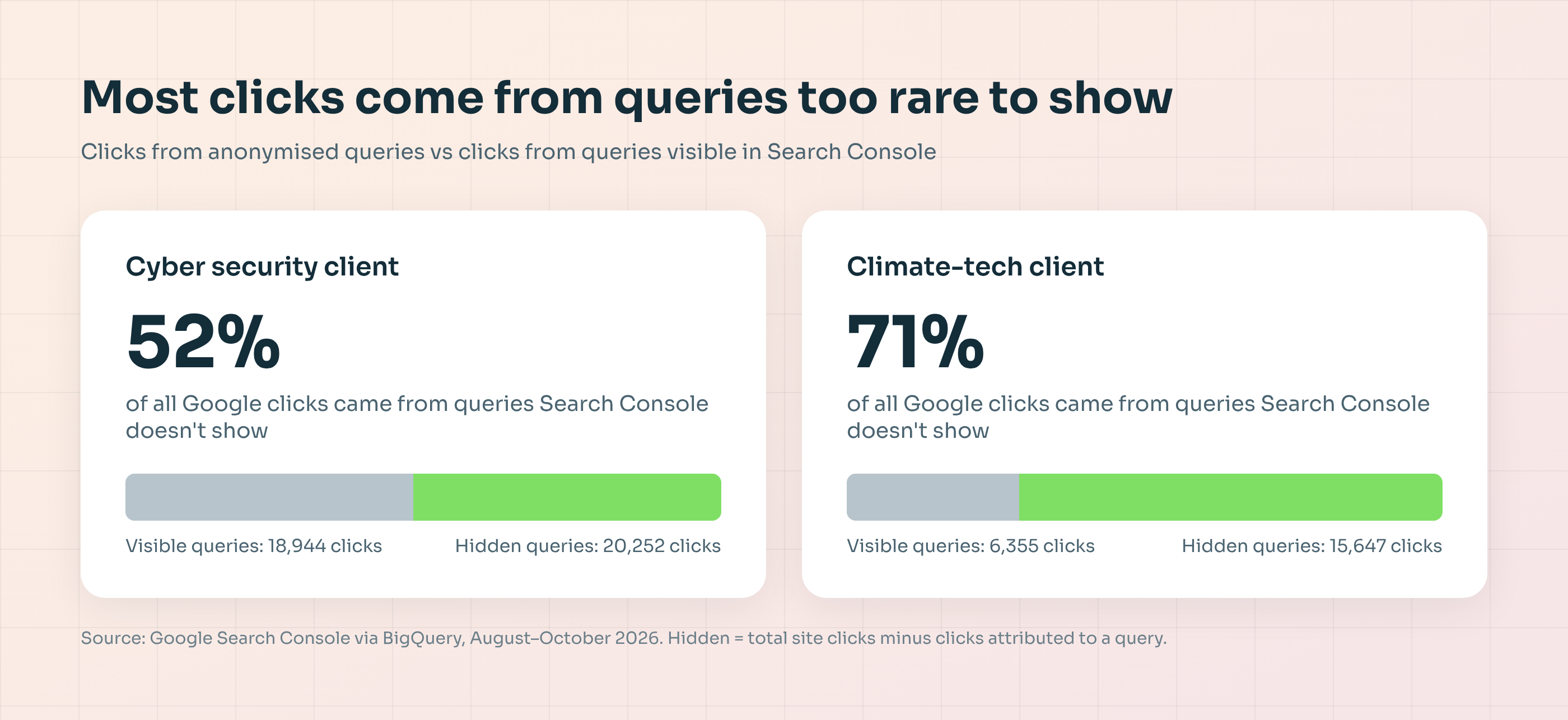
In other words, most of their search traffic came from users searching in ways so specific that Google considers them almost unique – low search keywords that no tool will ever list.
Keyword tools show 10–20 searches; Google shows real clicks
Finally, we compared a handful of buyer-relevant queries from both accounts with what Semrush shows for them. Every one of them has a US monthly search volume of 10 or 20 in the tool – the kind of number that gets a keyword cut from most plans.

Yet each one brought real clicks, usually from a top-three position: "how to calculate carbon credits from trees" brought 13 clicks in three months, "scan GitHub repo for vulnerabilities" 11, "additionality in carbon projects" 10 and "TruffleHog alternatives" 7. Those are not big numbers. But these are clicks from exactly the people both companies sell to, and they arrive every month without a single euro of ad spend.
This is also why we treat Search Console data as the most important keyword data you have. It's real search data from your own site, and it shows the searches tools never will. Which brings us to the biggest change in how people search.
AI search makes low-volume keywords even more important
If low search volume keywords mattered before, AI search has made them central. The way B2B buyers search is changing, and it's changing in the direction of longer, more specific and more personal questions.
On Google, people now type full questions because they expect an AI Overview to answer them. On ChatGPT, Perplexity and Gemini, they write whole briefs: their role, their company size, their tech stack and what they need. Those prompts almost never repeat word for word, so they never show up in keyword tools with search volume.
We can see this in our own data. On saastorm.io, 38% of the queries that brought us impressions in Search Console between August and October 2026 were eight words or longer – many of them clearly written like a prompt. Some were several sentences long, describing a CMO's exact situation before asking which AI visibility tool to use. We checked a sample of them in Semrush: six out of seven don't exist in its database at all, yet one of them alone brought us almost 1,000 impressions in three months.
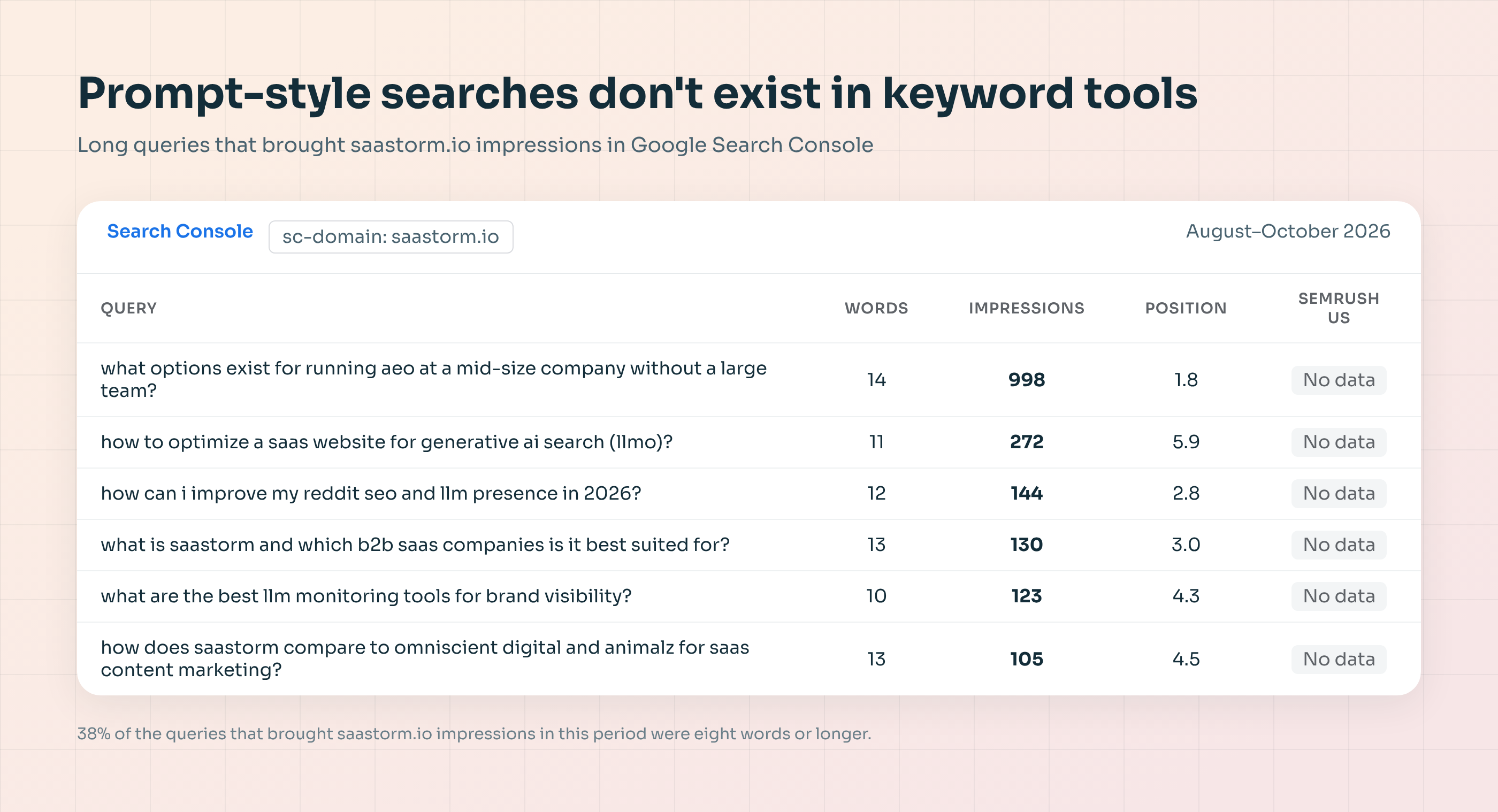
For B2B SaaS, this creates two opportunities. First, specific, low-volume questions are exactly what AI Overviews and AI assistants answer best, and they pull from the pages that answer that exact question most clearly. Second, being in the answer counts even without a click. When a buyer reads a list of three tools in an AI Overview and yours is one of them, your brand is on their shortlist – even if they never visit your blog.
"Maybe there will be only five searches, but we are there." – Romana Kuts, Founder at SaaStorm
That's why we track AI visibility alongside rankings. We use Scrunch to track bottom-of-funnel prompts for every client and see how often they're mentioned, where they appear in the answer and which pages get cited. If you want to go deeper into the overlap between the two channels, our guide to GEO vs SEO covers it, and our glossary explains what prompt volume means.
So how do you find these keywords if tools don't show them properly? Here's how we do it.
How we find and prioritise low search volume keywords
Finding the right low-volume keywords is less about clever tools and more about knowing where your buyers' real language lives. In every SEO discovery phase, we combine four sources, and then filter the result hard.
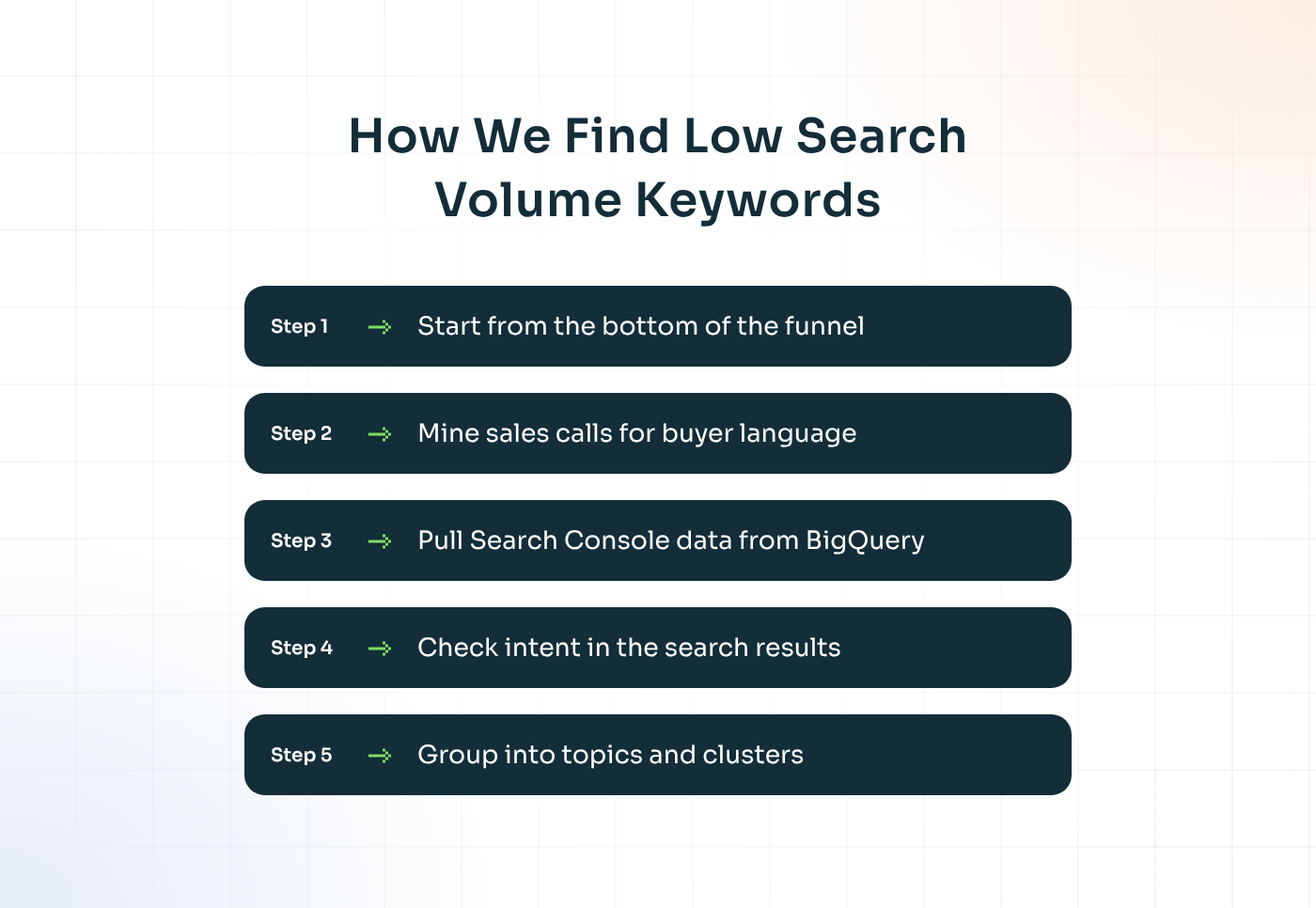
1. Start from the bottom of the funnel
We start with the searches closest to a buying decision, because that's where low volume matters least and intent matters most. That means every "best [category] software" and "best [category] for [industry or role]" variant, an alternatives page for every relevant competitor, every "A vs B" comparison, and pages for each use case, integration and industry you serve.
For a company with a narrow audience, this is often most of the plan for the first three to six months. Broader top-of-funnel content comes later, once the money pages exist.
2. Mine sales calls and customer conversations
Your sales calls are the best keyword research tool you have. The way buyers describe their problem on a call – "we're still doing it in Excel", "we need something that works with SAP" – is the way they search for it. We ask every client for sales call recordings at the start of discovery for exactly this reason, and we turn the phrases we hear into topics, even when a tool shows no data for them.
3. Use Google Search Console data, not just keyword tools
Search Console shows the search queries you already get impressions for, including many that keyword tools report as zero volume. It's where the best keyword opportunities usually hide: keywords related to your product that you rank for by accident. We pull the full data set from BigQuery, which shows far more queries than the Search Console interface, and look for relevant queries where the site ranks on page two or three, or where no page really answers the question. Those become new articles or optimisations.
On top of that, we use keyword tools such as Semrush for related keywords, questions and competitor gaps, Google autocomplete and People Also Ask for phrasing, and the prompts we track in Scrunch for AI search.
4. Check intent and group keywords into topics
Every candidate keyword then has to pass one test: would someone searching this be a good fit for your product? We check the search results for each one before creating content: which ranking pages already show up on the search engine results pages, whether there's an AI Overview, and which related searches and questions appear. If the search engines are showing job boards or consumer guides, the user intent doesn't match and the keyword goes, however tempting the number. The ones that pass get grouped into topics – one article per search intent – and then into clusters, so each page targets one main keyword plus its relevant keywords, related terms and the different ways people ask the same question. We explain that step in our guide to keyword mapping.
Done properly, this gives you a plan where almost every article targets something your buyers actually search for, even if no tool would have suggested it. But that doesn't mean every low-volume keyword is worth writing about.
When low search volume keywords aren't worth it
Low volume is not a strategy on its own. A keyword with 10 searches a month is only valuable if those 10 people could buy from you, and there are a few situations where they can't.
The first is when the intent is wrong. Job seekers, students and consumers often search in very specific ways too, and a niche keyword about "carbon credit jobs" or "free API key" will bring visitors who will never become customers. The second is "island" keywords: one-off searches that don't connect to any topic or cluster, so the page sits on its own with no internal links and no authority behind it. The third is when a broader page would serve the searcher better. If five low-volume variants all mean the same thing, they belong in one article, not five. Otherwise you end up with two pages competing for the same keyword – classic keyword cannibalisation.
It's also worth being honest about the limits. A plan built only on bottom-of-funnel, low-volume keywords can struggle to build topical authority on its own. For most clients, we add a smaller layer of educational content around the money pages – not because those topics convert, but because they help Google and AI assistants see you as an authority in your space.
Once the right keywords are in the plan, the last piece is knowing whether they work. And that means changing what you measure.
How to measure results when search volume is small
If you judge low search volume keywords by traffic, they'll always look disappointing. A page that ranks first for its main keyword might bring 15 visitors a month. The question is what those 15 people do next.
That's why we measure organic traffic on what it produces – MQLs, SQLs, pipeline and revenue – not on clicks and impressions. In practice, that means tracking demo requests and sign-ups by landing page, checking which pages buyers visited before they converted, and adding a "how did you hear about us?" field to forms, because a lot of AI-influenced demand never shows up in Google Analytics. Our guide to SEO for lead generation explains the set-up we use.
We still watch Search Console impressions, rankings and AI visibility, because they're early signals that a page is working. But we report them as leading indicators, not as the result. A niche page that sends five demo requests a quarter is worth more than a top-of-funnel article with 5,000 visitors and none.
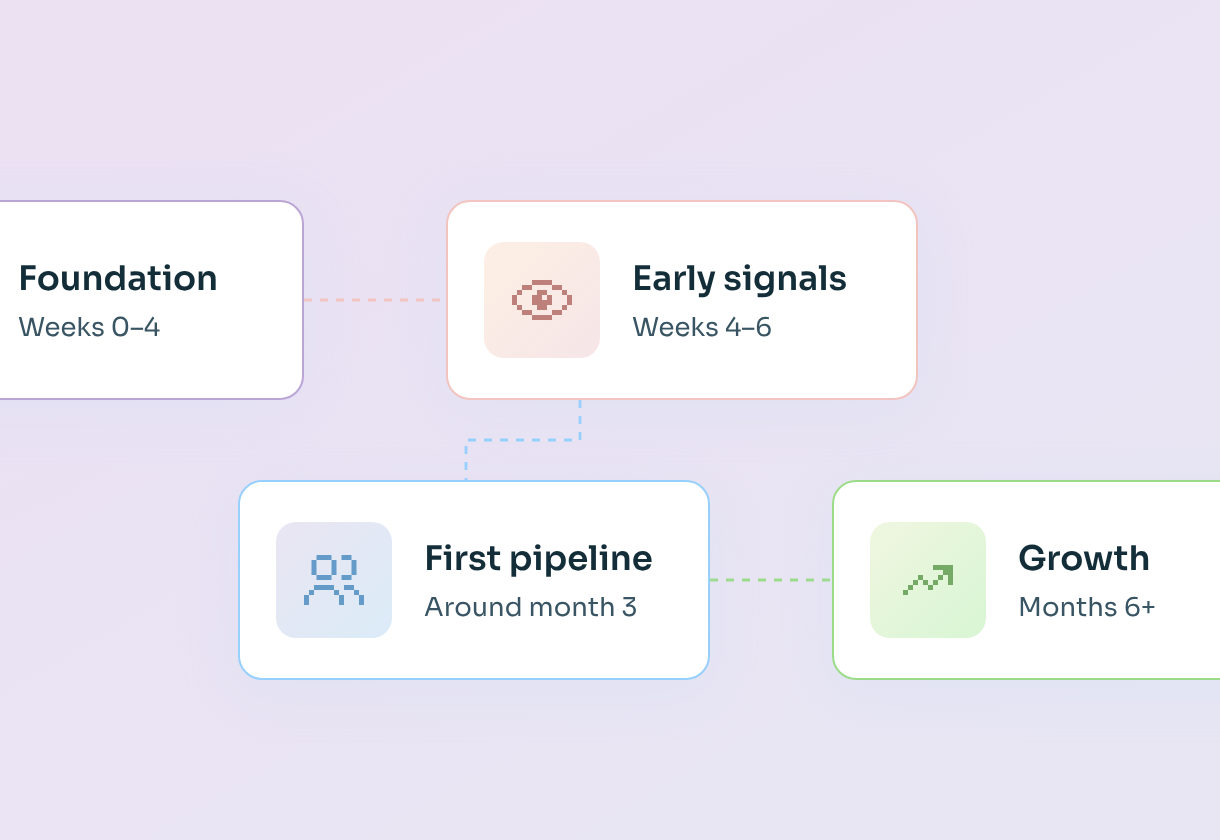
It also helps to set realistic expectations about timing. Low-competition pages often start ranking within a few weeks of going live, but leads and pipeline usually follow over the next two to three months. Our guide to how long SEO takes goes through the typical timeline.
The bottom line
Low search volume keywords aren't a consolation prize for companies in small markets. In B2B SaaS, they're usually where the buyers are: specific searches with clear intent, low competition and far more real demand than keyword tools show. AI search is only making that truer.
So if an agency tells you your market is too small for SEO, look at the data before you believe it. Check your Search Console, listen to how your buyers talk on sales calls, and count the keywords that sit closest to a purchase. In our experience, that list is almost always long enough to build a pipeline on.
"We just need to dominate the market in these top 100 or 200 keywords. It's not a problem at all – I would say it's an advantage." – Romana Kuts, Founder at SaaStorm
00:00
/
00:00
Want to know which low-volume, high-intent keywords your buyers are searching for? Book a call with us and we'll show you what a discovery would uncover for your market.
FAQs
What are low search volume keywords?

Low search volume keywords are search terms that keyword tools estimate at a small number of monthly searches, usually 0–50. They're typically specific, long-tail searches, and in B2B SaaS they often carry the strongest buying intent.
What is a good search volume for a keyword?
There's no universal number. For a B2B SaaS company, a keyword with 10–50 monthly searches can be excellent if the people searching are your buyers. Judge a keyword on intent, competition and how close it is to a purchase, not on volume alone.
Are zero search volume keywords worth targeting?
Often, yes. A zero in a keyword tool means the tool doesn't have enough data, not that nobody searches. If the term comes up in sales calls or Search Console and fits your product, it's worth a page or a section of one.
What are low competition keywords?
Low competition keywords are terms that few strong websites target, so they're easier to rank for. They usually have a low keyword difficulty score and often overlap with low search volume keywords.
How do you find low search volume keywords?
Start with bottom-of-funnel searches, then use Google Search Console data, sales call recordings, keyword tools, Google autocomplete and People Also Ask. Check the search results for each one for intent before adding it to your plan, and don't drop such keywords just because a tool shows zero volume.
Do low search volume keywords matter for AI search?
Yes. Buyers ask AI assistants and Google's AI Overviews long, specific questions that rarely appear in keyword tools. Pages that answer those exact questions clearly are the ones that get cited and mentioned.



“SaaStorm became a key part of our inbound motion. Their SEO and content support helped us scale a consistent flow of high-intent traffic and build a content engine that supported £250K+ in inbound revenue. They plugged into our system and delivered every step of the way.”
Jonny Butler, Head of Marketing at OneUp
Related posts