Back to blog
ChatGPT SEO Guide: How to Rank in ChatGPT in 2027
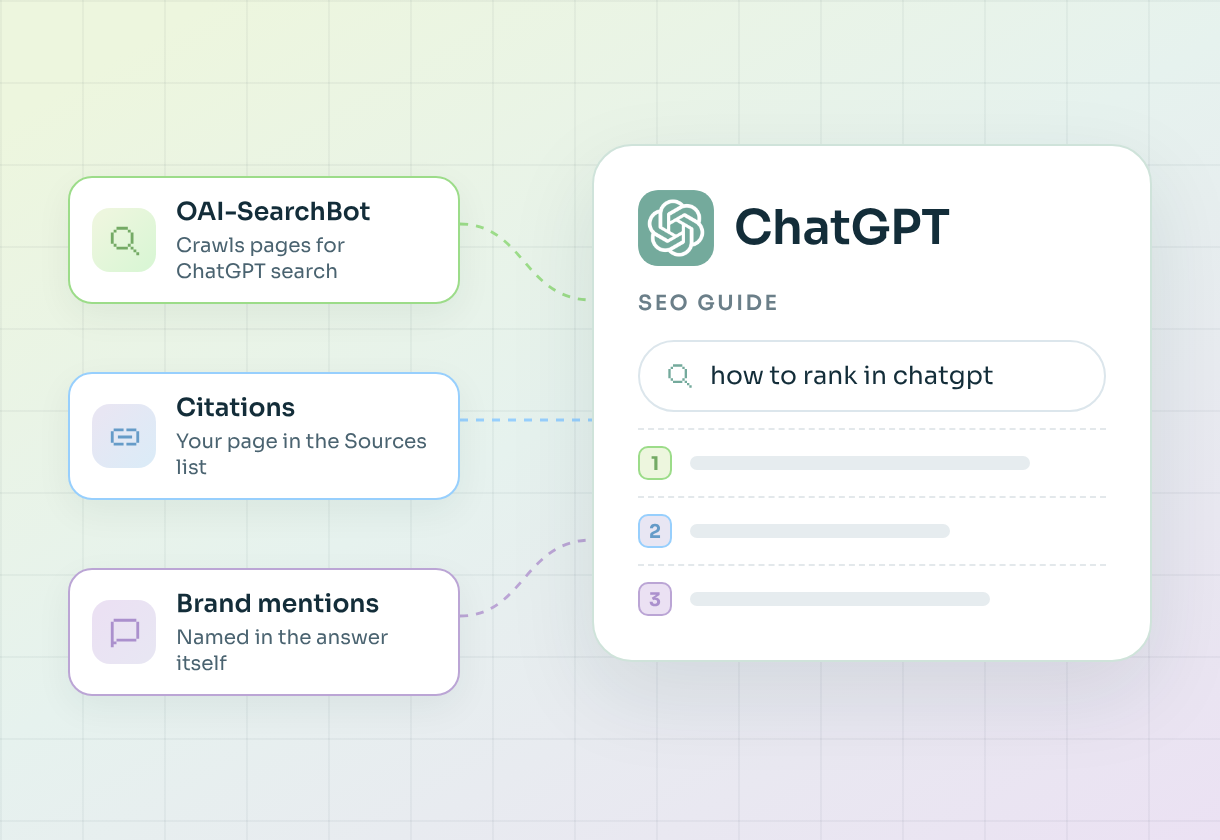

- There’s no position one in ChatGPT. ChatGPT writes an answer, and when it needs fresh information it runs a web search, reads a handful of pages and cites them. ChatGPT SEO is the work of getting your brand named in that answer and your pages cited as sources. You don’t rank once. You win a place in the answer, prompt by prompt.
- OAI-SearchBot is the bot that matters for ChatGPT search. OpenAI runs three bots: OAI-SearchBot (search), GPTBot (training) and ChatGPT-User (pages a user asks ChatGPT to open). You can block GPTBot and still appear in ChatGPT search. Block OAI-SearchBot, and OpenAI says your pages won’t be shown as search answers.
- ChatGPT search leans on third-party search providers, and Bing is the one everyone points to. If your key pages aren’t in Bing, you’re making ChatGPT’s job harder. Our Bing SEO guide covers that part.
- It works, and it’s measurable. For one of our sales-tech SaaS clients, ChatGPT named the brand in 20% of tracked buyer prompts in May 2026 and in 37% by November, with the highest share of voice in its category. AI search deals in their CRM grew 68% half on half.
- ChatGPT cites how-to guides and product pages most, then listicles. Across the 22,875 ChatGPT citations we analysed for that client’s category, how-to guides took 25%, product pages 22% and listicles 13%. Third-party listicles that include you still do a lot of the heavy lifting.
- Big brands start ahead. For an HR tech SaaS client, the two category leaders appear in 73% of ChatGPT answers, while our client appears in 21%. ChatGPT reflects what the web already says about a category, so challenger brands have to earn more mentions.
- ChatGPT traffic is small but it converts. For that same HR tech client, chatgpt.com sent almost 3,000 sessions in 12 months with an 11.6% key event rate, roughly eight times the site average.
- What to do: let OAI-SearchBot in, get indexed in Bing, answer the buyer’s question in the first 100 words, publish original data, earn mentions on the listicles and review sites ChatGPT reads, and track mentions, citations and referral conversions every month.
If you’re a CMO or Head of Marketing at a B2B SaaS company, this guide is for you. OpenAI said in October 2025 that ChatGPT had 800 million weekly users, and your buyers are among them. In almost every client call I have now, someone says “a lead told us they found us in ChatGPT”. Then the next question is always the same: “OK, so how do we get more of that?”
This guide is my answer. It’s written for marketing leaders who already have a decent Google foundation and want to understand what changes when buyers ask ChatGPT instead of typing a keyword into a search engine. It matters because ChatGPT is now where a lot of B2B buyers build their shortlist, often before they ever visit your website. By the end, you’ll know how ChatGPT search picks sources, what to fix on your site this week, what to publish, and how to measure ChatGPT visibility in a way your CFO will actually accept.
I’ll show you anonymised data from our clients along the way: ChatGPT visibility tracked over six months, the page types ChatGPT cites most, a real GA4 report and what happened in a client’s CRM.
What is ChatGPT SEO?
Let me start with a definition, because “ChatGPT SEO” means different things to different people.
ChatGPT SEO is the practice of making your brand and website visible inside ChatGPT’s answers. In practice, it covers two different outcomes:
- A brand mention. ChatGPT names your company in its answer, for example when someone asks for the best tools in your category.
- A citation. ChatGPT links to one of your pages as a source, in the inline citations or the Sources panel.

You’ll also see other names for this: generative engine optimization (GEO), LLM SEO, AI search optimisation or answer engine optimisation. They all describe the same shift. Search engines return a list of links. Large language models (LLMs) return an answer, and your job is to be part of it. That’s why some people call it LLM SEO, and why your search visibility now includes places where nobody clicks a blue link.
How does ChatGPT search find and cite sources?
To optimise for ChatGPT search, it helps to picture what actually happens between the buyer’s question and the answer. It’s a different process from a person scrolling Google search results.

Step 1: ChatGPT decides whether it needs to search
Not every answer uses the web. For a question like “what is a sales pipeline”, ChatGPT can answer from its training data. For “best tools for X in 2026”, “pricing of Y” or anything recent, it usually runs a web search. Users can also force a search themselves.
That’s why the same brand can be missing from one answer and cited in the next. A different question can mean a different mode.
Step 2: It turns the prompt into its own search queries
This is the part most marketers miss. The buyer’s prompt is not the search query. A ChatGPT user might write three sentences about their team, their budget and their tech stack. ChatGPT turns that into one or more shorter queries, often several at once, and searches each of them.
So you’re not doing classic search optimization for one keyword. You’re optimising for the whole family of queries that a question like your buyer’s might produce. This is also why classic keyword research still matters: those rewritten queries look a lot like normal search queries.
Step 3: It retrieves results from search providers and its own index
OpenAI says ChatGPT search uses third-party search providers, content from partners and its own crawler, OAI-SearchBot. Microsoft Bing is widely reported as one of those providers, and OpenAI and Microsoft have a long partnership, but OpenAI doesn’t publish the full list.
The practical takeaway is simple: there’s no single “ChatGPT SERP” to win. Your page has to be findable in the search indexes ChatGPT draws from, and crawlable by OpenAI’s own bot.
Step 4: It reads the pages and writes the answer with citations
ChatGPT then reads the most promising results and builds the answer. Citations appear inline, and users can open a Sources panel to see every reference. When someone clicks through, ChatGPT usually adds utm_source=chatgpt.com to the link, which is how you’ll see it in your analytics.
Which OpenAI bots should you allow?
Now that you know how the pipeline works, let’s open the door. A lot of companies block AI bots by accident, through a firewall rule, a CDN setting or a robots.txt line someone added in 2023 and forgot about.

OpenAI runs three main bots, and each one has a different job:
The important part: OpenAI says these settings are independent. You can allow OAI-SearchBot for search visibility and block GPTBot if you don’t want your content used for training. That’s a legal and brand decision, not an SEO one, but it’s good to know you have the choice.
A robots.txt setup for most B2B SaaS sites
For most of our clients, this is the starting point:
If your legal team wants to opt out of training, change the GPTBot line to Disallow: / and leave the other two open. OpenAI says robots.txt changes can take around 24 hours to be picked up.
Check the firewall, not just robots.txt
Here’s the trap. Robots.txt can say “allow” while Cloudflare, your WAF or a bot-protection tool quietly blocks OpenAI’s IP ranges. OpenAI publishes those IP ranges, and it recommends allowing them.
Once the bots can get in, the next question is whether they can actually read what they find.
Make every key page readable by AI bots
Allowing the bots is step one. Step two is making sure they can actually read what they find. AI bots are less patient than Googlebot, and most of them don’t render JavaScript the way a browser does.

Here’s the technical checklist we run for every client:
- Key pages return a 200 status and aren’t behind a login, a geo-block or a cookie wall.
- Critical content is in the initial HTML. If your pricing table, feature list or FAQ only appears after JavaScript runs, assume ChatGPT can’t see it.
- Clean canonicals and no duplicate versions of the same page. Point everything to one URL to avoid duplicate crawling.
- An accurate XML sitemap, submitted to Google Search Console and Bing Webmaster Tools.
- Indexed in Bing. Check your key pages with Bing Webmaster Tools and fix whatever isn’t indexed. If you want the full process, it’s in our Bing SEO guide.
- Internal links with descriptive anchor text and clear navigational links, so bots can reach your deeper pages.
- Fast, stable pages. Slow pages and pop-ups don’t help humans, and they don’t help bots either.
- Schema markup where it fits (Organization, Product, Article, FAQPage), but with every key fact also in plain text. Structured data uses the schema.org vocabulary, which Google has used for over a decade for rich snippets, and it helps AI systems understand what a page is about too.
Content creation: how to write pages ChatGPT wants to cite
Once the doors are open, the content has to earn the citation. This is where most of the work is, and also where most teams copy the Google playbook a bit too literally.
Answer the question in the first 100 words
ChatGPT reads your page looking for the part that answers the query it wrote. If your answer sits under a 300-word introduction about “today’s fast-paced landscape”, you make it work too hard.
Open each page with a direct answer in the first 50 to 150 words. Direct answers are what AI systems look for first. Then add context (who it applies to, any conditions), evidence (data, examples, a comparison table) and a clear next step. That structure suits human readers too, which is the point.
Write for prompts, not just keywords
Your buyers don’t type “email automation software” into ChatGPT. They write “we’re a 50-person SaaS team on HubSpot, what should we use to automate onboarding emails for new trial users?”
So build pages around the real questions buyers ask:
- “What is the best X for Y?”
- “How much does X cost?”
- “X vs Y: which should I choose?”
- “What are the alternatives to X?”
- “How do I do X with Y?”
One page, one clear question. That makes it easier for ChatGPT to retrieve the right page and quote the right section. A topical cluster of focused pages beats one giant page that tries to answer everything.
Make your claims short, specific and easy to quote
ChatGPT quotes and paraphrases sentences. The easier a sentence is to lift out and still make sense, the better your chances. Compare:
The second one is a fact. It has numbers, a time frame and something ChatGPT can check. Write your key claims like that, and back them with authoritative sources or your own data.
Add what AI can’t make up: original data and first-hand experience
Everyone can generate a generic article now, and ChatGPT has read millions of them. What it can’t find everywhere is your data, your screenshots, your customer stories and your team’s opinion. Original research, benchmarks and real examples are what make a page worth citing instead of just another source that says the same thing.
This is also why we still put human writers on the pages that matter most. AI is a great helper for content creation at scale, but the pages that win citations usually carry something only your company knows.
Use tables, lists and clear headings
Comparison tables, pricing breakdowns, step-by-step lists and descriptive H2s make your page easy to extract. Content with high extraction value does better in AI search engines and in featured snippets. Put a short “key takeaway” or definition block near the top of long pages.
What our client data shows about ChatGPT visibility
Enough theory. Here’s what we see in the data for our own clients, anonymised. I’m sharing this because most ChatGPT SEO advice online is opinion, and I’d rather show you numbers.
Lesson 1: ChatGPT visibility can grow, and it shows up in the pipeline
For a sales-tech SaaS client, we track a set of non-branded buyer prompts in ChatGPT every day with Peec AI. These are prompts like “best tools for X”, where the buyer hasn’t named the brand.

In May 2026, ChatGPT named the brand in 20% of those answers. By November it was 37%, across a much larger prompt set. Over the last three months (24 August to 23 November 2026), ChatGPT named them in 32.3% of 8,415 answers, mentioned them first in 16% of all answers, and gave them the highest share of voice in their category: 19.5%, ahead of the biggest competitor at 15.7%.

In the last 30 days alone, the picture looks even better: 37% visibility, a 21% share of voice and the highest win rate in the category, meaning ChatGPT names them first more often than any competitor.
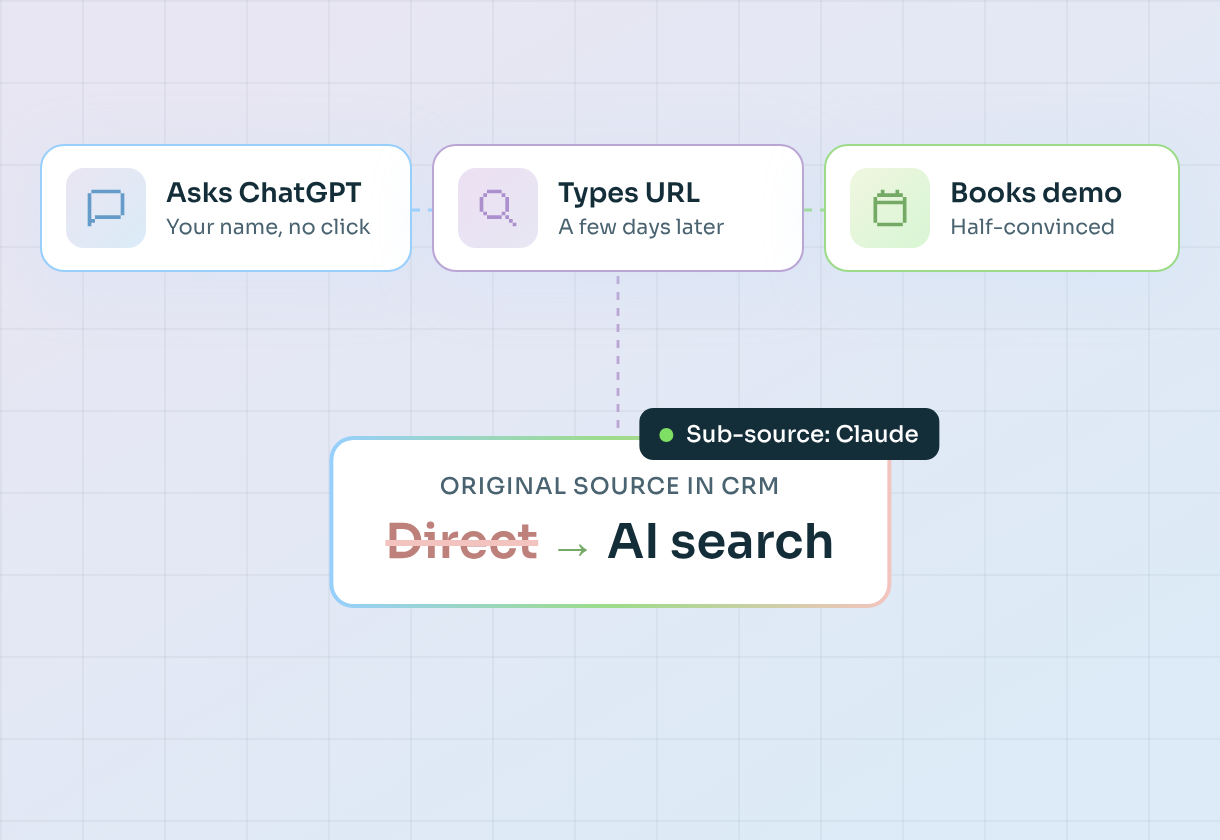
The sales team saw it too. In the client’s CRM, deals with AI search as a source grew from 44 in the second half of 2025 to 74 in the first half of 2026, a 68% increase. That’s the number that gets budget approved.

The monthly view tells the story better than any visibility chart. At the start of 2025, almost every organic deal came from classic search engines. By September 2026, 26 of the 35 organic deals that month came from AI search. When we opened those 26 deals, about half had ChatGPT as the source, and most of the rest came from Claude.

What drove it? Not one trick. A steady programme of comparison and alternative pages, deep how-to guides, product pages rewritten to answer real buyer questions, and a lot of work getting the brand onto the third-party listicles that ChatGPT reads.
Lesson 2: ChatGPT cites how-to guides and product pages most, and listicles still matter
We looked at the top 1,000 URLs that ChatGPT cited for this client’s category over three months, 22,875 citations in total, and grouped them by page type.
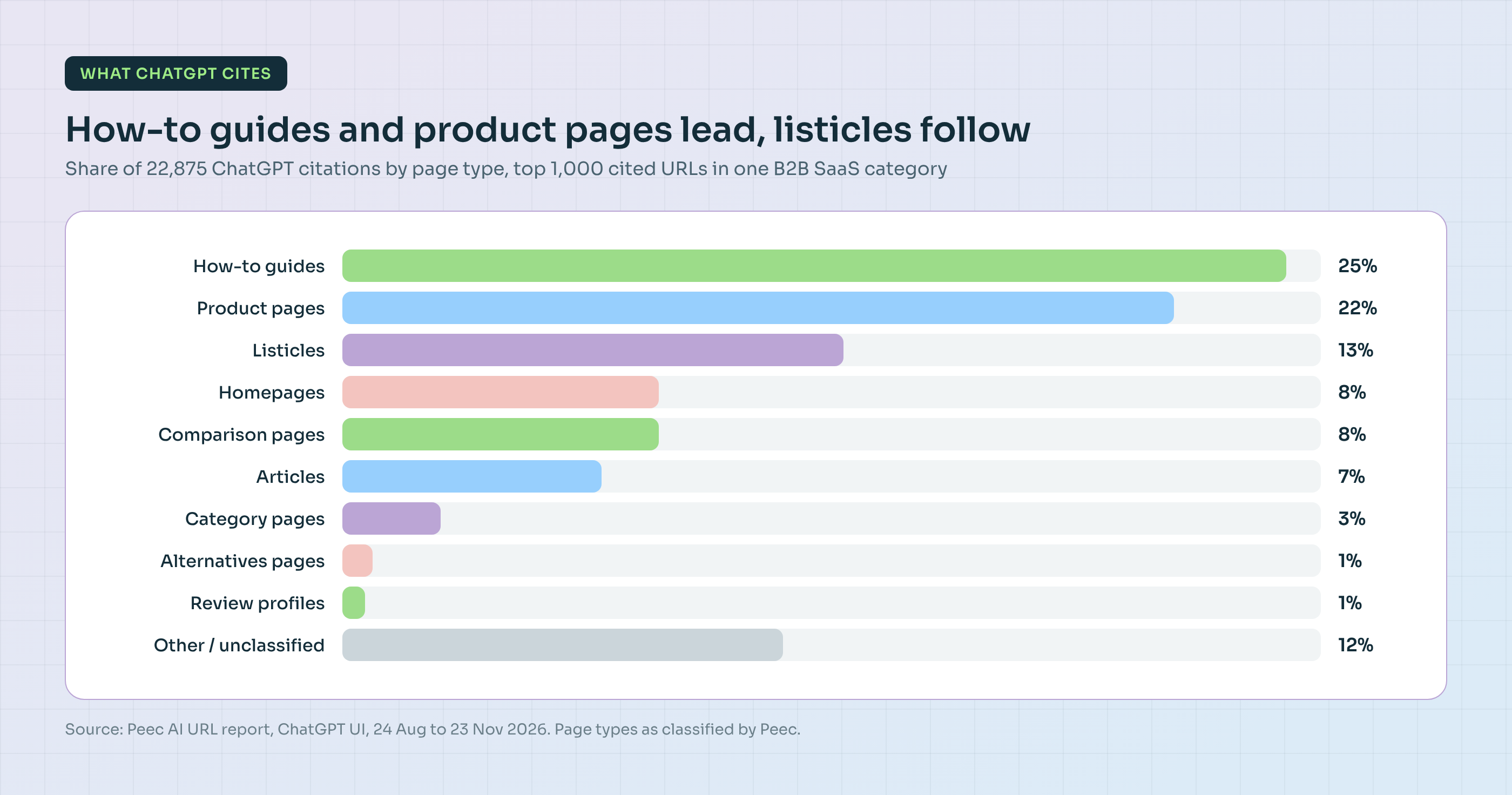
Two things stand out for me. First, product pages are cited a lot, so they deserve the same care as your blog. If ChatGPT can’t find your pricing logic, integrations or use cases on your product pages, it’ll take them from someone else’s.
Second, the single most cited URL in this category was a competitor’s “best tools” comparison page, and it includes our client. The top third-party listicles in the category also all include them. That’s not luck. It’s the result of a link building and placements programme designed around the pages AI tools actually read. If you want the full process, I wrote about it in our SaaS link building guide.
Lesson 3: Big brands start with a head start
Not every client story looks like Lesson 1, and I don’t want to pretend otherwise. For an HR tech SaaS client in a crowded category, ChatGPT names the two category leaders in about 73% of tracked answers. Our client appears in 21%, behind several bigger and better-funded competitors.

ChatGPT reflects what the web already says about a category. If the incumbents have ten years of press coverage, reviews and listicle placements, they start far ahead. For challenger brands, the path is narrower and more specific: win the sub-questions the leaders don’t cover well (a niche, a region, a use case), and get mentioned on the sources ChatGPT reads for those questions.
Lesson 4: ChatGPT traffic is small but converts very well
AI visibility is nice. Revenue is better. More traffic from ChatGPT only matters if it turns into pipeline. So we always check what ChatGPT referral traffic does once it lands.

For the HR tech SaaS client, chatgpt.com sent 2,992 sessions in the last 12 months (24 November 2025 to 23 November 2026). That’s a small slice of their organic traffic. But those sessions had a 48% engagement rate and an 11.6% key event rate, roughly eight times the site’s average key event rate. Of the 845 key events from ChatGPT sources, 827 came from chatgpt.com.

Build brand mentions and authority beyond your own website
Your website is only part of the story. ChatGPT builds its picture of your brand from everything it reads about you: review sites, listicles, Reddit threads, podcasts, press coverage and partner pages. That’s why brand mentions matter so much in ChatGPT SEO.
I said this on a sales call in August, and I still explain it the same way:
“You need third-party mentions [...] so you basically show up in LLMs more because other people are talking about you.” – Romana Kuts, Founder at SaaStorm, on a client call in August 2026
Here’s where we focus for our clients:
- Listicles and comparison articles on independent sites in your category. Find the ones ChatGPT already cites (your AI visibility tool will show them) and work on those first.
- Review platforms like G2 and Capterra, with recent, detailed reviews.
- Community discussions on Reddit and niche forums, only where you can add something useful. Spam gets noticed by humans and models alike.
- Digital PR built on original research. A benchmark report or survey gives journalists and bloggers a reason to cite you.
- Podcasts, interviews and expert commentary from your founders and team.
- Consistent brand information everywhere. Your one-line description, category, pricing model and key facts should match on your website, LinkedIn, Crunchbase, G2 and directories. Mixed signals make ChatGPT less sure what you are.
Domain authority still plays a role, but it’s not the whole story. Brand presence across relevant content on other sites is what makes the brand appear in more answers. A smaller site that’s cited on the right listicles can beat a bigger site that nobody talks about.
Shopping and commercial answers in ChatGPT
A short note for anyone with a product catalogue or a self-serve plan. For shopping prompts, OpenAI says ChatGPT can show products based on relevance and structured metadata from first-party and third-party providers, including price and product descriptions.
For most B2B SaaS companies this is less important than for ecommerce, but the same idea applies to your pricing and product pages: keep prices, plans and feature lists accurate, crawlable and consistent with what review sites say. ChatGPT will happily quote an outdated price from a three-year-old listicle if your own page doesn’t make the current one clear.
How to measure ChatGPT visibility
You can’t improve what you can’t see, and there’s no ChatGPT version of Google Search Console. So you need a mix of tracking, analytics and CRM data. Here are the KPIs we report for clients every month.

A few practical tips:
- Track non-branded prompts. “What is [your brand]?” will always show you. “Best tools for X” is where the real competition is.
- Track daily, report monthly. ChatGPT answers vary a lot from one run to the next. One manual test tells you very little. Hundreds of runs show a trend.
- Use more than one tool if you can. Different tools run prompts differently (with or without web search, different locations), so their numbers won’t match exactly. Pick one as your source of truth and use it consistently.
- Add a self-reported attribution question to your demo form. Analytics misses a lot of AI-influenced buyers, and they’ll often tell you “ChatGPT” if you ask. I go deeper into this in our SEO attribution guide.
A 90-day ChatGPT SEO plan
If you want to turn this into a plan, here’s how we usually run the first quarter for a new client. It’s simple on purpose.

Days 1–14: Open the doors
- Allow OAI-SearchBot and ChatGPT-User in robots.txt, and decide on GPTBot.
- Check the firewall and CDN for blocked OpenAI IP ranges.
- Check your key pages are indexed in Bing.
- Audit JavaScript rendering, canonicals and your sitemap.
- Build a list of 30 to 50 buyer prompts and start tracking them.
Days 15–45: Make your pages citation-ready
- Rewrite intros so every key page answers its main question in the first 100 words.
- Add comparison tables, FAQs, definitions and sources.
- Upgrade five to ten priority pages, starting with product pages and comparison pages.
- Improve internal linking between related pages.
Days 46–75: Build authority
- Map the listicles, review sites and communities ChatGPT already cites for your prompts.
- Earn five to fifteen relevant mentions, placements or reviews.
- Publish one original asset: research, a benchmark, a calculator or a really deep guide.
- Make your brand description consistent everywhere.
Days 76–90: Measure and improve
- Compare mention rate, share of voice and citations with day one.
- Find pages that are cited but don’t convert, and pages that aren’t cited at all.
- Refresh pages with outdated facts or weak direct answers.
- Add ChatGPT sessions, key events and AI-sourced deals to your monthly report.
The other ChatGPT SEO: using ChatGPT for SEO work
You’ll notice that half the Google results for “ChatGPT SEO” are about something else: using ChatGPT as a tool to do SEO. That’s useful too, so here’s how we use it, briefly.
ChatGPT is a good research assistant and content optimiser when you give it real inputs. We use it to:
- Cluster keywords by search intent. Paste a Semrush export and ask it to group terms into topic clusters. It’s fast, and a strategist checks the result.
- Draft title tags and meta descriptions that are more likely to earn the click, then pick and edit the best ones.
- Spot content gaps in competitor analysis. Give it your page and three competing pages, and ask what they cover that you don’t.
- Build content frameworks and briefs, not whole articles. Outlines, FAQs and question lists are where it saves the most time.
- Speed up technical SEO tasks, like writing regex for redirects, drafting schema markup or summarising a crawl export. Regular SEO audits still need a human to decide what matters.
Where you still need people: original data, real opinions, client stories and the final edit. Google’s E-E-A-T guidelines (experience, expertise, authoritativeness and trustworthiness) and AI search engines reward the same thing, which is content that only you could have written.
Common ChatGPT SEO mistakes
Before I wrap up, here are the mistakes I see most often. Most of them are easy to fix once you know about them.
- Blocking OAI-SearchBot (or letting the firewall block it) and then wondering why ChatGPT never cites you.
- Treating ChatGPT like Google and chasing one keyword position instead of a family of prompts.
- Publishing generic AI content with no original data, opinion or experience. ChatGPT already has a thousand versions of it.
- Burying the answer under a long introduction.
- Ignoring third-party mentions and only working on your own site.
- Measuring traffic only. ChatGPT often influences the shortlist without sending a click. Track mentions and pipeline too.
- Testing one prompt once and drawing big conclusions from it.
- Assuming schema markup alone will get you cited. It helps systems understand a page. It doesn’t replace a good answer.
ChatGPT is one channel in a bigger AI-powered search picture
ChatGPT gets most of the attention, but your buyers use more than one AI tool. For the same sales-tech client, Scrunch shows ChatGPT as the strongest platform for non-branded prompts (34.4% mention rate, August to October 2026), with Copilot close behind and Claude far lower at 4.4%.

That Claude number comes with a catch, which I explain in our Claude guide: Scrunch runs Claude without web search, and with web search on the same brand appears in far more answers. Perplexity and Claude behave quite differently from ChatGPT. Each one has its own sources, crawlers and quirks, and each one changes how your brand appears to a different ChatGPT user, Perplexity user or Claude user.
If you want to go deeper on the others, we’ve written sister guides on Claude SEO, Perplexity SEO, Bing SEO and Brave SEO. Search trends are clear: buyers spread their questions across several AI tools, so you want better visibility in all of them, not just one. The good news is that most of the work overlaps: open the doors, write clear answers, publish something original and get talked about.
The bottom line
ChatGPT SEO isn’t a new discipline that replaces SEO. It’s SEO with a different finish line. Instead of a blue link in position one, you’re aiming to be named, cited and recommended in an answer.
The practical formula is simple: let OpenAI’s search bot in, make your pages technically easy to read, answer real buyer questions clearly, prove what you say with your own data, and earn mentions on the sources ChatGPT trusts. Then measure it properly, every month.
If you’d like help doing this for your SaaS, this is exactly what we do at SaaStorm. Our AEO and AI visibility team can show you where ChatGPT mentions you, where competitors are winning and what to fix first. Get in touch.
00:00
/
00:00
FAQs
How do I rank in ChatGPT?

You can’t rank in ChatGPT the way you rank on Google, because there’s no fixed list of results. To show up in ChatGPT, allow OAI-SearchBot, make sure your key pages are indexed in Bing, answer buyer questions clearly at the top of your pages, publish original data, and get mentioned on the listicles, review sites and communities ChatGPT reads.
What is OAI-SearchBot?
OAI-SearchBot is OpenAI’s crawler for ChatGPT search. It crawls websites so they can be surfaced and cited in ChatGPT search answers. OpenAI says sites that block it aren’t shown in ChatGPT search answers, although a plain link may still appear.
Should I block GPTBot?
That’s up to you. GPTBot collects content that may be used to train OpenAI’s models. Blocking it doesn’t remove you from ChatGPT search, because OpenAI says GPTBot and OAI-SearchBot settings are independent. Many B2B SaaS companies allow both, but if your legal team prefers to opt out of training, block GPTBot and keep OAI-SearchBot open.
Does ChatGPT use Google or Bing?
OpenAI says ChatGPT search uses third-party search providers, partner content and its own crawler, OAI-SearchBot. Bing is widely reported as one of the providers, given OpenAI’s long partnership with Microsoft. OpenAI doesn’t publish the full list, so the safest approach is to be well indexed in both Google and Bing.
How long does ChatGPT SEO take to work?
Technical fixes like unblocking OAI-SearchBot can have an effect within days. Content and authority work usually takes two to six months to show up clearly in tracking data. For our sales-tech client, ChatGPT visibility nearly doubled over about six months of steady work.
How do I track ChatGPT visibility?
Use an AI visibility tool such as Peec AI or Scrunch to run your buyer prompts daily and track brand mentions, share of voice and citations. Then add GA4 (session source chatgpt.com) for referral traffic and a CRM source field for AI-sourced deals.
What are ChatGPT ranking factors?
OpenAI hasn’t published ChatGPT ranking factors. From our data, the things that matter most are being crawlable by OAI-SearchBot, being present in the search indexes ChatGPT uses, answering the question clearly, having original and specific information, and being mentioned on trusted third-party sources.
Is ChatGPT SEO the same as generative engine optimization (GEO)?
Mostly, yes. Generative engine optimization (GEO) is the broader term for getting visible in AI-generated answers across tools like ChatGPT, Perplexity, Claude, Gemini and Google AI Overviews. ChatGPT SEO is GEO focused on one platform.



“SaaStorm became a key part of our inbound motion. Their SEO and content support helped us scale a consistent flow of high-intent traffic and build a content engine that supported £250K+ in inbound revenue. They plugged into our system and delivered every step of the way.”
Jonny Butler, Head of Marketing at OneUp
Related posts