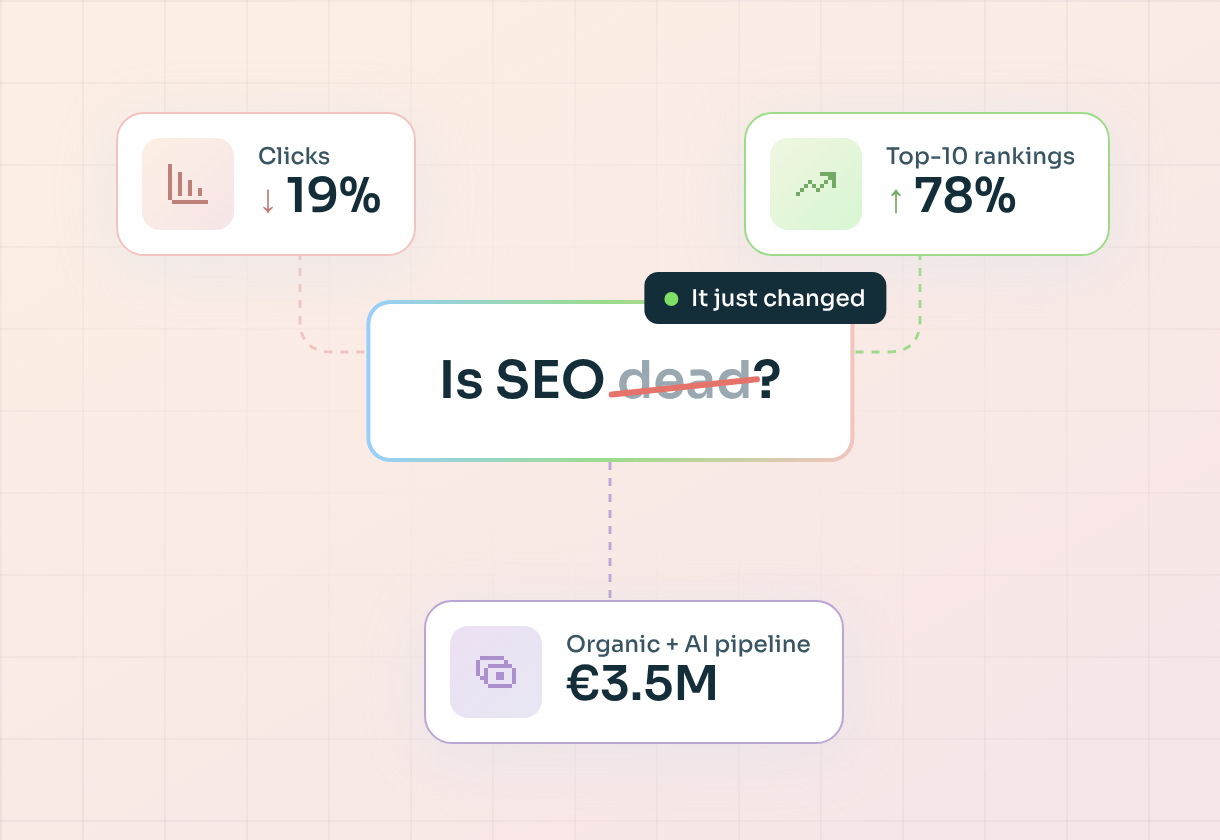

- SEO is not dead, but the click is weaker. Across the B2B SaaS sites we track, clicks fell 19% year on year while the number of queries ranking in Google's top 10 rose 78%.
- The reason is the search results page itself. Google's AI Overviews and AI Mode answer more questions directly, so click-through rates fell on 16 of the 19 sites we compared.
- The companies that kept investing still grew. Two clients grew their blog clicks four to five times in six months, and one company's organic and AI search channels have produced 530 deals and €3.5M in SQL pipeline since January 2025.
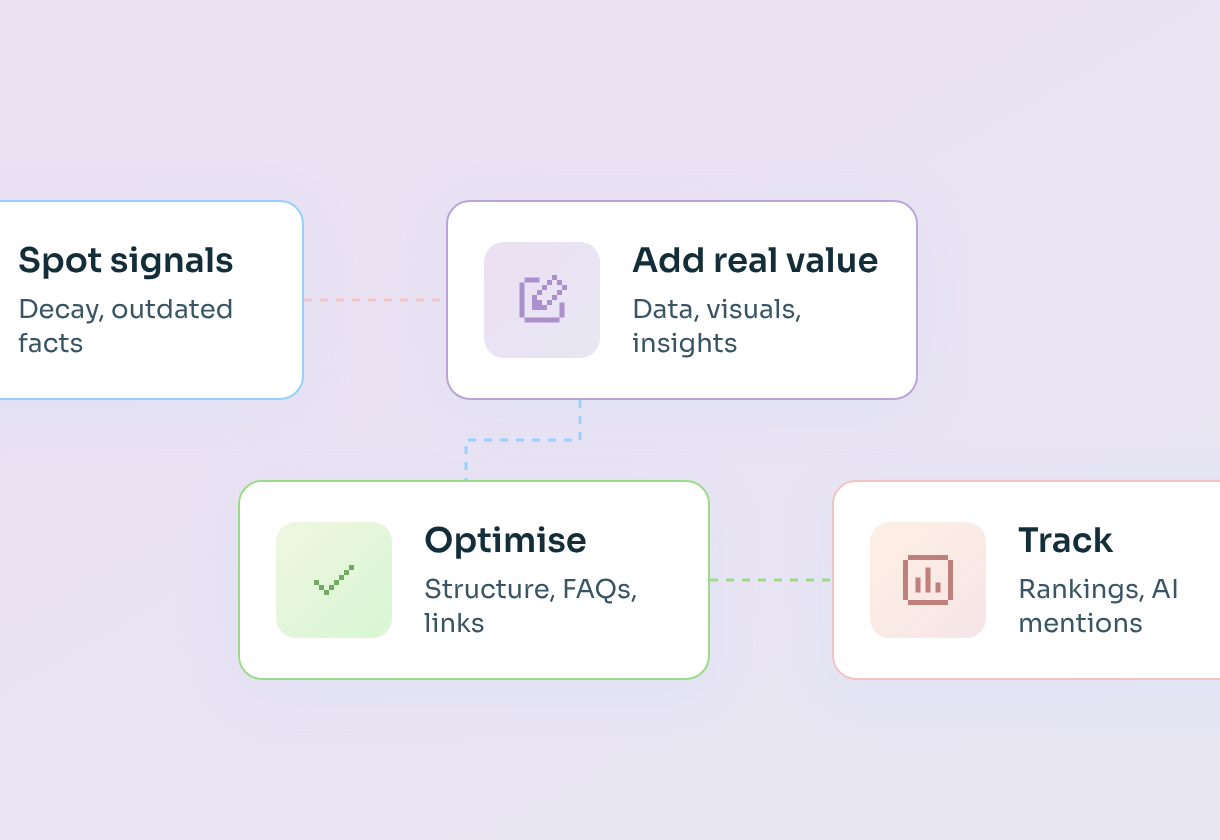
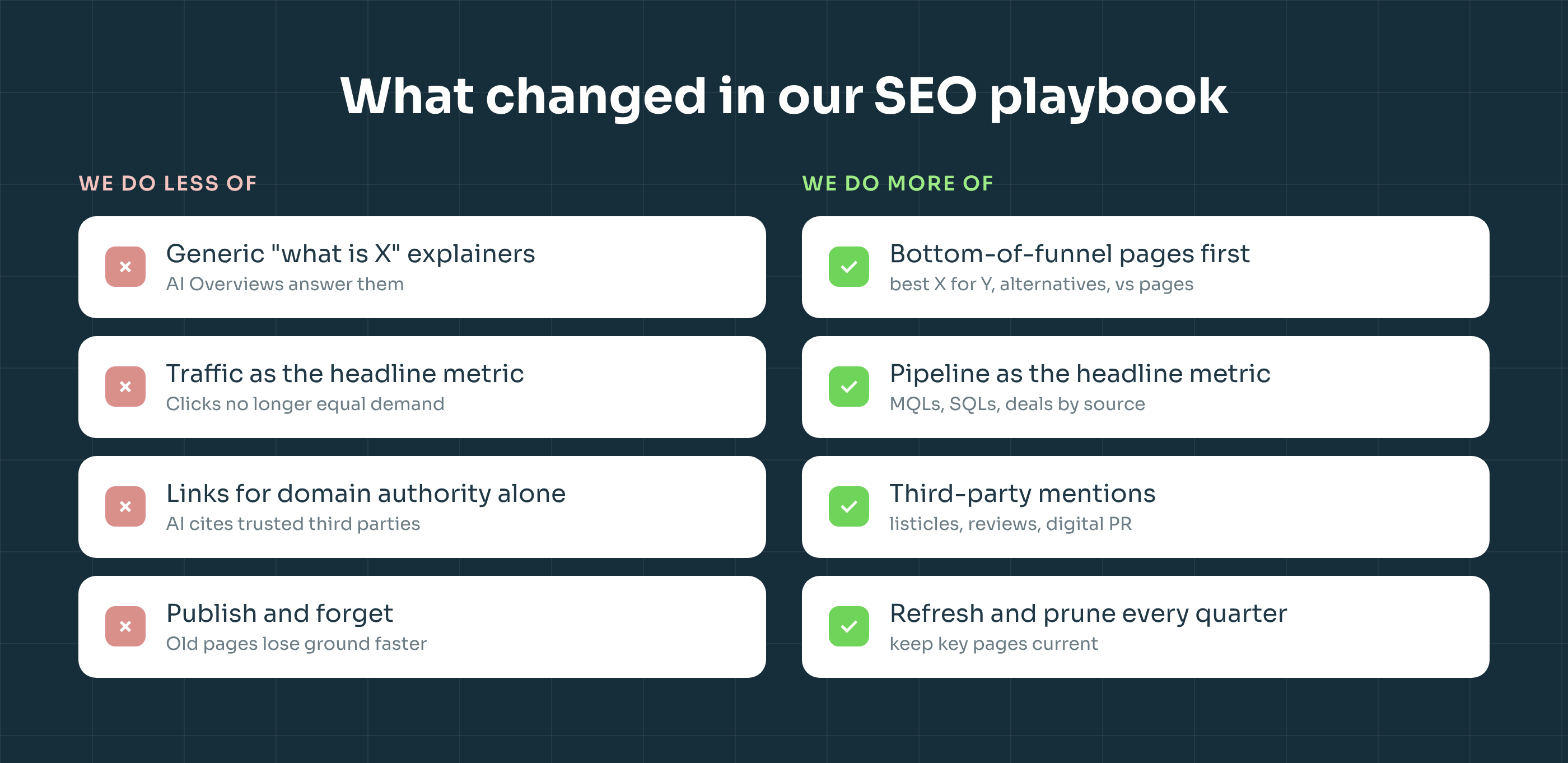
- What changed is the work: fewer top-of-funnel explainers, more bottom-of-funnel pages, more third-party mentions, regular refreshes and AI visibility tracking alongside rankings.
- Measure SEO in MQLs, SQLs and pipeline, not traffic. That's where it still pays off.
"Is SEO dead?" is the question I get most often from Heads of Marketing and CMOs at the moment. Usually their CEO has asked it first, after reading that AI search is replacing Google, or after looking at a traffic chart that has been flat for six months.
It's a fair question. Search has changed more in the last 18 months than in the ten years before: zero click searches, AI-generated summaries above the results and new AI tools that answer buyers directly. So instead of answering with an opinion, we looked at our own numbers: Google Search Console data for every B2B SaaS site we report on, AI visibility data from Scrunch, analytics, and CRM pipeline from clients who let us share it anonymously.
"SEO isn't dead. It just changed." – Romana Kuts, Founder at SaaStorm
Here's what the data shows, what it means for B2B SaaS, and what we changed in our own playbook because of it.
Is SEO dead? The short answer
Before getting into the numbers, here's the honest short version, because it's more nuanced than either side of the debate likes to admit.
SEO is not dead. Search engines still send B2B SaaS companies buyers, demos and revenue, and the foundations of search engine optimization – technical SEO, keyword research, content quality and links – matter as much as ever. What is dying is the old model of SEO: chasing search volume with high-volume informational articles, obsessing over keyword density and exact match keywords, measuring success in organic traffic and expecting every ranking to turn into a click. Modern SEO is about relevant content for real user intent, wherever the search happens.
The difference matters, because the two lead to very different decisions. If you think SEO is dead, you stop investing and hand the channel to your competitors. If you understand what changed, you shift budget to the pages and signals that still bring buyers in – which is exactly what the companies in our data that kept growing did.
So what does "changed" actually look like in the numbers?
What our client data shows: rankings up, clicks down
To answer the question properly, we compared October 2025 with October 2026 across the 17 B2B SaaS websites we've tracked continuously for that period, using Google Search Console data stored in BigQuery. The sites range from seed-stage startups to Series C companies, in categories from developer security to HR tech.
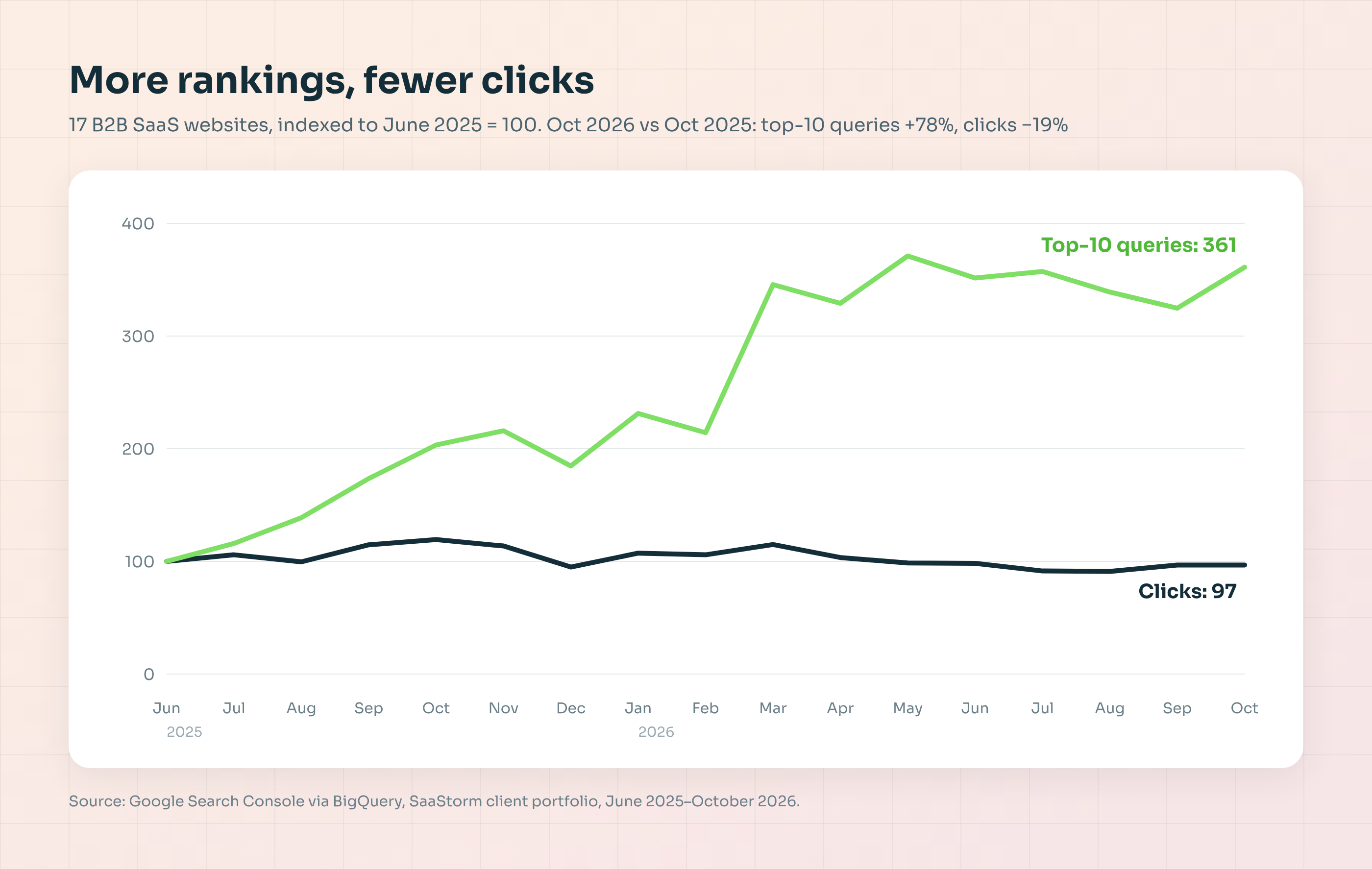
The headline numbers tell a clear story:
In other words, these sites are more visible than ever. They rank for far more queries, and more of their pages appear in search results. But fewer of those appearances turn into a click.
The same pattern shows up site by site. Click-through rate fell on 16 of the 19 sites we could compare year on year, and impressions grew on 15 of them. Nine of the 19 still grew total clicks; the rest lost some, mostly in very competitive categories where informational content used to bring in a lot of traffic.
Branded clicks were almost flat (−2%), so branded search volume and search demand for these companies haven't disappeared – the losses came from non-branded, mostly informational searches. That gap between search engine rankings and clicks is the heart of the "is SEO dead" debate. So where are the missing clicks going?
Why clicks are falling: AI answers on the search results page
The clicks haven't disappeared because people stopped searching. They've disappeared because the search results page now answers more questions itself.
Instant answers: Google's AI Overviews and AI Mode
Google's AI Overviews sit above the blue links for a large share of informational queries, and AI Mode turns a search into a conversation. For a question like "what is a partner portal" or "how is carbon intensity calculated", the AI-generated answer is often good enough. The searcher reads it and moves on. Featured snippets started this trend years ago; AI-generated summaries have taken it much further, because they give direct answers to far more queries in the search engine results.
Independent research backs this up. A Pew Research Center study found that users clicked a traditional search result on 8% of visits when an AI summary appeared, compared with 15% when it didn't – and they clicked a link inside the summary itself on just 1% of visits.
On our client calls, this is now a monthly conversation. As my co-founder Mike put it to one client: click-through rates are declining "because most people get the responses in the AI overview and all the AI modes on the top of the Google search results".
Top-of-funnel content took the biggest hit
Not all content lost equally. The pages that lost most of their clicks were definitional and educational articles – the "what is X" and "how does Y work" posts that used to be the backbone of SaaS content marketing. Those are exactly the informational queries AI answers best.
"All of the top of the funnel stuff that we were producing at the beginning – what is this, what is that – doesn't work, because now AI will give you a super personalised response." – Romana Kuts, Founder at SaaStorm
Bottom-of-funnel pages held up much better. When a buyer searches for "best partner portal software" or "Rippling alternatives", they still want to compare options, read reviews and visit vendor sites. AI summaries can shortlist tools, but they rarely close the decision.
Search behaviour is moving into AI assistants
Part of the decline also comes from searches that no longer happen on Google at all. Buyers ask ChatGPT, Claude, Perplexity and Gemini for vendor recommendations, and those conversations don't show up in Search Console. Across nine clients with analytics data for September 2026, AI referral sessions were already equal to 5.8% of organic search sessions – small, but growing every month, and usually very high intent.
User behaviour is changing, and search trends will keep moving in this direction. That's the change. Now for the part the "SEO is dead" headlines leave out.
Where SEO still works: the companies that kept investing
Falling clicks across a portfolio doesn't mean every site is shrinking. The companies that kept building the right pages grew – in some cases dramatically – even with AI Overviews on almost every results page.
An AI research platform: blog clicks up almost four times
The first example is a B2B SaaS company in AI-powered consumer research. Comparing the last six months with the six before, clicks to its content hub grew from 1.76K to 6.68K, and impressions grew from 350K to 1.78M.
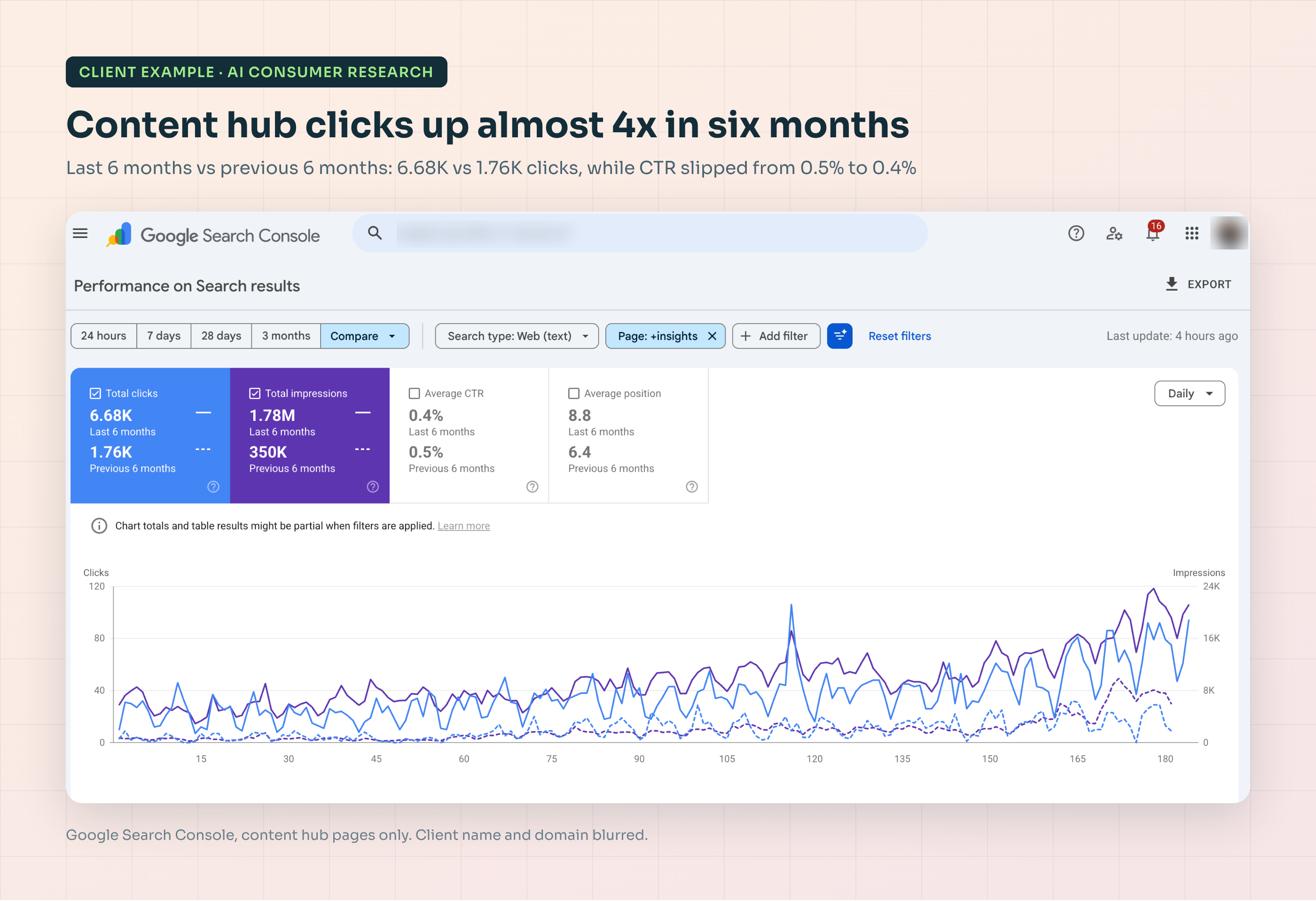
Look at the click-through rate, though: it fell from 0.5% to 0.4%, and average position moved from 6.4 to 8.8 as the content started ranking for far more, and broader, queries. More visibility, a slightly lower CTR – and still almost four times as many visitors from search.
A low-code platform: blog clicks up five times
The second is a low-code app development platform we started working with in August 2026. In six months, its blog went from 177 clicks to 890, and from 38.1K impressions to 312K. Average position improved from 10 to 8.7.
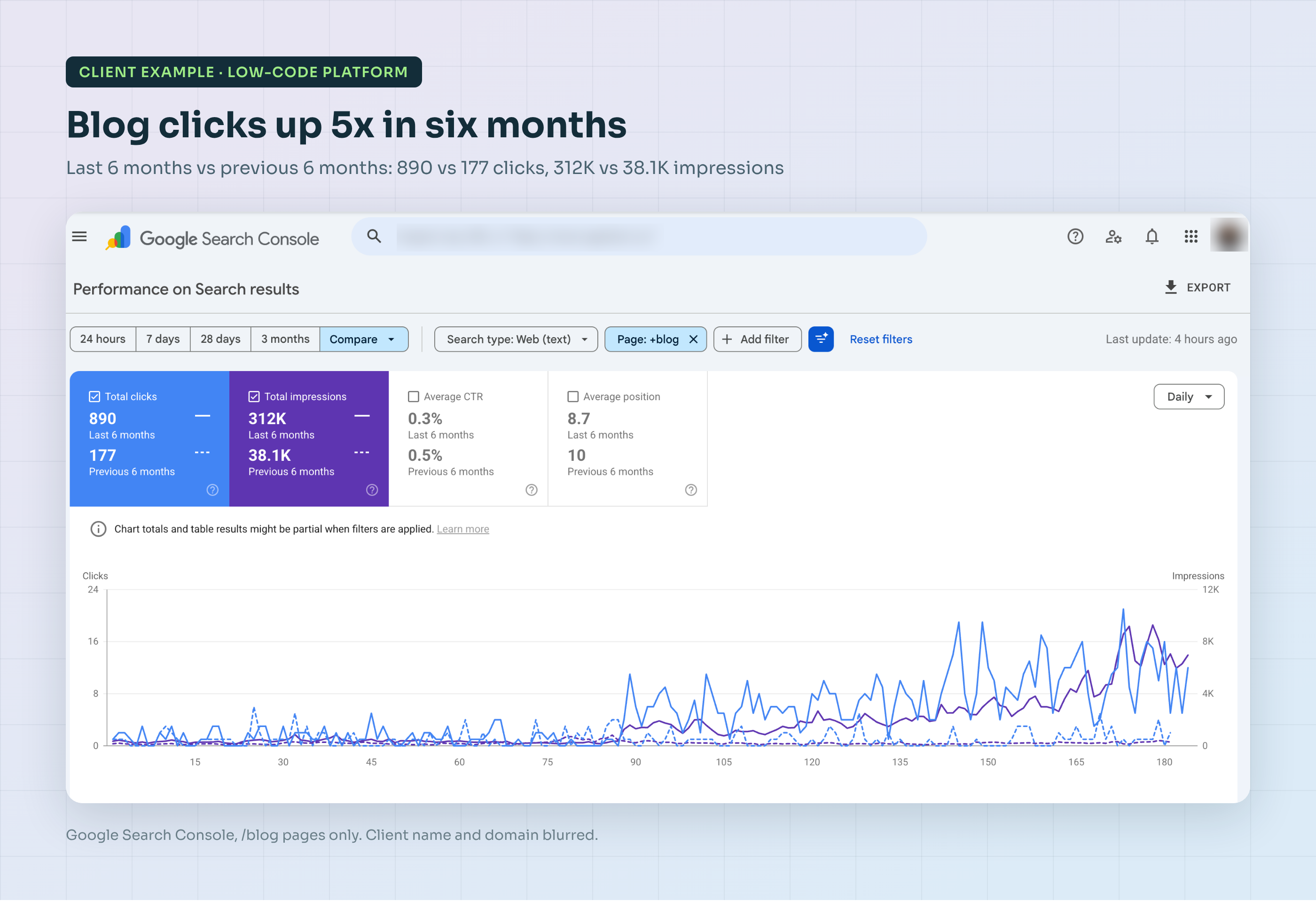
Again, CTR fell from 0.5% to 0.3%. If you only looked at that number, you'd think something was broken. But the blog brought in five times as many visitors from search as in the previous six months.
A sales tech SaaS: 530 deals and €3.5M in pipeline
Traffic is only half the story, so the most important example comes from a CRM. One of our clients, a sales tech B2B SaaS, tracks every deal by source in HubSpot. Since January 2025, organic search and AI search together have sourced 530 deals: 298 from search engines and 232 from AI search.

The trend is what matters. In early 2025, the channel brought in four to fifteen deals a month, almost all from Google. By late 2026, it brought in 34 or 35 a month – and AI search had grown from almost nothing to the majority of them.
The pipeline follows the same curve. Since January 2025, deals sourced by organic and AI search have added €3.54M in SQL pipeline: €1.96M from search engines and €1.58M from AI search, with the best month reaching €318K.

Here's the key point. AI search didn't replace this company's SEO – it grew on top of it. The pages that rank on Google are the same pages AI assistants find, read and cite. Without the SEO foundation, there would be no AI search pipeline either.
We see the same pattern in our published case studies. For Jimo, 17 of 43 MQLs in the first seven months came from LLM search, and Asora generated €20.15M in qualified pipeline from organic search in nine months.
So if SEO still works, what exactly do you need to do differently?
What changed in our SEO strategy (and what didn't)
The foundations are the same. What we produce, how we prioritise it and how we measure it have changed a lot. Here's what that looks like in practice across our client accounts.
What didn't change: the SEO foundation
AI search engines still rely on the same signals Google does. Technical SEO, website speed and Core Web Vitals, on-page SEO, clean internal linking, keyword research grounded in real search intent and high quality content are what make a page rank – and ranking pages are what AI systems read and cite. Traditional SEO strategies like keyword stuffing and thin, AI-generated articles stopped working years ago; good SEO still works.
What changed: what we produce
We still create content every month, but our content strategies have changed: we publish far fewer generic top-of-funnel articles. Instead, we start every content plan with bottom-of-funnel pages: "best X for Y" listicles, comparison pages, alternatives pages, use-case, industry and integration pages. These target buyers close to a decision, and they're the pages that still get clicks and still get quoted in AI answers. Our keyword strategy has changed too. Keyword research tools still matter, but we also target more specific, long-tail keywords, because conversational search makes questions longer – our guide to low search volume keywords explains why those matter more now.
What changed: beyond your own website
AI answers draw heavily on third-party sources: review sites, "best tools" listicles, comparison articles, Reddit threads and industry media. So link building has become less about domain authority and more about being mentioned in the places AI assistants trust. Digital PR, listicle placements and community presence now sit in the same plan as the blog.
What changed: keeping content fresh
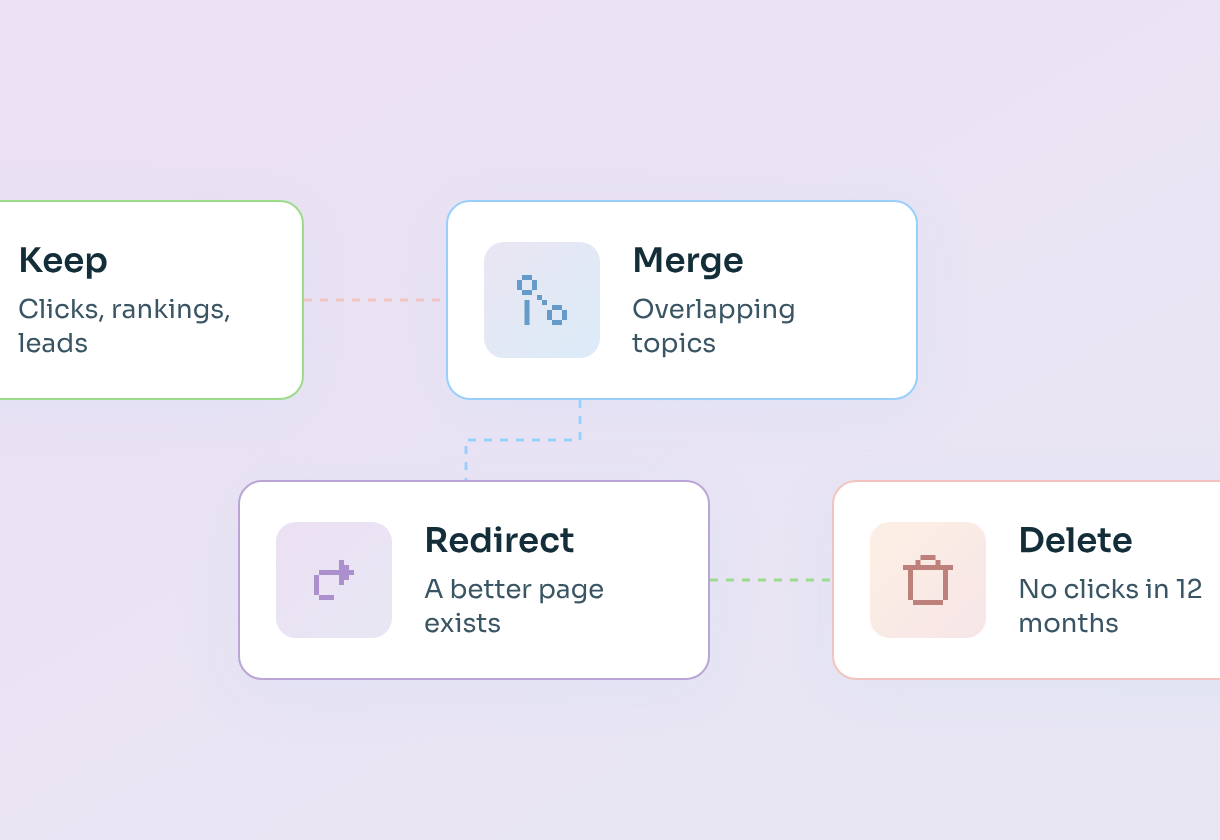
Pages that rank but don't get updated lose ground faster than before, both on Google and in AI answers. We review every important page every few months, refresh what's ageing and prune or merge what no longer earns its place. Our guide to content refresh covers how we decide.
What changed: tracking AI visibility next to rankings
Rankings alone no longer tell you whether you're visible. We track bottom-of-funnel prompts for every client in Scrunch to see how often they're mentioned in ChatGPT, Perplexity, Gemini and Google's AI Overviews, and which pages get cited. Across the 15 brands we track there, AI presence went up for 12. If you're choosing a tool, here's our comparison of AI visibility tracking software, and our guide to GEO vs SEO explains how generative engine optimization and SEO fit together.
All of this only works if you measure the right thing, which brings us to the most important change of all.
How to measure SEO when clicks fall
If you report on SEO with traffic and SEO rankings alone, 2026 will look like a bad year even when the channel is working. Many site owners and digital marketing teams are in exactly that position right now. That's why we stopped making clicks the headline metric.
Instead, we tie organic and AI search to MQLs, SQLs, pipeline and revenue. In practice, that means a CRM set-up that records the original source of every deal – including "AI search" as its own channel, as the sales tech company above does – plus self-reported attribution on demo forms, because many AI-influenced buyers arrive by typing your URL directly. We still track impressions, rankings, CTR and AI visibility, but as leading indicators, not as the result.
Search rankings are still worth watching, because pages that rank are the ones AI tools cite. But this is also how we decide where to invest. A page with falling clicks but rising citations and demo requests is working. A page with rising traffic and no leads isn't. Our guide to SEO for lead generation goes through the reporting set-up we use, and how long SEO takes covers what to expect, and when.
Will SEO exist in five years?
Nobody can predict exactly how search will look in 2031. But a few things seem very likely based on what we see today.
People will keep searching – on Google, in AI assistants and in whatever comes next – and those systems will keep needing trustworthy pages to read, rank and quote. The companies with clear, specific, regularly updated content, a technically sound website and a strong presence on third-party sites will keep being found. The ones that rely on high-volume informational traffic, or stop investing because "SEO is dead", will be easier to replace in AI answers.
That's why we don't think of SEO and AI search as two separate channels. It's one organic growth engine, and the foundation is still SEO.
The bottom line
So, is SEO dead in 2027? No. Clicks are falling and the old traffic-first model is fading, but search is still one of the most reliable sources of B2B SaaS pipeline – and AI search is being built on top of it, not instead of it.
The question to ask isn't whether SEO still works. It's whether your SEO is set up for how buyers search now: bottom-of-funnel pages, third-party mentions, fresh content, AI visibility tracking and reporting on pipeline. If it is, falling clicks are a footnote. If it isn't, that's where to start.
00:00
/
00:00
Want to see what SEO and AI search could add to your pipeline? Book a call with us and we'll show you what our SEO discovery phase would uncover for your business.
FAQs
Is SEO dead in 2027?

No. Clicks from Google are falling because AI Overviews and AI Mode answer more questions directly, but B2B SaaS companies still get demos and pipeline from organic search. What's fading is traffic-first SEO built on informational content.
Is SEO still relevant with AI search?
Yes. AI search engines and assistants rely on the same pages that rank in Google, so strong SEO is the foundation for AI visibility. In our client data, AI search grew on top of organic search, not instead of it.
Will SEO be replaced by AI?
AI is changing how search results look and how people search, but it isn't replacing the need for findable, trustworthy content. SEO is evolving to include AI visibility, sometimes called generative engine optimization or answer engine optimization.
Why are my organic clicks dropping if my rankings are improving?
Because more answers now appear directly on the search results page. Across the sites we track, top-10 rankings rose 78% year on year while clicks fell 19%. Track pipeline and AI visibility alongside clicks to see the full picture.
What SEO strategies still work in 2027?
Bottom-of-funnel pages such as comparisons, alternatives and "best X for Y" articles, technical SEO, regular content refreshes, third-party mentions and listicle placements, and tracking AI visibility alongside rankings.
Should B2B SaaS companies still invest in SEO?
Yes, if it's measured on pipeline. In one sales tech SaaS we work with, organic and AI search sourced 530 deals and €3.5M in SQL pipeline since January 2025.



“SaaStorm became a key part of our inbound motion. Their SEO and content support helped us scale a consistent flow of high-intent traffic and build a content engine that supported £250K+ in inbound revenue. They plugged into our system and delivered every step of the way.”
Jonny Butler, Head of Marketing at OneUp
Related posts